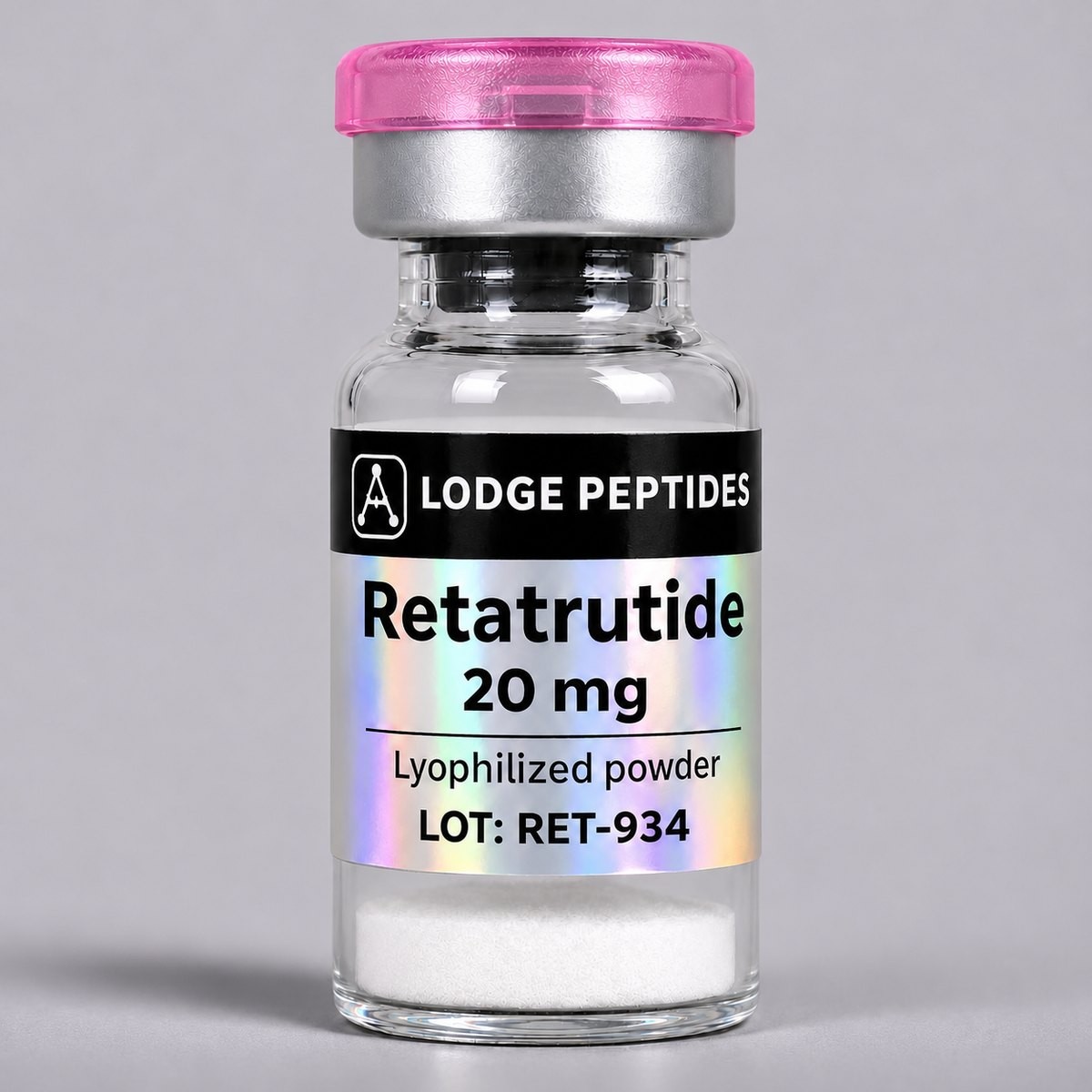
A lot of the questions around retatrutide now start from somewhere else. Someone is already working with tirzepatide (Mounjaro, Zepbound, or a research vial) or semaglutide (Ozempic, Wegovy, or a research vial) and wants to know what actually changes if the work moves to retatrutide. The comparison pages on this site cover receptors and trial results side by side. This guide is about the switch itself: what the three compounds share, what they do not, why the literature does not offer a 1:1 conversion, and what a research vial should show before you buy one in Canada.
Nothing here is medical advice, and none of it is a protocol for use in people. Lodge Peptides sells these peptides for laboratory research only.
- Semaglutide acts on the GLP-1 receptor. Tirzepatide acts on GIP and GLP-1. Retatrutide adds a third target, the glucagon receptor.
- Published weight-change figures come from separate trials of different lengths. They are useful context, not a conversion chart. The first direct retatrutide vs tirzepatide trial, TRIUMPH-5, has not reported results.
- All three were designed as long-acting, once-weekly compounds in clinical studies, so activity from one does not stop the day work moves to another. No published trial has tested a formal switching protocol.
- Lodge Peptides sells Tirzepatide 10 mg ($40) and Retatrutide 10 mg through 40 mg. We do not sell semaglutide. Third-party reports for current tested lots are in the COA library.
- Everything here is for laboratory research use only and is not medical advice.
Looking for retatrutide in Canada? Compare all four strengths, the tested lots and price per mg on our retatrutide Canada page.
The three compounds, and why they are not interchangeable
All three are incretin-pathway peptides studied for metabolic outcomes, and all three were dosed once weekly in the main clinical programs. That is about where the overlap ends.
| Semaglutide | Tirzepatide | Retatrutide | |
|---|---|---|---|
| Developer code | Several (Novo Nordisk) | LY3298176 | LY3437943 |
| Receptors | GLP-1 | GIP and GLP-1 | GIP, GLP-1 and glucagon |
| Brand names | Ozempic, Wegovy, Rybelsus | Mounjaro, Zepbound | None (investigational) |
| Status | Approved prescription drug | Approved prescription drug | Phase 3, not approved |
The glucagon receptor is the piece that makes retatrutide a different tool, not a stronger copy of tirzepatide. Tirzepatide already covers the two incretin receptors; retatrutide keeps those and adds glucagon-receptor activity, which is the rationale for studying energy expenditure and fat oxidation alongside appetite. Our guides on retatrutide vs tirzepatide and retatrutide vs semaglutide walk through that receptor map in more detail, and what retatrutide is covers the mechanism on its own.
Moving from semaglutide to retatrutide is a larger step than moving from tirzepatide: you go from one receptor to three. Moving from tirzepatide still adds a receptor that tirzepatide does not touch. In either case, you are not swapping two versions of the same molecule.
What the trials actually show
The numbers people quote when they talk about switching come from different studies, in different populations, over different lengths of time. They are not a head-to-head table, and they are not a recipe for changing one vial for another.
| Trial | Compound and dose | Length | Average weight change | Placebo |
|---|---|---|---|---|
| STEP 1 (NEJM, 2021) | Semaglutide 2.4 mg | 68 weeks | −14.9% | −2.4% |
| STEP UP (2025) | Semaglutide 7.2 mg | 72 weeks | −18.7% (−20.7% if taken as directed) | – |
| SURMOUNT-1 (NEJM, 2022) | Tirzepatide 5 / 10 / 15 mg | 72 weeks | −15.0% / −19.5% / −20.9% | −3.1% |
| SURMOUNT-5 (NEJM, 2025) | Tirzepatide vs semaglutide | 72 weeks | Tirzepatide −20.2% vs semaglutide −13.7% | – |
| Phase 2 (NEJM, 2023) | Retatrutide 12 mg | 48 weeks | −24.2% | −2.1% |
| TRIUMPH-1 (NEJM, 2026) | Retatrutide 4 / 9 / 12 mg | 80 weeks | −17.6% / −23.7% / −25.0% (treatment regimen); −19.0% / −25.9% / −28.3% if taken as directed | −3.9% |
A few cautions sit under those rows. TRIUMPH-1 ran longer than STEP 1 or the 48-week retatrutide phase 2 study, so a larger average change is not, by itself, proof of a cleaner switch. The treatment-regimen figures include people who stopped; the higher “if taken as directed” figures describe those who stayed on treatment. Our comparison guides use the same split and explain it more fully.
Retatrutide has also been reported in people with type 2 diabetes and obesity (TRIUMPH-2: −20.8% at 12 mg, 80 weeks) and in people with a BMI of 35 or higher and heart disease (TRIUMPH-3: −22.6% at 12 mg, 80 weeks). Those are still retatrutide-versus-placebo results, not switch trials. TRIUMPH-5 is the first direct comparison of retatrutide and tirzepatide; results are not out.
Why a switch is not a 1:1 conversion
There is no published milligram-for-milligram map from semaglutide 2.4 mg, or from tirzepatide 5, 10 or 15 mg, onto retatrutide 4, 9 or 12 mg. The trial arms were chosen for each program, not as equivalents of one another. A 10 mg research vial is a quantity in a bottle, not a weekly clinical dose, and it is not interchangeable across compounds just because the label says 10 mg.
Three other facts get in the way of a simple swap:
- The receptor sets are different. Dropping semaglutide and starting retatrutide adds GIP and glucagon activity that were never part of the first compound. Dropping tirzepatide still adds glucagon-receptor activity that tirzepatide does not provide, while the GIP and GLP-1 overlap stays.
- They are long-acting. In clinical use each was built for once-weekly administration. Activity from one compound does not end the day a protocol changes. No published study has tested a washout, an overlap, or a stepped handoff between these three.
- Side effects in this class scale with receptor activity. In SURMOUNT-1, nausea on tirzepatide ranged from 24.6% to 33.3% across doses (placebo 9.5%). In TRIUMPH-1, nausea on retatrutide ranged from 28.6% to 42.4% (placebo 14.8%), and a minority of participants reported dysesthesia, an unusual skin sensation, at 5.1% to 12.5% (placebo 0.9%). That finding was not a notable feature of the tirzepatide or semaglutide obesity trials. Combining compounds, or stacking residual exposure with a new agonist, has not been studied.
For any protocol that involves people, those are questions for a licensed clinician. This page does not recommend starting amounts, tapering or overlap. It only explains why the papers do not give you a conversion factor.
What else changes besides the receptors
Most of the discussion you see about switching is about appetite, gastrointestinal effects and how quickly the numbers move. The trial data can support only a limited version of that conversation. Average weight change was larger on retatrutide in its own programs than on semaglutide in STEP 1, and larger than on tirzepatide in SURMOUNT-1, but those were not switch studies and they were not the same length. Gastrointestinal effects (nausea, diarrhea, vomiting) show up in all three programs and were dose-related. Dysesthesia is the finding that is more specific to retatrutide so far.
Lean mass is a separate question, and it applies to the whole class rather than to the switch alone. How much of the weight change in these trials was lean mass is covered in do retatrutide and tirzepatide cause muscle loss?
Regulatory status also differs, which matters if you are trying to tell a prescription product from a research vial. Semaglutide and tirzepatide are approved prescription drugs. Retatrutide is still investigational: phase 3 results are being reported, and a US filing has been described as planned for early 2027. It is not an approved medicine in Canada. Research vials are sold for laboratory work, not as a substitute for a prescription.
What a research vial should show
If the work itself is moving from one lyophilized peptide to another, the lab checks do not get simpler. Insist on a third-party report for the exact lot, not a generic product sheet: identity by mass spectrometry, purity by HPLC, and the measured content in milligrams, with a verification code you can check on the testing lab’s own site. Our guides on how to read a peptide COA and how to verify a lab report cover the method. Lodge Peptides uses Peptide Test Canada for this work.
Content matters as much as purity when you change compounds, because a 10 mg label is not always a 10 mg fill. That changes concentration arithmetic in the peptide calculator. Handling after reconstitution is the same class of problem it always was; for retatrutide specifically see how to mix and store retatrutide.
Lodge Peptides retatrutide and tirzepatide
Lodge Peptides ships from within Canada. Shipping is a flat $20 by Canada Post, free on orders over $150, and orders paid by 12 pm Pacific Monday to Friday ship the same business day. We sell tirzepatide and retatrutide as lyophilized research peptides. We do not sell semaglutide.
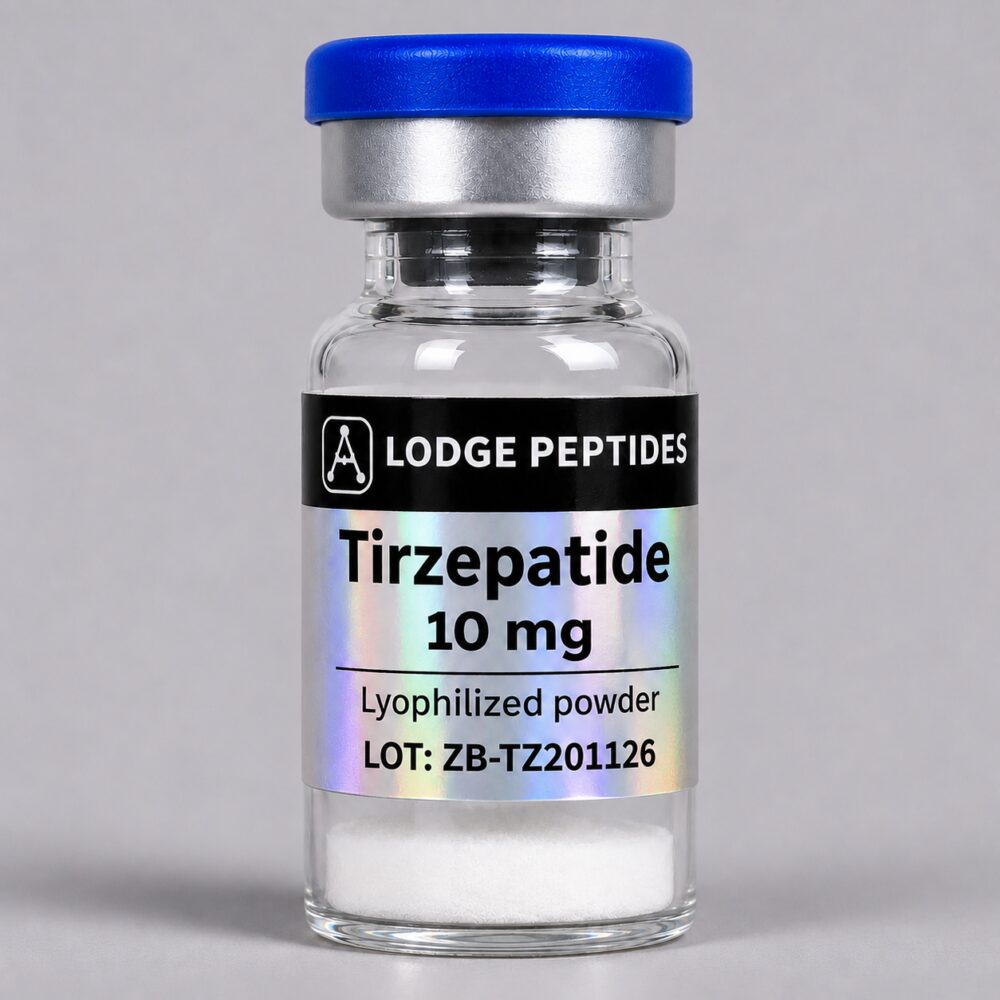
| Product | Lot | Purity | Measured content | Price (CAD) |
|---|---|---|---|---|
| Tirzepatide 10 mg | ZB-TZ201126 | 99.5% | 10.56 mg (105.6%) | $40 |
| Retatrutide 10 mg | ZB-RT10526 | 99.5% | 9.31 mg (93.1%) | $64.99 |
| Retatrutide 20 mg | RET-934 | 99.6% | 24.65 mg (123.3%) | $120 |
| Retatrutide 30 mg | ZB-RT30526 | 99.7% | 32.96 mg (109.9%) | $160 |
| Retatrutide 40 mg | In for testing | Pending | Pending | $195 |
The 20 mg and 30 mg retatrutide vials hold more than the label; the 10 mg vial measured a little under. That is why price per measured milligram is the fairer comparison, and why you should use the measured figure when you calculate a concentration. A 10-pack of any of these strengths is priced 20% below ten single vials. The 40 mg lot is in for third-party testing now; results will go on the product page and in the COA library when they are ready. Every tested lot is also in the lab results roundup. For a deeper look at 10 vs 20 vs 30 vs 40 mg, see retatrutide strengths compared. Buying pages for each compound are where to buy retatrutide in Canada and where to buy tirzepatide in Canada.
Frequently asked questions
Can you switch from tirzepatide to retatrutide?
There is no published trial of a formal switch, and no 1:1 milligram conversion between the two. They share the GIP and GLP-1 receptors, but retatrutide also acts on the glucagon receptor, and both are long-acting. Our retatrutide vs tirzepatide guide covers the trial data; this page covers why that data is not a conversion chart. Lodge Peptides sells both as research peptides only.
Can you switch from Ozempic or Wegovy (semaglutide) to retatrutide?
The same limits apply, and the receptor gap is wider: semaglutide acts only on GLP-1, while retatrutide acts on GIP, GLP-1 and glucagon. STEP and TRIUMPH results are from separate programs of different lengths. Lodge Peptides does not sell semaglutide.
Is there a dose conversion between these peptides?
No published paper maps a semaglutide or tirzepatide trial arm onto a retatrutide trial arm. The milligram amounts used in clinic programs are not the same thing as the milligrams on a research-vial label, and they are not interchangeable across compounds.
Has retatrutide been compared head-to-head with tirzepatide?
Not yet in a published trial. TRIUMPH-5 is the first direct comparison; results are not out. The figures usually quoted come from separate studies (SURMOUNT-1, TRIUMPH-1 and others).
Does Lodge Peptides sell retatrutide and tirzepatide in Canada?
Yes. Tirzepatide 10 mg is $40 (lot ZB-TZ201126, 10.56 mg at 99.5%). Retatrutide is sold as 10, 20, 30 and 40 mg vials, with third-party reports posted for the 10, 20 and 30 mg lots. The 40 mg lot is in for testing. We ship from within Canada.
Is this medical advice?
No. Products sold by Lodge Peptides are for laboratory research use only and are not for human or animal consumption. This article is educational and is not a protocol for use in people.
Related guides
- Retatrutide vs tirzepatide: what the research shows
- Retatrutide vs semaglutide: what the trials show
- What is retatrutide? A research overview
- Tirzepatide: a research overview
- Where to buy retatrutide in Canada
- Where to buy tirzepatide in Canada
- Retatrutide strengths compared
- Do retatrutide and tirzepatide cause muscle loss?
- How to mix and store retatrutide
- COA library
Sources
- Wilding JPH, et al. Once-weekly semaglutide in adults with overweight or obesity (STEP 1). N Engl J Med. 2021. PubMed 33567185
- Once-weekly semaglutide 7.2 mg in adults with obesity (STEP UP). Lancet Diabetes Endocrinol. 2025.
- Jastreboff AM, et al. Tirzepatide once weekly for the treatment of obesity (SURMOUNT-1). N Engl J Med. 2022. PubMed 35658024
- Aronne LJ, et al. Tirzepatide as compared with semaglutide for the treatment of obesity (SURMOUNT-5). N Engl J Med. 2025.
- Jastreboff AM, et al. Triple-hormone-receptor agonist retatrutide for obesity: a phase 2 trial. N Engl J Med. 2023. PubMed 37366315
- Retatrutide, a triple hormone receptor agonist, for treatment of obesity (TRIUMPH-1). N Engl J Med. 2026.
- Eli Lilly. TRIUMPH-1 topline results (May 2026); TRIUMPH-2 and TRIUMPH-3 topline results (July 2026).
- ClinicalTrials.gov. TRIUMPH-5, retatrutide versus tirzepatide (results not yet reported).
- Lodge Peptides. Retatrutide vs tirzepatide and retatrutide vs semaglutide.
Products sold by Lodge Peptides are intended for laboratory research use only and are not for human or animal consumption. This article is for educational purposes and is not medical advice.
Email list
Get lot reports and guides in your inbox
New lot reports, research guides, restocks, and occasional offers from the Lodge Peptides team.