
MOTS-c is an unusual peptide: it is encoded not in the cell nucleus but in the small genome inside mitochondria. Since its discovery in 2015 it has become one of the most-studied mitochondrial-derived peptides in metabolism and exercise research. This overview covers what MOTS-c is, what the research has found, and exactly what our 40 mg vial contained when it was tested, with a mixing chart for a 40 mg vial.
- MOTS-c is a 16-amino-acid peptide (MRWQEMGYIFYPRKLR, about 2,174.6 g/mol) encoded within the mitochondrial 12S rRNA gene.
- It was first described by Lee and colleagues in Cell Metabolism (2015). Most research is in cells and mice, on metabolism, insulin sensitivity and exercise capacity.
- Our MOTS-c 40 mg lot ZB-MC40526 measured 39.23 mg at 99.4% purity, 98.1% of label.
- With 2 mL of water, a 40 mg vial is about 20 mg/mL, so 1 mg is 5 units on a U-100 syringe.
- Everything here is for laboratory research use only and is not medical advice.
Looking for MOTS-c in Canada? The price, current lot and lab report are on our MOTS-c 40mg page.
What MOTS-c is
Mitochondria carry their own small DNA, long thought to code only for a fixed set of RNAs and proteins used inside the organelle. In 2015, Changhan Lee, Pinchas Cohen and colleagues reported a short open reading frame, 51 base pairs long, hidden within the mitochondrial 12S ribosomal RNA gene. It codes for a 16-residue peptide they named MOTS-c: mitochondrial open reading frame of the 12S rRNA type-c. Its sequence is Met-Arg-Trp-Gln-Glu-Met-Gly-Tyr-Ile-Phe-Tyr-Pro-Arg-Lys-Leu-Arg.
MOTS-c belongs to a small group of mitochondrial-derived peptides that also includes humanin. At about 2,175 g/mol it is a mid-sized research peptide, comparable to many of the compounds in our lab results roundup.
What the research has looked at
In the original 2015 study, MOTS-c acted mainly on skeletal muscle in mice, inhibiting the folate cycle and de novo purine synthesis and activating AMPK, a central energy sensor. Treated mice were protected from diet-induced obesity and from age- and diet-related insulin resistance. In 2018, Kim and colleagues reported that under metabolic stress MOTS-c moves into the cell nucleus and regulates nuclear genes, an example of mitochondria signalling back to the nucleus. In 2021, Reynolds and colleagues reported in Nature Communications that exercise raised MOTS-c levels in human muscle and blood, and that treatment improved physical performance in mice of different ages.
Almost all of the interventional evidence comes from cell and animal models. MOTS-c is not an approved medicine anywhere, and claims about it should be read with that in mind.
What our 40 mg vial contains
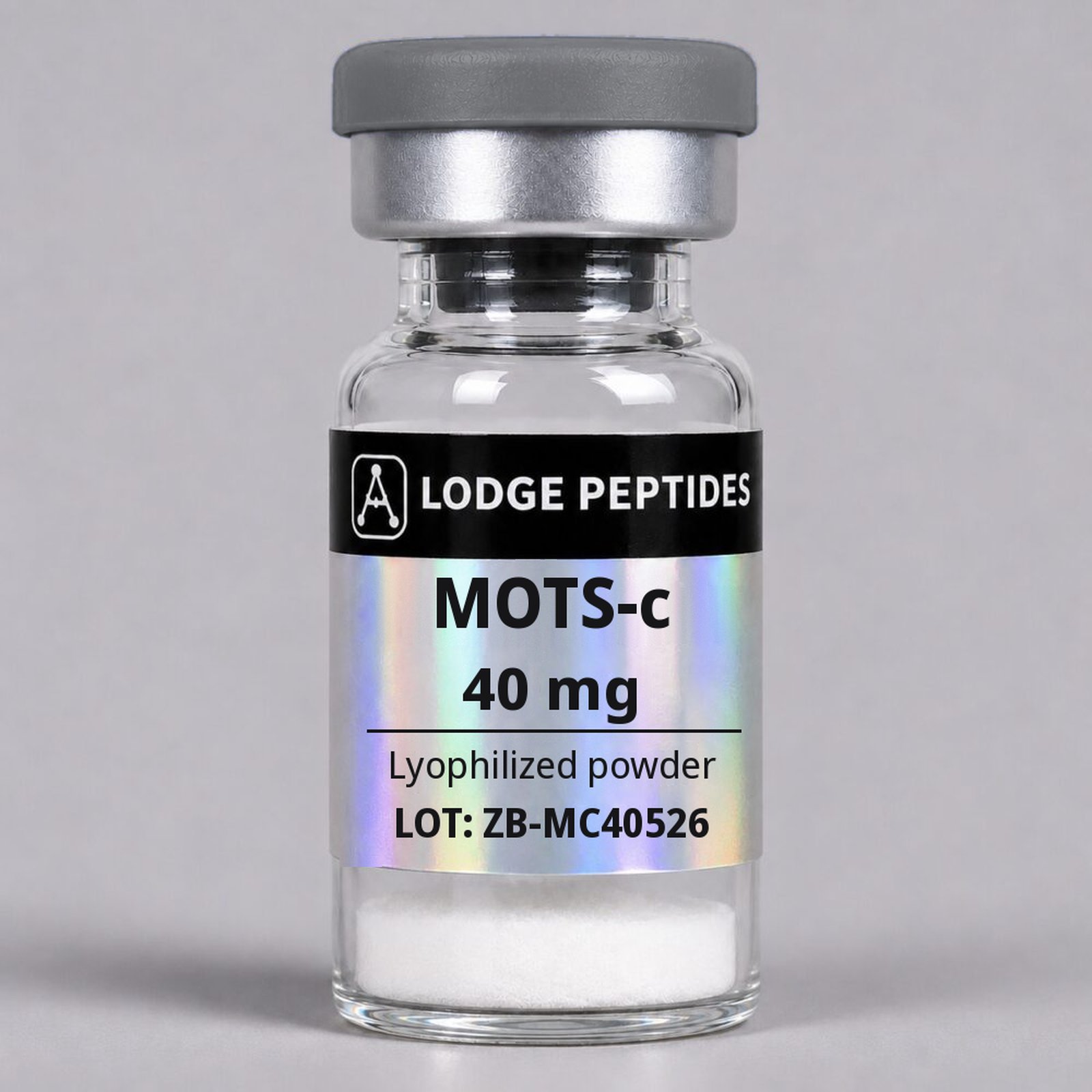
| Lot | ZB-MC40526 |
| Testing lab | Peptide Test Canada (SideChain Analytics) |
| Method | HPLC-MS/MS |
| Purity | 99.4% |
| Measured content | 39.23 mg (40 mg label, 98.1%) |
| Date tested | 29 September 2026 |
| Report | COA-2026-SC-03013, verify code PTC-9TCPWRVY |
The fill came in just under label, within normal filling variation, and we publish it as measured. At $96 a vial that is $2.40 per labelled milligram and about $2.45 per measured milligram, or $1.96 in a 10-pack. Compare any vial with the price per mg calculator, and check the report yourself with the lab’s verify code, as in how to verify a peptide lab report.
Mixing chart for a 40 mg vial
A 40 mg vial is a large fill, so the water you choose makes a big difference to concentration. The chart uses the same arithmetic as our peptide calculator: concentration is the milligrams in the vial divided by the millilitres of water, and on a U-100 insulin syringe 100 units is 1 mL. The measured column uses the 39.23 mg from the current lot report.
| Water added | 40 mg label | Measured 39.23 mg | Units for 1 mg (label) |
|---|---|---|---|
| 1 mL | 40 mg/mL | 39.23 mg/mL | 1 mg = 2.5 units |
| 2 mL | 20 mg/mL | 19.61 mg/mL | 1 mg = 5 units |
| 3 mL | 13.33 mg/mL | 13.08 mg/mL | 1 mg = 7.5 units |
| 4 mL | 10 mg/mL | 9.81 mg/mL | 1 mg = 10 units |
| 5 mL | 8 mg/mL | 7.85 mg/mL | 1 mg = 12.5 units |
Larger volumes make small measurements easier to draw accurately; a 1 mL mix is very concentrated, at 2.5 units per milligram. For the method, see how to reconstitute lyophilized peptides, how much bacteriostatic water to add and insulin syringe units to mL.
Storage and handling
Keep the sealed powder cold, dry and away from light. Once mixed, a 40 mg vial holds a lot of material, so plan your volume around how quickly the solution will be used; our guide to degradation and freeze-thaw stability covers why repeated warming and refreezing should be avoided, and how to store lyophilized peptides covers the dry vial.
Frequently asked questions
What is MOTS-c?
A 16-amino-acid peptide (MRWQEMGYIFYPRKLR) encoded within the mitochondrial 12S rRNA gene, first described in 2015. It is studied in metabolism, insulin sensitivity and exercise research.
Is MOTS-c approved as a medicine?
No. MOTS-c is not an approved medicine anywhere. Most interventional research has been in cells and mice.
What did the Lodge Peptides MOTS-c lot test at?
Lot ZB-MC40526 measured 39.23 mg against a 40 mg label (98.1%) at 99.4% purity by HPLC-MS/MS, tested by Peptide Test Canada on 29 September 2026 (verify code PTC-9TCPWRVY).
How much water do I add to a 40 mg MOTS-c vial?
The volume only sets the concentration. With 2 mL, a 40 mg vial is 20 mg/mL, so 1 mg is 5 units on a U-100 syringe; with 4 mL it is 10 mg/mL and 1 mg is 10 units. The calculator works it out for any volume.
Why does the report show less than 40 mg?
Filling lyophilized powder is not perfectly exact. This lot measured 39.23 mg, 98.1% of label. We publish measured amounts whether they come in above or below label.
Does Lodge Peptides ship MOTS-c within Canada?
Yes. Every order ships from within Canada by Canada Post, $20 flat or free over $150. Orders placed by 12 pm Pacific time, Monday to Friday, ship the same day.
Related guides
- Peptide reconstitution calculator
- How much bacteriostatic water to add
- Insulin syringe units to mL
- Peptide price per mg calculator
- Lab results roundup
Sources
- Lee C, et al. The mitochondrial-derived peptide MOTS-c promotes metabolic homeostasis and reduces obesity and insulin resistance. Cell Metab. 2015;21(3):443-454. PubMed 25738459
- Kim KH, et al. The mitochondrial-encoded peptide MOTS-c translocates to the nucleus to regulate nuclear gene expression in response to metabolic stress. Cell Metab. 2018;28(3):516-524. PubMed 29983246
- Reynolds JC, et al. MOTS-c is an exercise-induced mitochondrial-encoded regulator of age-dependent physical decline and muscle homeostasis. Nat Commun. 2021;12:470. PubMed 33473109
- PubChem. MOTS-c, CID 146675088. pubchem.ncbi.nlm.nih.gov
Products sold by Lodge Peptides are intended for laboratory research use only and are not for human or animal consumption. This article is for educational purposes and is not medical advice.
Email list
Get lot reports and guides in your inbox
New lot reports, research guides, restocks, and occasional offers from the Lodge Peptides team.