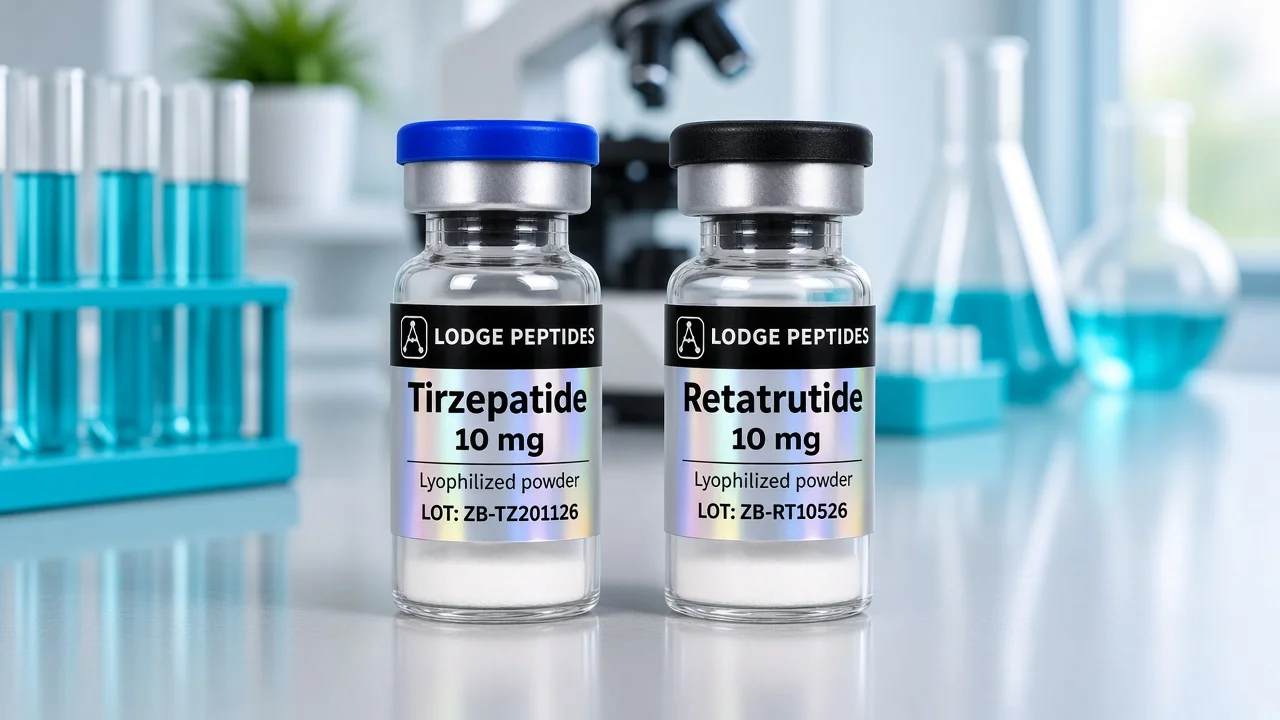
Retatrutide and tirzepatide are the two peptides researchers in Canada ask us about most, and more and more people are comparing them directly. Both come from Eli Lilly and both act on incretin hormone receptors, but they are not the same molecule and the trial data are not the same either. This guide sets out how they differ, what the published trials found, and what the evidence does and does not say about appetite.
- Tirzepatide is a dual agonist (GIP and GLP-1). It is an approved prescription drug, sold as Mounjaro and Zepbound in both Canada and the US.
- Retatrutide is a triple agonist (GIP, GLP-1 and glucagon). It is still investigational. Lilly has reported six positive phase 3 trials since December 2025 and plans to file in the US in the first quarter of 2027.
- In separate trials, retatrutide produced the larger average weight loss. Counting everyone randomized, the top dose averaged 25.0% at 80 weeks in TRIUMPH-1, against 20.9% at 72 weeks for tirzepatide’s top dose in SURMOUNT-1.
- Those trials had different lengths and populations, so they are not a head-to-head result. The direct comparison trial, TRIUMPH-5, lists an estimated primary completion date of November 2026 on its registry; no results had been released as of 22 November 2026.
- Stomach side effects (nausea, diarrhea, vomiting, constipation) were the most common for both and rose with dose. Retatrutide trials also reported dysesthesia, an unusual skin sensation, more often than placebo.
Looking for retatrutide in Canada? Compare all four strengths, the tested lots and price per mg on our retatrutide Canada page.
Two receptors vs three
GLP-1 and GIP are incretin hormones. Their receptors are linked in the research to appetite, stomach emptying and blood sugar control. Tirzepatide activates both of these receptors with a single molecule, which is why it is called a dual agonist.
Retatrutide activates the same two receptors plus a third: the glucagon receptor. In research, glucagon receptor activity is linked to energy expenditure and to fat metabolism in the liver. The idea behind retatrutide is that adding this third pathway increases the amount of energy the body uses, not only how much is eaten. Our retatrutide research overview covers the receptor picture in more detail.
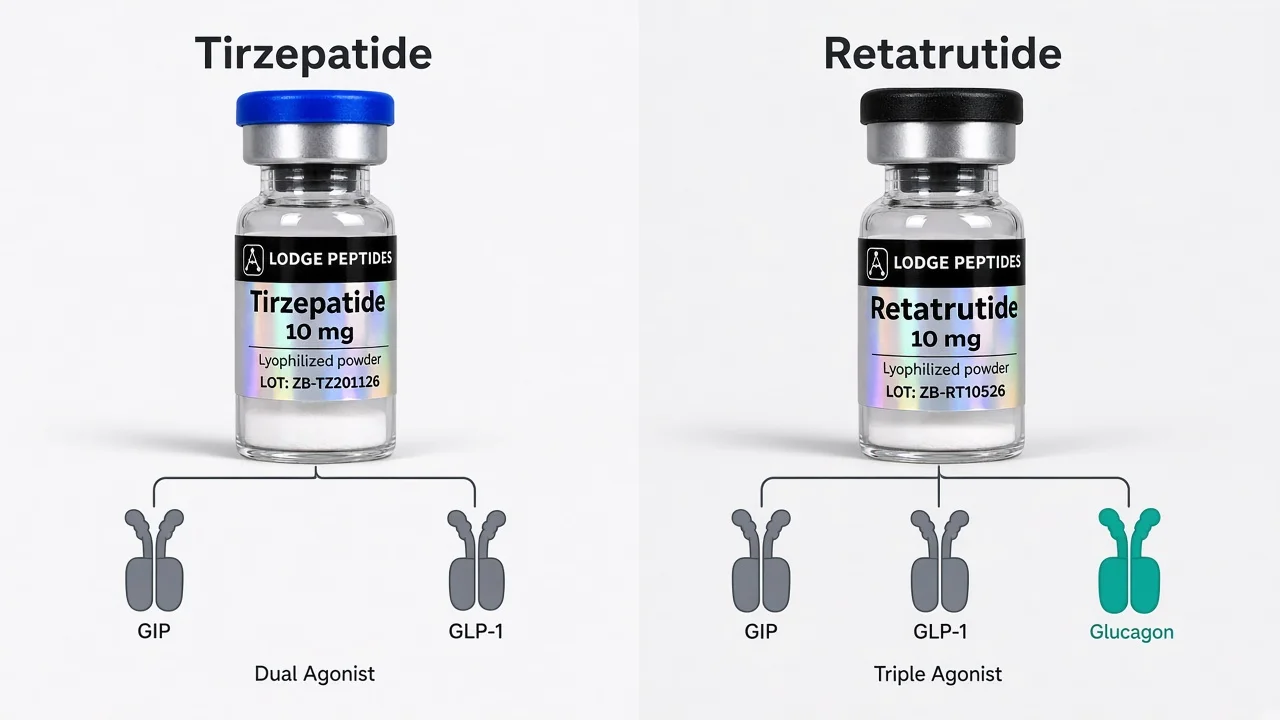
At a glance. Weight figures count everyone randomized unless marked topline; they come from separate trials.
| Tirzepatide | Retatrutide | |
|---|---|---|
| Developer code | LY3298176 | LY3437943 |
| Receptors | GIP, GLP-1 | GIP, GLP-1, glucagon |
| Dosing in trials | Once weekly | Once weekly |
| Trial dose arms | 5, 10 and 15 mg | 4, 9 and 12 mg (phase 3) |
| Status | Approved prescription drug (Mounjaro, Zepbound) | Investigational; US filing planned for Q1 2027 |
| Top-dose weight loss, no diabetes | −20.9% at 72 weeks (SURMOUNT-1) | −25.0% at 80 weeks (TRIUMPH-1) |
| Top-dose weight loss, type 2 diabetes | −14.7% at 72 weeks (SURMOUNT-2) | −18.8% at 80 weeks (TRIUMPH-2) |
| Head-to-head vs semaglutide | −20.2% vs −13.7% (SURMOUNT-5) | −20.9% vs −9.4% in type 2 diabetes (TRANSCEND-T2D-2, topline) |
| Most common side effects | Nausea, diarrhea, vomiting, constipation | Nausea, diarrhea, vomiting, constipation; also dysesthesia |
What the trials found
Trials report weight change two ways. Everyone counted (the treatment-regimen estimand) includes every person randomized, whether or not they stayed on the drug. If all stayed on treatment (the efficacy estimand) estimates what would have happened had everyone kept taking it as assigned, so in these trials it is the larger number. Placebo figures are listed in the same order. Compare like with like, and remember these are separate trials with different lengths and populations.
| Trial | Population and length | Top dose | Everyone counted | If all stayed on treatment | Placebo |
|---|---|---|---|---|---|
| SURMOUNT-1 (tirzepatide) | Obesity without diabetes, 72 weeks | 15 mg | −20.9% | −22.5% | −3.1% / −2.4% |
| SURMOUNT-2 (tirzepatide) | Type 2 diabetes with obesity, 72 weeks | 15 mg | −14.7% | −15.7% | −3.2% / −3.3% |
| TRIUMPH-1 (retatrutide) | Obesity without diabetes, 80 weeks | 12 mg | −25.0% | −28.3% | −3.9% / −2.2% |
| TRIUMPH-2 (retatrutide) | Type 2 diabetes with obesity, 80 weeks | 12 mg | −18.8% | −20.8% (topline) | −5.1% / −4.0% |
| TRIUMPH-3 (retatrutide) | BMI 35+ with heart disease, 80 weeks | 12 mg | Not yet reported | −22.6% (topline) | – / −3.2% |
| TRIUMPH-4 (retatrutide) | Knee osteoarthritis with obesity, 68 weeks | 12 mg | −23.7% | −28.7% | −4.6% / −2.1% |
Two patterns stand out. First, retatrutide’s top dose produced more average weight loss than tirzepatide’s top dose in comparable non-diabetic populations, on either way of counting. Second, both compounds worked less well in people with type 2 diabetes, which is consistent across this whole drug class. Weight loss also rose with dose: in TRIUMPH-1, 4, 9 and 12 mg gave −17.6%, −23.7% and −25.0% counting everyone (−19.0%, −25.9% and −28.3% for those who stayed on treatment). The earlier 48-week phase 2 trial reported up to −24.2%.
TRIUMPH-1 is published in the New England Journal of Medicine and TRIUMPH-2 in The Lancet (both September 2026), and TRIUMPH-4 in the New England Journal of Medicine (November 2026). TRIUMPH-3 figures are still topline results from Lilly.
Head-to-head trials so far
| Trial | Comparison | Result |
|---|---|---|
| SURMOUNT-5 | Tirzepatide vs semaglutide, obesity without diabetes, 72 weeks | −20.2% vs −13.7% (NEJM, 2025) |
| TRANSCEND-T2D-2 | Retatrutide vs semaglutide 2 mg (Ozempic), type 2 diabetes, 80 weeks | −20.9% (12 mg) vs −9.4%; A1C down 2.2 vs 1.8 points (Lilly topline, October 2026, stayed on treatment) |
| TRIUMPH-5 (NCT06662383) | Retatrutide vs tirzepatide, about 800 adults with obesity (estimated enrolment), 80 weeks | Not reported yet. Estimated primary completion November 2026, study completion December 2026 |
Both drugs have now beaten semaglutide head to head, but in different populations, so those results still do not rank retatrutide against tirzepatide. TRIUMPH-5 is the only trial that does. Lilly has not given a date for its results. For the single-agonist comparison, see retatrutide vs semaglutide.
Appetite and “food noise”
A common claim in online communities is that retatrutide quiets appetite and “food noise” less than tirzepatide, even though it produces more weight loss. Here is what the evidence can and cannot say about that:
- No trial has measured it head to head yet. TRIUMPH-5 is the first direct comparison, and its results are not out.
- Retatrutide does reduce appetite in trials. “Decreased appetite” was reported in up to 17.1% of people on the top dose in TRIUMPH-2 and 14.5% in TRIUMPH-3, against 3 to 4.5% on placebo. In TRIUMPH-4 it was 19.0% (9 mg) and 18.2% (12 mg), against 9.4% on placebo.
- There is a plausible explanation for the reports. Part of retatrutide’s effect is thought to come from the glucagon pathway increasing energy use. If some of its weight loss comes from burning more rather than eating less, it could feel less appetite-suppressing than its weight loss suggests. This is a hypothesis, not a proven finding.
- Individual reports vary a lot. Experiences on forums depend on the amount used, how quickly it was increased, the product’s actual purity and content, and expectations. Anecdotes are a reason to look at the data, not a substitute for it.
Side effects reported in trials
For both compounds, stomach and gut effects were the most common. They were mostly mild to moderate, happened mostly while the dose was being increased, and became more frequent at higher doses.
| Reported in trials | Tirzepatide (SURMOUNT-1) | Retatrutide (TRIUMPH-1) |
|---|---|---|
| Nausea | 24.6 to 33.3% across doses (placebo 9.5%) | 28.6 to 42.4% across doses (placebo 14.8%) |
| Diarrhea | 18.7 to 23.0% (placebo 7.3%) | 25.2 to 34.1% (placebo 13.5%) |
| Vomiting | 8.3 to 12.2% (placebo 1.7%) | 10.6 to 25.3% (placebo 4.8%) |
| Dysesthesia (unusual skin sensation) | Not a notable finding | 5.1 to 12.5% (placebo 0.9%) |
| Stopped due to side effects | 4.3 to 7.1% (placebo 2.6%) | 4.1 to 11.3% (placebo 4.9%) |
Dysesthesia rates varied by trial: 8.8% (9 mg) and 20.9% (12 mg) in TRIUMPH-4 against 0.7% on placebo, which Lilly described as generally mild, and 4.8% and 6.5% in TRANSCEND-T2D-2 against 2.7% on semaglutide. Retatrutide also raises heart rate somewhat, as other drugs in this class do, and in the published knee osteoarthritis trials serious adverse events were more common with retatrutide than with placebo.
Researching both together
Some researchers ask about using retatrutide and tirzepatide together, or moving from one to the other. The relevant facts:
- They overlap heavily. Both activate the GLP-1 and GIP receptors. Combining them stacks two drugs on the same pathways, plus retatrutide’s glucagon effect.
- No trial has tested the combination. All published safety and efficacy data come from each compound used on its own.
- Side effects in this class rise with total receptor activity. Nausea, vomiting and stopping because of side effects all increased with dose in every trial above. Running both together would be expected to push in the same direction.
- Both are long-acting. Each was designed for once-weekly use, so the effects of one carry on for days after the last use. This matters for any study that switches between them.
For any protocol involving people, these are questions for a licensed clinician. Lodge Peptides sells both compounds for laboratory research only.
For a closer look at moving from tirzepatide or semaglutide to retatrutide, and why the literature does not offer a 1:1 conversion, see switching from tirzepatide or semaglutide to retatrutide.
Regulatory status
Tirzepatide is approved by Health Canada as Mounjaro (Notice of Compliance November 2022) for type 2 diabetes and as Zepbound for chronic weight management (authorized 13 May 2025), and in the US as Mounjaro and Zepbound. Retatrutide is not approved anywhere; Lilly says no regulator in the world has reviewed or approved it. Lilly has reported positive results from six phase 3 trials, most recently TRANSCEND-T2D-2 in October 2026, and plans to submit it for US approval in the first quarter of 2027. Both are sold by Lodge Peptides as research peptides for laboratory use only.
Cost per mg and lab reports at Lodge Peptides
| Product | Price (CAD) | Per mg |
|---|---|---|
| Tirzepatide 10 mg | $40 | $4.00 |
| Retatrutide 10 mg | $64.99 | $6.50 |
| Retatrutide 20 mg | $120 | $6.00 |
| Retatrutide 30 mg | $160 | $5.33 |
| Retatrutide 40 mg | $195 | $4.88 |
Ten-packs are 20% off, and paying with crypto takes another 10% off products. Every tested lot is linked to a third-party lab report, showing purity and measured content. Learn how to read a COA, compare the retatrutide strengths, and use the peptide calculator for concentration math.

Muscle and lean mass: how much of the weight lost in these trials was lean mass, and what preserves it, is covered in do retatrutide and tirzepatide cause muscle loss?
More on tirzepatide: its mechanism, the SURMOUNT and SURPASS results and what to check on a lab report are covered in tirzepatide: a research overview.
Frequently asked questions
Is retatrutide stronger than tirzepatide?
In separate trials, retatrutide’s top dose produced more average weight loss: 25.0% at 80 weeks in TRIUMPH-1 against 20.9% at 72 weeks for tirzepatide’s top dose in SURMOUNT-1, counting everyone randomized. The trials differed in length and population, and the direct comparison trial, TRIUMPH-5, has not reported yet.
What is the difference between retatrutide and tirzepatide?
Tirzepatide activates two receptors, GIP and GLP-1. Retatrutide activates those two plus the glucagon receptor, which research links to energy expenditure. Tirzepatide is an approved drug; retatrutide is still investigational.
Does retatrutide suppress appetite less than tirzepatide?
That is a common online report, but it has not been tested head to head. Retatrutide trials did report decreased appetite well above placebo. One hypothesis is that part of retatrutide’s effect comes from increased energy use through the glucagon pathway rather than reduced eating.
Have retatrutide and tirzepatide been studied together?
No. All published trial data come from each compound on its own. Both act on GLP-1 and GIP receptors, so combining them overlaps the same pathways, and side effects in this class rise with dose.
When will TRIUMPH-5 report?
No results date has been published. The trial registry lists estimated primary completion in November 2026 and study completion in December 2026, and no results had been released as of 22 November 2026.
Is retatrutide approved in Canada?
No. Retatrutide is investigational. Lilly plans to file with the US FDA in early 2027 after positive phase 3 results. Tirzepatide is approved in Canada as Mounjaro.
Which is cheaper per mg at Lodge Peptides?
Tirzepatide 10 mg is $4.00 per mg. Retatrutide ranges from $6.50 per mg for the 10 mg vial down to $4.88 per mg for the 40 mg vial.
Sources and further reading
- Retatrutide, a Triple Hormone Receptor Agonist, for Treatment of Obesity (TRIUMPH-1), New England Journal of Medicine, 2026
- Eli Lilly: TRIUMPH-1 topline results (May 2026)
- Eli Lilly: TRIUMPH-2 and TRIUMPH-3 topline results (July 2026)
- Retatrutide phase 2 results, 48 weeks (Patient Care)
- Eli Lilly: SURMOUNT-1 results and side effect rates (2022)
- SURMOUNT-1 trial summary (American College of Cardiology)
- Retatrutide in adults with obesity and type 2 diabetes (TRIUMPH-2), The Lancet, September 2026
- Retatrutide in adults with knee osteoarthritis pain and obesity (TRIUMPH-4 and TRIUMPH-1-OA), New England Journal of Medicine, 2026
- Eli Lilly: TRIUMPH-4 topline results (December 2025)
- Eli Lilly: TRANSCEND-T2D-2, retatrutide vs Ozempic 2 mg (October 2026)
- Tirzepatide as Compared with Semaglutide for the Treatment of Obesity (SURMOUNT-5), New England Journal of Medicine, 2025
- Tirzepatide in people with type 2 diabetes and obesity (SURMOUNT-2), The Lancet, 2023
- Eli Lilly: SURMOUNT-2 results, both analyses (2023)
- ClinicalTrials.gov: TRIUMPH-5, retatrutide vs tirzepatide (NCT06662383)
- Eli Lilly: What to know about retatrutide (October 2026)
- Eli Lilly Canada: Zepbound approved and available in Canada (2025)
- Health Canada: Summary Basis of Decision for Mounjaro
Products sold by Lodge Peptides are intended for laboratory research use only and are not for human or animal consumption. This article summarises published research and is general educational information, not medical advice. It does not recommend any dose or protocol.
Email list
Get lot reports and guides in your inbox
New lot reports, research guides, restocks, and occasional offers from the Lodge Peptides team.