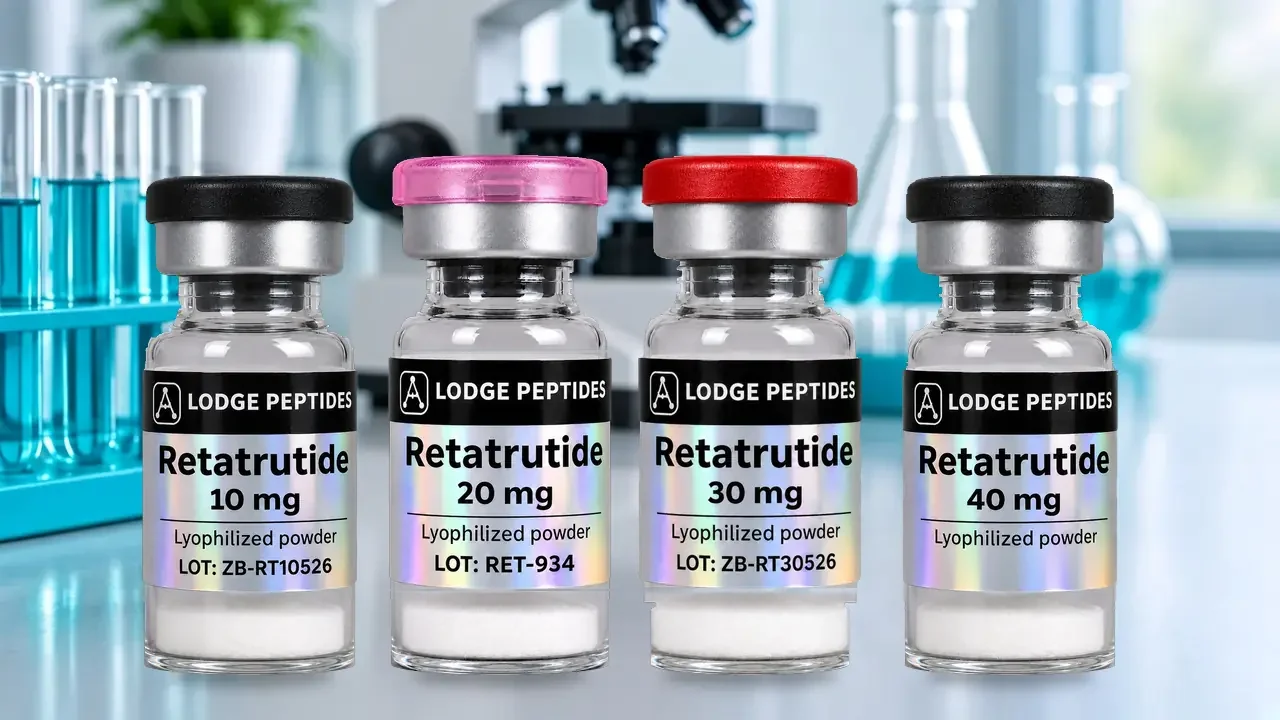
Retatrutide arrives as a freeze-dried powder, and two questions come up with every vial: how much bacteriostatic water to add, and how long it keeps once mixed. This guide answers both for each of the four strengths we carry, 10, 20, 30 and 40 mg, with a mixing chart, the measured content of our current lots, and the storage rules for powder and solution. It is laboratory arithmetic and handling for research use. For the compound itself, see what is retatrutide?
- The water you add sets the concentration, not the amount of peptide. A 20 mg vial holds the same peptide whether you add 1 mL or 2 mL.
- Pick a volume that gives round syringe units. On a U-100 syringe, 100 units = 1 mL.
- Real vials rarely hold exactly the label amount. Our current lots measured 93.1% to 123.3% of label, which shifts the true concentration.
- Keep the powder cold, dry and dark. Once mixed, keep it at 2 to 8 °C and discard after 28 days unless the supplier states otherwise.
- Everything here is for laboratory research use only and is not medical advice.
Looking for retatrutide in Canada? Compare all four strengths, the tested lots and price per mg on our retatrutide Canada page.
What you need
A retatrutide vial, bacteriostatic water (it contains 0.9% benzyl alcohol, which suits a vial you draw from more than once), sterile syringes and alcohol prep pads.
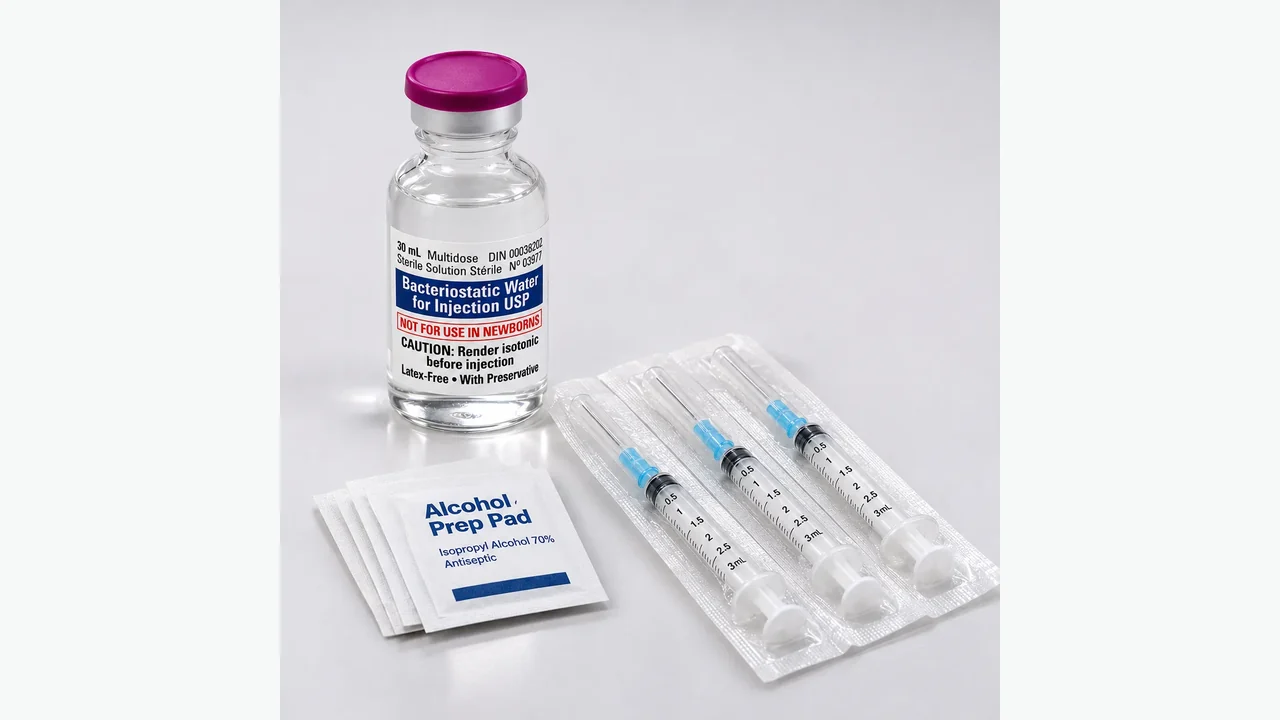
In short: wipe both stoppers, add the water slowly down the inside of the glass, then swirl gently until the powder dissolves. Do not shake. Vent an equal volume of air so the stopper does not bulge. Label the vial with the date and the concentration. The full technique, including how to avoid coring the stopper, is in our step-by-step reconstitution guide.
Retatrutide mixing chart by strength
These are easy starting volumes, not rules. Any volume works if you do the arithmetic; the chart just puts 1 mg on a round number of units.
| Vial | Bac water | Concentration (label) | 1 mg on a U-100 syringe |
|---|---|---|---|
| 10 mg | 2 mL | 5 mg/mL | 20 units |
| 10 mg | 1 mL | 10 mg/mL | 10 units |
| 20 mg | 2 mL | 10 mg/mL | 10 units |
| 30 mg | 3 mL | 10 mg/mL | 10 units |
| 30 mg | 1.5 mL | 20 mg/mL | 5 units |
| 40 mg | 2 mL | 20 mg/mL | 5 units |
Most research vials are 3 mL glass, so keep the total at or below roughly 2.5 to 3 mL to leave headroom. More water spreads the same peptide over more units, which makes small amounts easier to read. Our guide on how much bacteriostatic water to add explains the trade-off, and the peptide calculator does the sums for any volume.
Label vs measured: why your concentration may differ
The chart uses the label amount. A third-party report measures what is actually in the vial, and that is rarely exactly the label. Here is what our current lots measured, and what that does to the concentration at the chart volume.
| Vial | Lot | Measured | At chart volume |
|---|---|---|---|
| 10 mg | ZB-RT10526 | 9.31 mg (93.1%) | 4.66 mg/mL in 2 mL |
| 20 mg | RET-934 | 24.65 mg (123.3%) | 12.33 mg/mL in 2 mL |
| 30 mg | ZB-RT30526 | 32.96 mg (109.9%) | 10.99 mg/mL in 3 mL |
| 40 mg | In for testing | Pending (use the 40 mg label) | 20 mg/mL in 2 mL (label) |
The 10, 20 and 30 mg lots were tested by Peptide Test Canada. The 40 mg lot is in for third-party testing, so work from its label amount until the report is posted. On the 20 mg lot, working from the label would understate the concentration by about a fifth. If you want your arithmetic to reflect the vial in your hand, enter the measured amount from the lot’s report into the calculator. The published reports are in the COA library, and retatrutide strengths compared sets out price per measured milligram.
Storing retatrutide before you mix it
Lyophilized retatrutide is handled like other freeze-dried peptides. For long-term storage, a freezer at −20 °C; for vials you will use soon, the fridge. Either way, keep it sealed, dry and out of light. The powder tolerates normal transit for several days, so the risk is after delivery: bring the parcel inside promptly and do not leave it in a hot mailbox or on a cold porch. More detail is in how to store lyophilized peptides and shipping peptides: heat and stability.
Storing retatrutide after mixing
Once water is added, stability drops sharply. No published stability study covers reconstituted research-grade retatrutide specifically, so these rules follow the general standard for multi-dose vials in our storage guide.
- Refrigerate at 2 to 8 °C. A shelf toward the back of the fridge holds temperature better than the door.
- Discard after 28 days from first puncture unless the supplier states otherwise.
- Use bacteriostatic water for a vial you will draw from more than once.
- Do not shake, and keep the vial upright and out of light.
- Avoid freeze-thaw cycles. If a solution must be frozen, split it into small single-use aliquots first. See peptide degradation and freeze-thaw stability.
If a mixed vial turns cloudy, our guide on why a peptide goes cloudy covers the causes.
Choosing a strength with storage in mind
A larger vial is cheaper per milligram, but once mixed, the whole vial is on the 28-day clock. If a research run will not use a full 30 or 40 mg vial within that window, a smaller strength can waste less. Retatrutide strengths compared lays out the four sizes side by side, and you can see prices and lots on where to buy retatrutide in Canada.
Frequently asked questions
How much bacteriostatic water should I add to 10 mg of retatrutide?
Any volume works. 2 mL is a common choice because it gives 5 mg/mL, so 1 mg is a round 20 units on a U-100 syringe. 1 mL gives 10 mg/mL, or 10 units per mg.
How much water for 20, 30 or 40 mg retatrutide vials?
Easy starting points are 2 mL for 20 mg (10 mg/mL), 3 mL or 1.5 mL for 30 mg (10 or 20 mg/mL), and 2 mL for 40 mg (20 mg/mL). Keep the total within the vial’s headroom.
How long does mixed retatrutide last in the fridge?
Kept at 2 to 8 °C with bacteriostatic water, the common standard for a multi-dose vial is to discard it 28 days after the stopper is first punctured, unless the supplier states otherwise.
Can I freeze reconstituted retatrutide?
Repeated freeze-thaw cycles damage peptides in solution. If a solution has to be frozen, divide it into small single-use aliquots first so each portion thaws only once.
How should I store retatrutide before mixing?
Sealed, dry and out of light: in a freezer at −20 °C for long-term storage, or in the fridge for vials you will use soon.
Why does my concentration not match the label?
Vials rarely hold exactly the labelled amount. Our current retatrutide lots measured between 93.1% and 123.3% of label, so the true concentration differs. Use the measured amount from the lot report if you want exact arithmetic.
Related guides
- How to reconstitute lyophilized peptides
- How much bacteriostatic water to add
- How to store lyophilized peptides
- Retatrutide strengths compared: 10 to 40 mg
- What is retatrutide? A research overview
- Where to buy retatrutide in Canada
- Peptide price per mg calculator
Products sold by Lodge Peptides are intended for laboratory research use only and are not for human or animal consumption. This article is for educational purposes and is not medical advice.
Email list
Get lot reports and guides in your inbox
New lot reports, research guides, restocks, and occasional offers from the Lodge Peptides team.