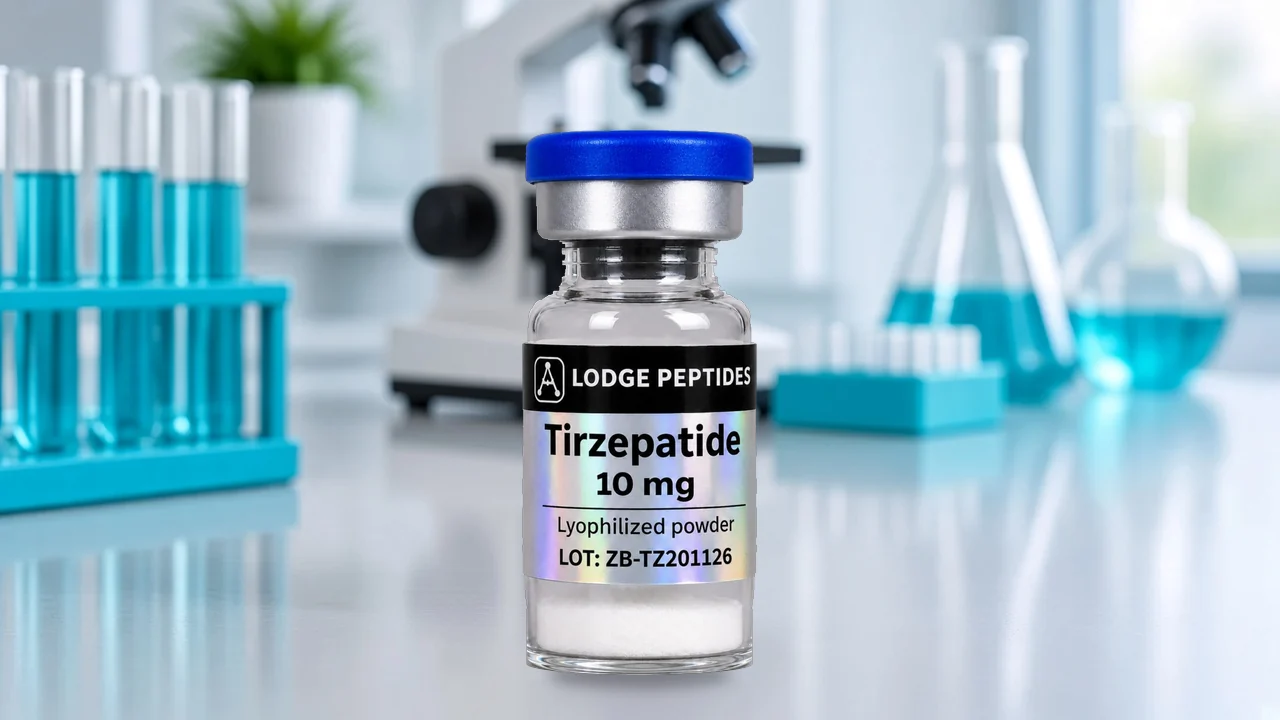
Tirzepatide is the first approved medicine that acts on two gut-hormone receptors at once: GIP and GLP-1. It has one of the largest clinical trial programs of any metabolic drug, and it is now the reference point that newer compounds such as retatrutide are measured against. This overview covers what tirzepatide is, how it is described at the receptor level, what the major trials found, and what to check on a lab report for research material.
- Tirzepatide (LY3298176) is a 39-amino-acid peptide with a fatty acid side chain, developed by Eli Lilly. It is a dual GIP and GLP-1 receptor agonist.
- In Canada it is approved as Mounjaro for type 2 diabetes and, since May 2025, as Zepbound for chronic weight management.
- In SURMOUNT-1, average weight loss at 72 weeks was 15.0% to 20.9% depending on dose, versus 3.1% on placebo. In SURMOUNT-5 it outperformed semaglutide head to head (20.2% vs 13.7%).
- For research material, the COA should confirm identity by mass (about 4.8 kDa), purity by HPLC and the measured amount in mg, all for the same lot as the vial.
Looking for tirzepatide in Canada? The price, current lot and lab report are on our Tirzepatide 10mg page.
What it is
Tirzepatide is a synthetic peptide of 39 amino acids. Its sequence is based on GIP (glucose-dependent insulinotropic polypeptide), with changes that also let it activate the GLP-1 receptor. A C20 fatty diacid side chain lets it bind to albumin in the blood, which slows its clearance and gives it a half-life of about five days. Its molecular formula is C225H348N48O68 (CAS 2023788-19-2), with a molecular weight of roughly 4.8 kDa.
It was developed by Eli Lilly under the code LY3298176. Health Canada approved it as Mounjaro for adults with type 2 diabetes, and authorized it as Zepbound for chronic weight management in May 2025. In the United States the same molecule is sold under both names.
Why two receptors?
GLP-1 and GIP are both incretins: hormones released by the gut after a meal that increase insulin release when blood sugar is high. GLP-1 drugs such as semaglutide act on one receptor. Tirzepatide was designed to act on both.
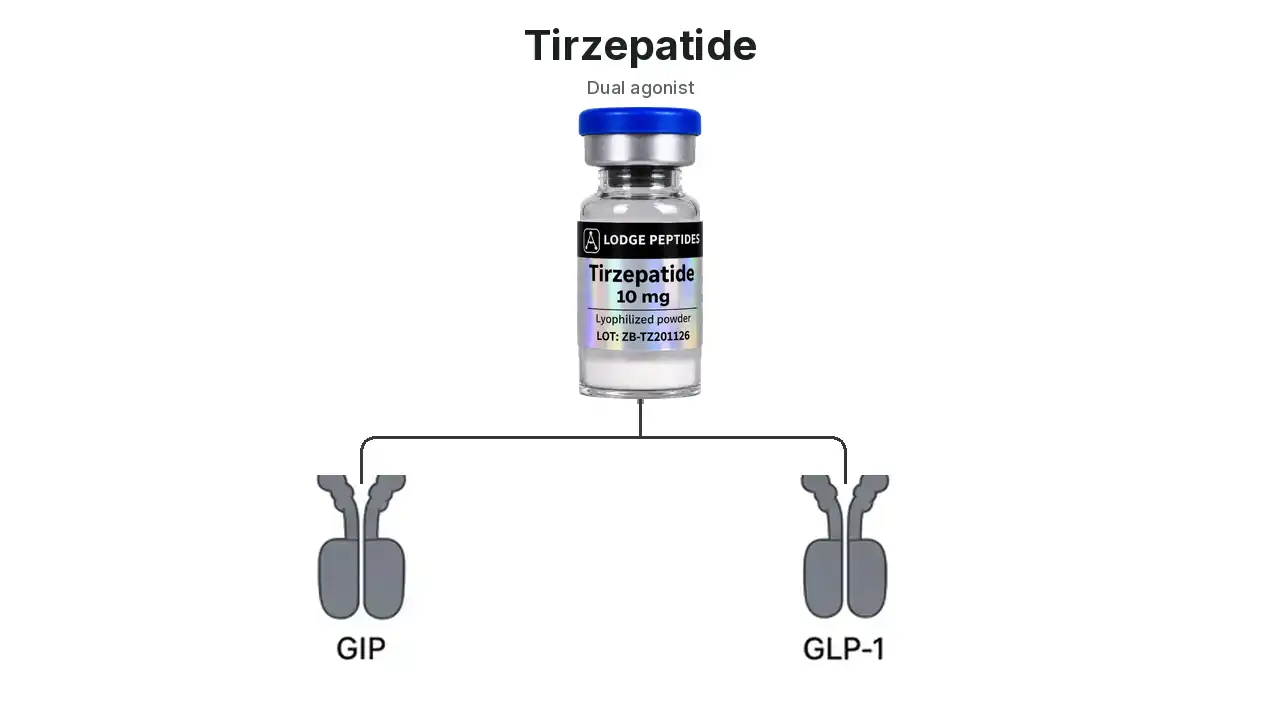
- GLP-1 receptor: slows stomach emptying, increases insulin release and acts on appetite centres in the brain.
- GIP receptor: also boosts insulin release, and is studied for effects on fat tissue and on the nausea that GLP-1 drugs can cause.
Laboratory work published by Lilly describes tirzepatide as an “imbalanced” agonist. It binds the GIP receptor about as strongly as natural GIP does, but binds the GLP-1 receptor roughly five times more weakly than natural GLP-1. Exactly how much the GIP side adds to the results is still debated. Retatrutide adds a third receptor, glucagon; our retatrutide vs tirzepatide comparison explains the difference.
Where the research stands
Tirzepatide has been studied in two large phase 3 programs: SURPASS in type 2 diabetes and SURMOUNT in obesity, plus trials in sleep apnea, heart failure and heart outcomes. The key results:
| Trial | Who took part | Main result |
|---|---|---|
| SURMOUNT-1 (NEJM, 2022) | 2,539 adults with obesity or overweight, without diabetes, 72 weeks | Average weight change of −15.0%, −19.5% and −20.9% on the three doses, versus −3.1% on placebo |
| SURMOUNT-5 (NEJM, 2025) | 751 adults with obesity, without diabetes, 72 weeks | −20.2% on tirzepatide versus −13.7% on semaglutide, the first head-to-head trial of the two |
| SURPASS program | Adults with type 2 diabetes | Lower HbA1c and more weight loss than the comparators tested, including semaglutide 1 mg in SURPASS-2 |
| SURPASS-CVOT (NEJM, 2025) | 13,299 adults with type 2 diabetes and heart disease, about 4 years | Major heart events were 8% lower than on dulaglutide (hazard ratio 0.92). This met the test for being no worse, but did not prove it was better |
Regulators have followed the data. The US FDA approved tirzepatide for moderate to severe obstructive sleep apnea in adults with obesity in December 2024, and in August 2026 added a heart-risk reduction claim for adults with type 2 diabetes based on SURPASS-CVOT.
Two caveats are worth knowing. These trials used the pharmaceutical product made under strict manufacturing controls, so the results say nothing about the quality of any research-grade material. And a share of the weight lost in these trials was lean mass rather than fat; our guide to muscle loss in body-composition studies covers what was measured.
Side effects reported in trials
The most common side effects in the trials were gastrointestinal: nausea, diarrhea, vomiting and constipation. They were mostly mild to moderate and most frequent while the dose was being stepped up. A minority of participants stopped treatment because of them. The product labels also carry warnings about pancreatitis, gallbladder problems and, based on animal studies, thyroid C-cell tumours. This summary is for background only. It is not medical advice, and products sold by Lodge Peptides are not for human use.
What to check on a COA
Tirzepatide is a large peptide, so the lab report matters more than for a short one. A good certificate of analysis should show:
- Identity by mass spectrometry: a measured mass that matches tirzepatide, at about 4,813 Da. HPLC purity alone cannot tell tirzepatide apart from a similar peptide.
- Purity by HPLC: the share of peptide material that is tirzepatide. 98% or above is typical for good material.
- Content in mg: how much tirzepatide is actually in the vial, compared with the label. A vial can be very pure and still be under-filled. See purity versus net peptide content.
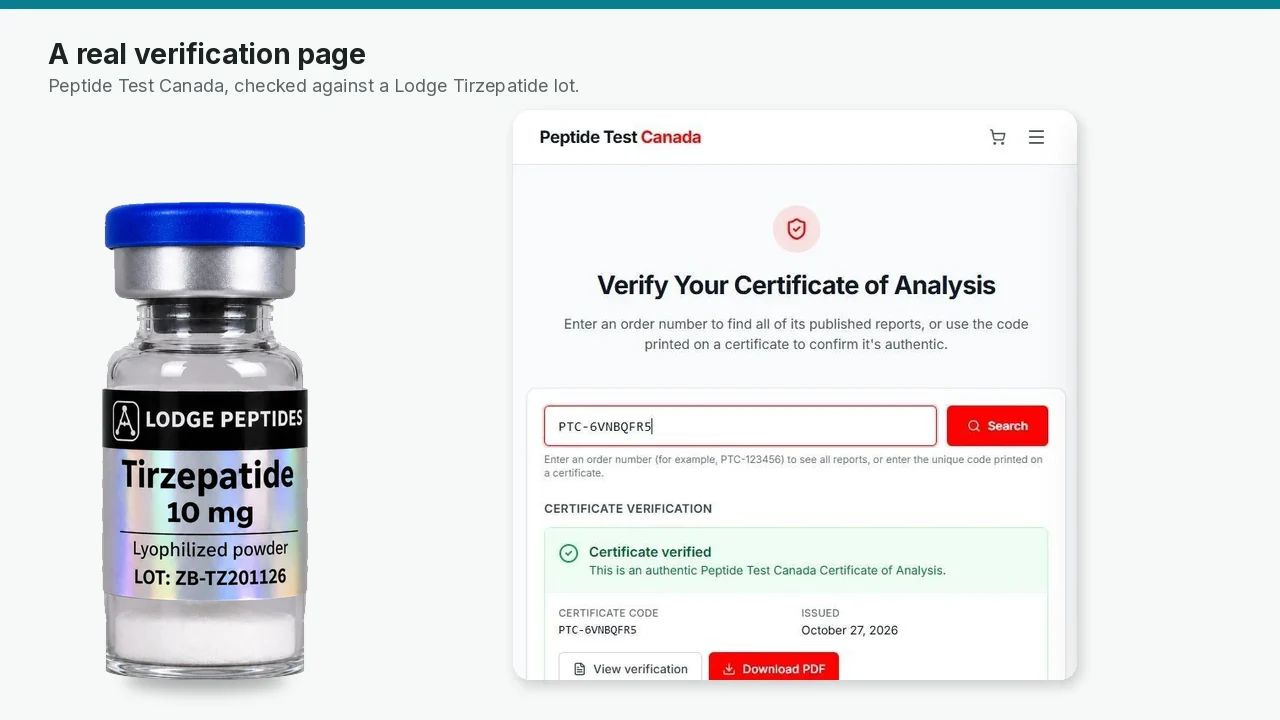
- A matching lot number and a way to verify the report with the lab. Our verification guide shows how.
If you have two reports that disagree, why two labs give different results explains how much difference is normal. Our calculator can read a COA and use the measured amount rather than the label.
Handling and storage
Like most research peptides, tirzepatide is supplied freeze-dried. Unopened vials keep best cold, dry and away from light. The fatty acid side chain makes the molecule somewhat “sticky”, so dissolve it gently and fully rather than shaking hard. Our guides cover how to reconstitute lyophilized peptides and how to store them.
Our lot and what it tested at
We carry tirzepatide 10 mg. The current lot, ZB-TZ201126, was tested by Peptide Test Canada using HPLC-MS/MS: 99.5% purity and 10.56 mg measured, which is 105.6% of the label amount. The full report and its verification code are on the lot ZB-TZ201126 results page, and every other lot is in the COA library.
Switching from tirzepatide or semaglutide: why the literature does not offer a 1:1 conversion is covered in switching from tirzepatide or semaglutide to retatrutide.
Frequently asked questions
What is tirzepatide?
Tirzepatide is a 39-amino-acid synthetic peptide that activates both the GIP and GLP-1 receptors. It was developed by Eli Lilly (code LY3298176) and is sold as Mounjaro and Zepbound.
Is tirzepatide approved in Canada?
Yes. Health Canada approved it as Mounjaro for adults with type 2 diabetes, and authorized it as Zepbound for chronic weight management in May 2025. Research-grade tirzepatide is a different thing and is not a medicine.
How is tirzepatide different from semaglutide?
Semaglutide acts only on the GLP-1 receptor. Tirzepatide acts on both GIP and GLP-1. In the head-to-head SURMOUNT-5 trial, average weight loss at 72 weeks was 20.2% on tirzepatide versus 13.7% on semaglutide.
How is tirzepatide different from retatrutide?
Retatrutide adds a third target, the glucagon receptor, to GIP and GLP-1. It is still in phase 3 trials and is not approved anywhere. Tirzepatide is approved and has far more trial data.
What molecular weight should a tirzepatide COA show?
About 4,813 Da (roughly 4.8 kDa). A mass spectrometry result close to this confirms the identity. HPLC purity on its own does not.
How much weight loss did tirzepatide show in trials?
In SURMOUNT-1, adults without diabetes lost an average of 15.0% to 20.9% of body weight over 72 weeks depending on dose, compared with 3.1% on placebo.
Sources and further reading
- Jastreboff AM et al. Tirzepatide once weekly for the treatment of obesity (SURMOUNT-1). New England Journal of Medicine, 2022
- Aronne LJ et al. Tirzepatide as compared with semaglutide for the treatment of obesity (SURMOUNT-5). New England Journal of Medicine, 2025
- Coskun T et al. LY3298176, a novel dual GIP and GLP-1 receptor agonist. Molecular Metabolism, 2018
- Eli Lilly Canada: Zepbound KwikPen approved and available in Canada (July 2025)
- HCPLive: FDA approves tirzepatide to cut cardiovascular risk in type 2 diabetes (SURPASS-CVOT)
- Retatrutide: a research overview
- How to read a peptide certificate of analysis
- Retatrutide vs semaglutide: what the trials show
Products sold by Lodge Peptides are intended for laboratory research use only and are not for human or animal consumption. This article summarizes published research for educational purposes and is not medical advice.
Email list
Get lot reports and guides in your inbox
New lot reports, research guides, restocks, and occasional offers from the Lodge Peptides team.