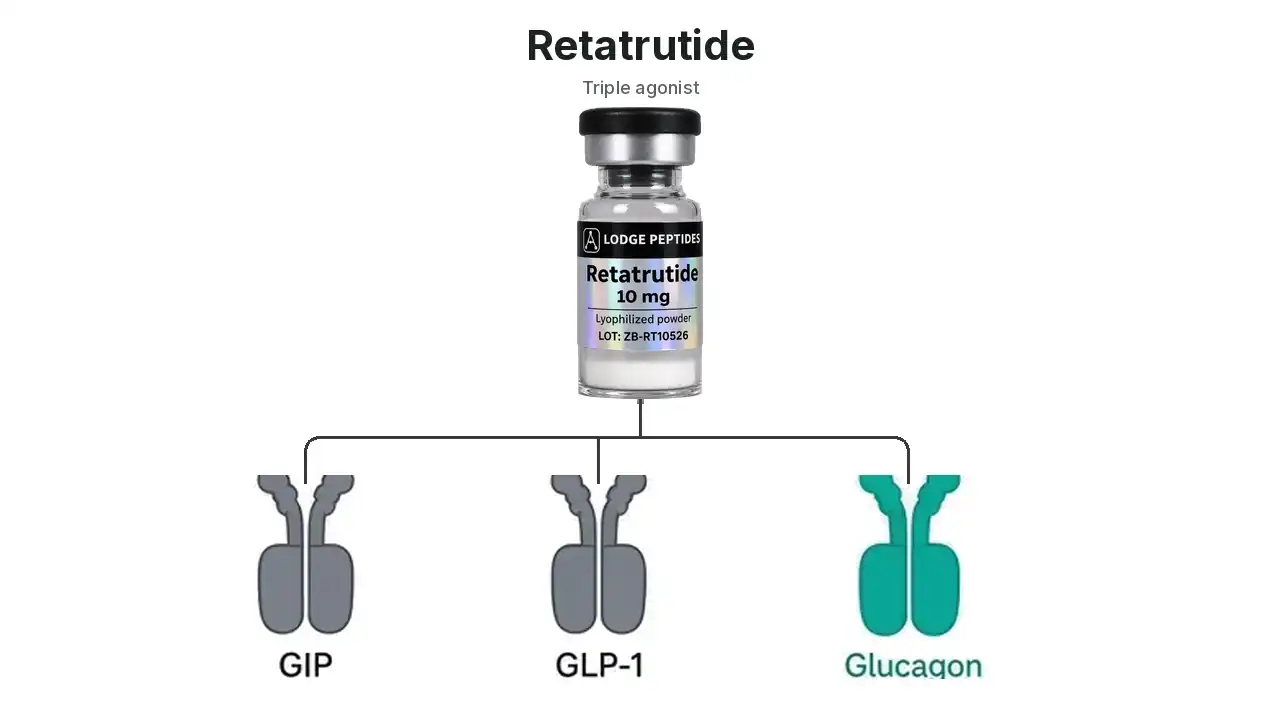
Retatrutide is the most-searched research peptide in Canada, and most of the questions behind those searches are about two things: how much weight people lost in the trials, and what side effects were reported. This page summarises the published retatrutide trial results, phase 1 through phase 3, with the numbers as the trials and Eli Lilly reported them. It is a summary of the scientific literature, not medical advice, and nothing here is a protocol for use in people. Lodge Peptides sells retatrutide for laboratory research only.
- Retatrutide (LY3437943) is an investigational triple agonist of the GIP, GLP-1 and glucagon receptors, developed by Eli Lilly. It is not approved by any regulator.
- In the phase 2 obesity trial (NEJM, 2023), the 12{N}mg dose produced a mean weight change of −24.2% at 48 weeks versus −2.1% for placebo.
- In the phase 3 TRIUMPH-1 trial (NEJM, 2026), mean weight change at 80 weeks was −19.0% (4{N}mg), −25.9% (9{N}mg) and −28.3% (12{N}mg) versus −2.2% for placebo (efficacy estimand).
- Adverse events were mostly gastrointestinal (nausea, diarrhoea, constipation, vomiting) and dose-related. In TRIUMPH-1, discontinuation due to adverse events was 4.1%, 6.9% and 11.3% across doses versus 4.9% for placebo.
- A dose-related adverse event of special interest was dysesthesia (altered skin sensation): 5.1%, 12.3% and 12.5% across doses versus 0.9% placebo in TRIUMPH-1.
- Lilly has said it plans to file retatrutide with the US FDA in the first quarter of 2027.
Looking for retatrutide in Canada? Compare all four strengths, the tested lots and price per mg on our retatrutide Canada page.
What retatrutide is
Retatrutide is a single peptide that activates three hormone receptors at once: the glucose-dependent insulinotropic polypeptide (GIP) receptor, the glucagon-like peptide-1 (GLP-1) receptor and the glucagon receptor. That makes it a step beyond tirzepatide (GIP + GLP-1) and semaglutide (GLP-1 alone); the three targets are also why some vendors nickname it “GLP-3”. Our retatrutide research overview covers the mechanism, and retatrutide vs tirzepatide compares the three.
Phase 1
The first human data came from a phase 1b study in people with type 2 diabetes (Urva et al., Lancet, 2022). It reported dose-proportional pharmacokinetics, a half-life of about six days supporting once-weekly dosing, placebo-adjusted HbA1c reductions at the higher doses, and dose-dependent weight loss up to about −8.96 kg in the highest-dose group over 12 weeks. Gastrointestinal events were the most common adverse events. These data set up the dose range for later trials.
Phase 2
The phase 2 obesity trial (Jastreboff et al., NEJM, 2023) randomised 338 adults with obesity to retatrutide or placebo for 48 weeks. The least-squares mean weight change at 48 weeks was:
| Dose | Mean weight change at 48 weeks |
|---|---|
| 1 mg | −8.7% |
| 4 mg | −17.1% |
| 8 mg | −22.8% |
| 12 mg | −24.2% |
| Placebo | −2.1% |
At 48 weeks, a weight reduction of 15% or more had occurred in 83% of the 12 mg group versus 2% of placebo. The most common adverse events were gastrointestinal, dose-related, mostly mild to moderate, and partly reduced by starting at a lower dose. A parallel phase 2 trial in type 2 diabetes (Rosenstock et al., Lancet, 2023) showed HbA1c reductions up to about −2.02% and weight loss up to about −16.9% at 36 weeks.
Phase 3: TRIUMPH-1
TRIUMPH-1 (Jastreboff et al., NEJM, 2026; ClinicalTrials.gov NCT05929066) randomised 2,339 adults with obesity and without diabetes to retatrutide 4, 9 or 12 mg or placebo for 80 weeks. For the efficacy estimand, mean weight change at 80 weeks was:
| Dose | Weight change at 80 weeks | ≥25% weight loss | ≥30% weight loss |
|---|---|---|---|
| 4 mg | −19.0% | 27.8% | 15.3% |
| 9 mg | −25.9% | 52.9% | 37.9% |
| 12 mg | −28.3% | 62.5% | 45.3% |
| Placebo | −2.2% | 2.2% | 0.5% |
Lilly reported that 65.3% of the 12 mg group reached a BMI below 30, and in a pre-specified extension, participants who continued on 12 mg to 104 weeks lost an average of 30.3%. For the more conservative treatment-regimen estimand, 80-week weight change was −17.6%, −23.7% and −25.0% versus −3.9% for placebo, the figures the NEJM abstract leads with. TRIUMPH-1 also had nested groups with knee osteoarthritis and obstructive sleep apnea, where retatrutide improved pain and apnea measures.
Phase 3: TRIUMPH-4
TRIUMPH-4 (NEJM, 2026; NCT05931367) studied 445 adults with obesity and painful knee osteoarthritis for 68 weeks. For the efficacy estimand, weight change was −26.4% (9 mg) and −28.7% (12 mg) versus −2.1% placebo, with large reductions in WOMAC knee-pain scores. Dysesthesia was reported more often than in TRIUMPH-1, at about 20.9% in the 12 mg group versus 0.7% placebo; most events were mild and rarely led to stopping.
Type 2 diabetes trials
In the diabetes programme, TRANSCEND-T2D-1 (Lancet, 2026) reported HbA1c reductions up to 2.0% and weight loss up to 16.8% at 40 weeks, and a separate phase 3 monotherapy trial in type 2 diabetes (Bajaj et al., Lancet, 2026) reported HbA1c reductions up to −1.94% and weight change up to −15.3% at the 12 mg dose, with gastrointestinal events again the most common.
Reported side effects
Across the trials the safety signal is consistent and dominated by gastrointestinal events. The TRIUMPH-1 adverse-event rates (4, 9, 12 mg vs placebo) were:
| Adverse event | 4 mg | 9 mg | 12 mg | Placebo |
|---|---|---|---|---|
| Nausea | 28.6% | 38.4% | 42.4% | 14.8% |
| Diarrhoea | 25.2% | 34.1% | 32.0% | 13.5% |
| Constipation | 23.8% | 25.9% | 26.1% | 10.9% |
| Vomiting | 10.6% | 22.8% | 25.3% | 4.8% |
| Dysesthesia | 5.1% | 12.3% | 12.5% | 0.9% |
| Discontinuation for adverse events | 4.1% | 6.9% | 11.3% | 4.9% |
Lilly reported these events were generally consistent with other incretin-based therapies, mostly mild to moderate, with most resolving during treatment. An earlier phase 2 signal of dose-dependent increases in heart rate that peaked at 24 weeks and then declined was also noted. Serious adverse events were more common with retatrutide than placebo in the osteoarthritis trials.
How to read these numbers
Two cautions. First, trial results depend on which estimand is used: the “efficacy” estimand (as if everyone stayed on treatment) gives larger weight-loss figures than the “treatment-regimen” estimand (counting people who stopped), and reputable sources report both. Second, these are results from supervised clinical trials of a specific investigational product, under medical care, with dose escalation and monitoring. They are not a guide to what any unapproved vial does or to how it should be used. Retatrutide is not approved anywhere; see is retatrutide legal in Canada? for its regulatory status.
Lodge Peptides and retatrutide
Lodge Peptides sells retatrutide in 10, 20, 30 and 40 mg vials for laboratory research only. Every tested lot has a Peptide Test Canada report in our COA library; the 10, 20 and 30 mg lots tested 99.5% to 99.7% pure, and the 40 mg lot is in for testing. We do not sell retatrutide for human use and do not give dosing advice.
Frequently asked questions
How much weight did people lose on retatrutide?
In the phase 3 TRIUMPH-1 trial, mean weight change at 80 weeks was −19.0% (4 mg), −25.9% (9 mg) and −28.3% (12 mg) versus −2.2% for placebo, using the efficacy estimand.
What are the side effects of retatrutide in the trials?
Mostly gastrointestinal and dose-related: in TRIUMPH-1 at 12 mg, nausea 42.4%, diarrhoea 32.0%, constipation 26.1% and vomiting 25.3%. Dysesthesia (altered skin sensation) occurred in 12.5% versus 0.9% for placebo.
How many people stopped retatrutide because of side effects?
In TRIUMPH-1, discontinuation due to adverse events was 4.1%, 6.9% and 11.3% across the 4, 9 and 12 mg doses, versus 4.9% for placebo.
Is retatrutide approved?
No. Retatrutide is investigational and not approved by any regulator. Lilly has said it plans to file with the US FDA in the first quarter of 2027.
What is dysesthesia?
An altered or abnormal sense of touch, such as tingling or skin sensitivity. It was reported as a dose-related adverse event of special interest in the retatrutide trials, generally mild and usually resolving.
Are these results a dosing guide?
No. They come from supervised clinical trials of a specific investigational product under medical care. They are not a protocol for an unapproved vial, and Lodge Peptides does not give dosing advice.
Related guides
- Retatrutide: a research overview
- Retatrutide vs tirzepatide
- Do retatrutide and tirzepatide cause muscle loss?
- Is retatrutide legal in Canada?
- Retatrutide in Canada: tested lots
Sources
- Jastreboff AM, et al. Triple-hormone-receptor agonist retatrutide for obesity—a phase 2 trial. N Engl J Med. 2023;389(6):514-526. PubMed 37366315
- Rosenstock J, et al. Retatrutide, a GIP, GLP-1 and glucagon receptor agonist, for people with type 2 diabetes: a phase 2 trial. Lancet. 2023;402(10401):529-544. PubMed 37385280
- Urva S, et al. LY3437943, a novel triple GIP, GLP-1 and glucagon receptor agonist, in people with type 2 diabetes: a phase 1b trial. Lancet. 2022;400(10366):1869-1881. PubMed 36354040
- Jastreboff AM, et al. Retatrutide, a triple hormone receptor agonist, for treatment of obesity (TRIUMPH-1). N Engl J Med. 2026. NEJM (NEJMoa2604169)
- Retatrutide once weekly in adults with knee osteoarthritis pain and obesity (TRIUMPH-4 and TRIUMPH-1-OA). N Engl J Med. 2026. NEJM (NEJMoa2610676)
- Bajaj HS, et al. Retatrutide in people with type 2 diabetes inadequately controlled with diet and exercise. Lancet. 2026. PubMed 42250575
- Eli Lilly and Company. TRIUMPH-1 and TRANSCEND-T2D-1 results; TRIUMPH-4 topline results. Investor news releases, 2025-2026. investor.lilly.com
- Reuters. Lilly plans to file retatrutide with the US FDA in Q1 2027. 23 July 2026.
Products sold by Lodge Peptides are intended for laboratory research use only and are not for human or animal consumption. This article is for educational purposes and is not medical advice.
Email list
Get lot reports and guides in your inbox
New lot reports, research guides, restocks, and occasional offers from the Lodge Peptides team.