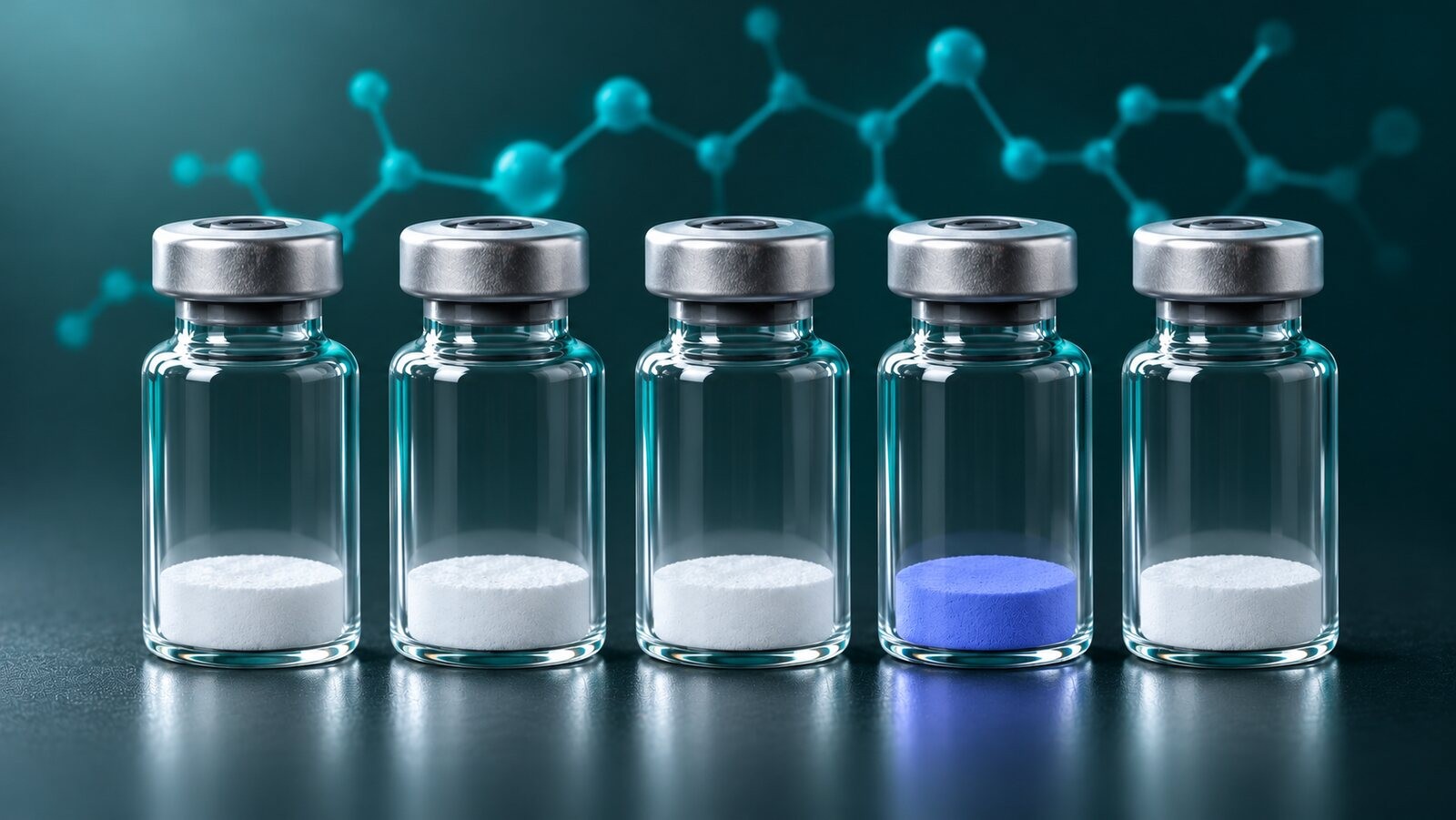
KLOW, GLOW and Wolverine are three of the most searched peptide blend names, and they are easy to mix up because they overlap almost completely. None of them is a molecule. Each is a seller’s name for a set of separate peptides weighed into one vial and freeze-dried together. This guide lays the three side by side, explains what each added peptide changes on the bench and on the lab report, and shows where our own five-peptide KLOW80 differs from the usual four-peptide KLOW.
- Wolverine is usually BPC-157 + TB-500. GLOW adds GHK-Cu. KLOW adds KPV on top of GLOW.
- The common versions are 20 mg, 70 mg and 80 mg per vial, but there is no standard recipe, so the label and the lab report are what count.
- GHK-Cu is 50 mg of the 70 or 80, so GLOW and KLOW are mostly copper peptide by mass and look blue-violet. Wolverine is white.
- Lodge Peptides’s KLOW80 has five components: its 10 mg of TB-500 is split into 5 mg TB-500 and 5 mg full-length thymosin beta-4, and the lab measured all five separately.
- Everything here is for laboratory research use only and is not medical advice.
BPC-157, TB-500, KPV, Wolverine and KLOW80 are compared on our recovery peptides page.
One family, built by addition
The easiest way to keep the three names straight is to start small and add one peptide at a time:
- Wolverine = BPC-157 + TB-500, commonly 10 mg of each (some sellers use 5 mg of each).
- GLOW = Wolverine + 50 mg of GHK-Cu, for about 70 mg in the vial.
- KLOW = GLOW + 10 mg of KPV, for about 80 mg. The K is for KPV.
These are naming conventions that grew up among sellers and forums, not pharmacopoeia standards. Ratios vary: some GLOW vials carry less BPC-157, and some Wolverine products are two separate vials rather than one blend. Always read the per-component amounts on the label rather than trusting the name.
KLOW vs GLOW vs Wolverine at a glance
| Wolverine | GLOW | KLOW | Lodge Peptides KLOW80 | |
|---|---|---|---|---|
| BPC-157 | 10 mg | 10 mg | 10 mg | 10 mg |
| TB-500 | 10 mg | 10 mg | 10 mg | 5 mg |
| Thymosin beta-4 (full length) | – | – | – | 5 mg |
| GHK-Cu | – | 50 mg | 50 mg | 50 mg |
| KPV | – | – | 10 mg | 10 mg |
| Total per vial | 20 mg | 70 mg | 80 mg | 80 mg label, 95.12 mg measured |
| Powder colour | White | Blue-violet | Blue-violet | Blue-violet |
| Peaks to expect on HPLC | 2 | 3 | 4 | 5 |
The first three columns are the most common versions sold under each name, not a fixed standard. Lodge Peptides sells KLOW80 and a 20 mg Wolverine blend (BPC-157 10 mg + TB-500 10 mg); we do not sell a premixed GLOW.
The building blocks
| Peptide | What it is | Approx. molar mass |
|---|---|---|
| BPC-157 | A 15-amino-acid peptide whose sequence derives from a protein in gastric juice | 1,419.5 g/mol |
| TB-500 | The acetylated seven-residue fragment Ac-LKKTETQ, residues 17 to 23 of thymosin beta-4 | 889.0 g/mol |
| Thymosin beta-4 | The full-length 43-amino-acid peptide that TB-500 is taken from | 4,963 g/mol |
| GHK-Cu | The copper(II) complex of the tripeptide glycyl-histidyl-lysine | About 402 g/mol |
| KPV | The tripeptide Lys-Pro-Val, the C-terminal end of alpha-MSH | 342.4 g/mol |
Each of these has its own research literature, almost all of it in cells and animals. We could not find a published study of GLOW or KLOW as a finished mixture, so claims about what a blend “does” go beyond the evidence. For each component, see our KLOW80 research overview, the GHK-Cu overview and TB-500 vs thymosin beta-4.
What changes on the bench
Wolverine to GLOW: the copper arrives
Adding 50 mg of GHK-Cu more than triples the mass in the vial and changes how it behaves. The cake turns blue-violet, the reconstituted solution is blue, and the copper complex now governs the chemistry of the whole vial: it is sensitive to pH, chelating agents and reducing agents in a way BPC-157 and TB-500 are not. That is why our guide to mixing peptides in one solution treats copper as its own question.
GLOW to KLOW: one more small peak
KPV adds 10 mg of a white tripeptide, so a GLOW vial and a KLOW vial look the same. The difference only shows up on paper: one more component on the label and one more peak the lab has to identify and quantify.
Volume and concentration
An 80 mg blend in 2 mL of bacteriostatic water is 40 mg/mL in total, but each component has its own concentration. In KLOW80 at 2 mL, GHK-Cu is 25 mg/mL by label while TB-500 is 2.5 mg/mL. The peptide calculator has a blend breakdown that does this per component, and how much bacteriostatic water to add explains how to choose the volume.
How Lodge Peptides KLOW80 differs
Most KLOW vials list 10 mg of TB-500. Ours splits that 10 mg between 5 mg of the TB-500 fragment and 5 mg of full-length thymosin beta-4, which is why it has five components instead of four. The two are different molecules, about 889 vs 4,963 g/mol, and a mass-spectrometry method separates them easily.
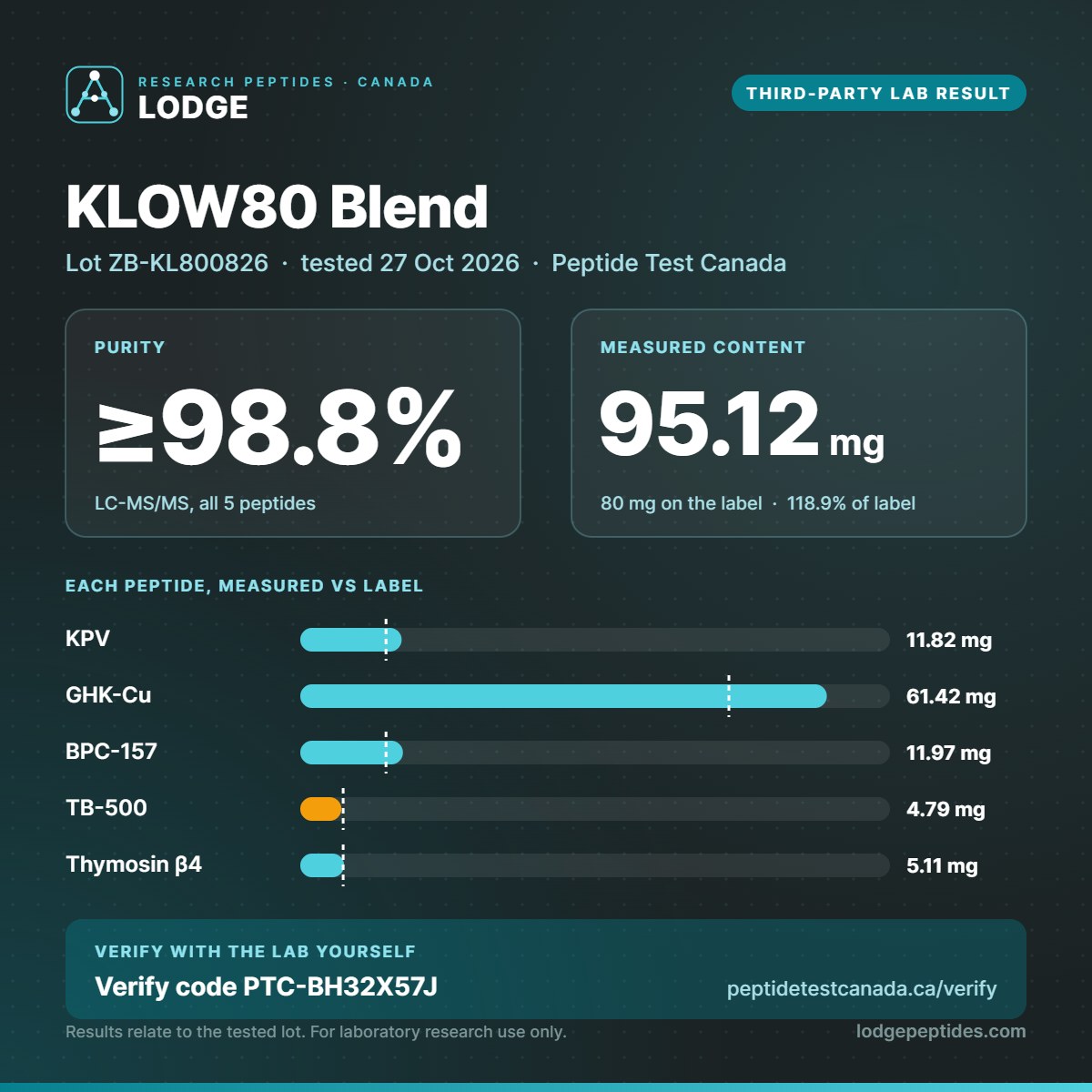
| Component | Label | Measured | Purity |
|---|---|---|---|
| GHK-Cu | 50 mg | 61.42 mg | 98.81% |
| BPC-157 | 10 mg | 11.97 mg | 99.59% |
| KPV | 10 mg | 11.82 mg | 99.59% |
| TB-500 | 5 mg | 4.79 mg | 99.52% |
| Thymosin beta-4 | 5 mg | 5.11 mg | 99.54% |
| Total | 80 mg | 95.12 mg | ≥98.8% |
Report COA-2026-SC-04211, tested 27 October 2026. You can check it yourself on the lab’s site with verify code PTC-64X7T4L9, or open the lot in our COA library.
Reading a blend lab report
A blend is harder to test than a single peptide, and reports vary a lot in what they actually show. Four things to look for:
- Every component listed by name, with its own amount in mg. A single “blend purity 99%” line tells you little about the smallest components.
- Measured, not calculated, per-component amounts. Some reports measure one total and then divide it by the seller’s stated ratio. That method cannot catch a vial that is short on TB-500 or KPV. Look for wording such as “calculated from total using the stated formulation ratio”, and ask.
- Identity for each peptide, ideally by mass spectrometry, so a cheaper substitute cannot hide inside the total.
- The lot number on your vial, and a verify code you can check with the lab. Our guide to verifying a peptide lab report walks through it.
Comparing blend prices fairly
Blends are hard to compare on price because the total milligrams differ (20, 70 or 80 mg) and so does the mix. Two fair ways to do it:
- Price per milligram of the component you care about. If GHK-Cu is the point, a 70 mg GLOW and an 80 mg KLOW both carry 50 mg of it.
- Price per measured milligram, using the lab report rather than the label. Our price per mg calculator does the arithmetic for up to four products.
KLOW80 at Lodge Peptides is $80 for a single vial or $640 for a 10-pack ($64 a vial). On the current lot that is $0.84 per measured milligram for a single vial and $0.67 in a 10-pack. Order on the KLOW80 product page, or read where to buy KLOW80 in Canada.
Wolverine at Lodge Peptides is $64 for a 20 mg vial or $512 for a 10-pack, on the Wolverine blend page. If you would rather work with the peptides separately, BPC-157 10 mg and Thymosin Beta-4 (TB-500) 10 mg are $48 a vial each and KPV 10 mg is $40. The Wolverine and BPC-157 lots are in for third-party testing now, and each report will be posted on its product page and in the COA library when it arrives. The standalone 10 mg vial is already tested: Peptide Test Canada identified lot ZB-BT10926 as full-length thymosin beta-4, so it is sold as Thymosin Beta-4 (TB-500).
Frequently asked questions
What is the difference between KLOW and GLOW?
KLOW is GLOW plus 10 mg of KPV. In their common versions GLOW holds GHK-Cu 50 mg, BPC-157 10 mg and TB-500 10 mg (70 mg), and KLOW adds KPV for 80 mg.
What is in the Wolverine blend?
Wolverine is usually BPC-157 and TB-500, most often 10 mg of each in one vial. Some sellers use 5 mg of each or sell the two as separate vials.
Why are GLOW and KLOW blue?
Because 50 mg of each vial is GHK-Cu, a copper(II) complex. The copper makes the powder and the solution blue-violet. Wolverine contains no copper and is white.
Is KLOW80 the same as KLOW?
Close, with one difference. Lodge Peptides KLOW80 splits the usual 10 mg of TB-500 into 5 mg TB-500 and 5 mg full-length thymosin beta-4, so it has five components. The lab measured all five separately for lot ZB-KL800826.
Does Lodge Peptides sell GLOW or Wolverine?
Lodge Peptides sells Wolverine as a 20 mg BPC-157 / TB-500 blend, plus KLOW80 and single-compound GHK-Cu 100 mg, BPC-157 10 mg, Thymosin Beta-4 (TB-500) 10 mg and KPV 10 mg. We do not sell a premixed GLOW.
Has GLOW or KLOW been studied as a blend?
We could not find a published study of GLOW or KLOW as a finished mixture. Each component has its own literature, mostly cell and animal research.
Sources and related guides
- KPV peptide: a research overview, the K in KLOW
- Esposito et al., Drug Testing and Analysis: identification of the Ac-Tb4(17-23) fragment in TB-500
- PubChem: TB-500 (Ac-LKKTETQ)
- KLOW80 blend explained: components and lab testing
- Mixing peptides in one solution
- Where to buy GHK-Cu in Canada
- Where to buy BPC-157 in Canada
- BPC-157 vs TB-500: how the two peptides differ
Products sold by Lodge Peptides are intended for laboratory research use only and are not for human or animal consumption. This article is for educational purposes and is not medical advice.
Email list
Get lot reports and guides in your inbox
New lot reports, research guides, restocks, and occasional offers from the Lodge Peptides team.