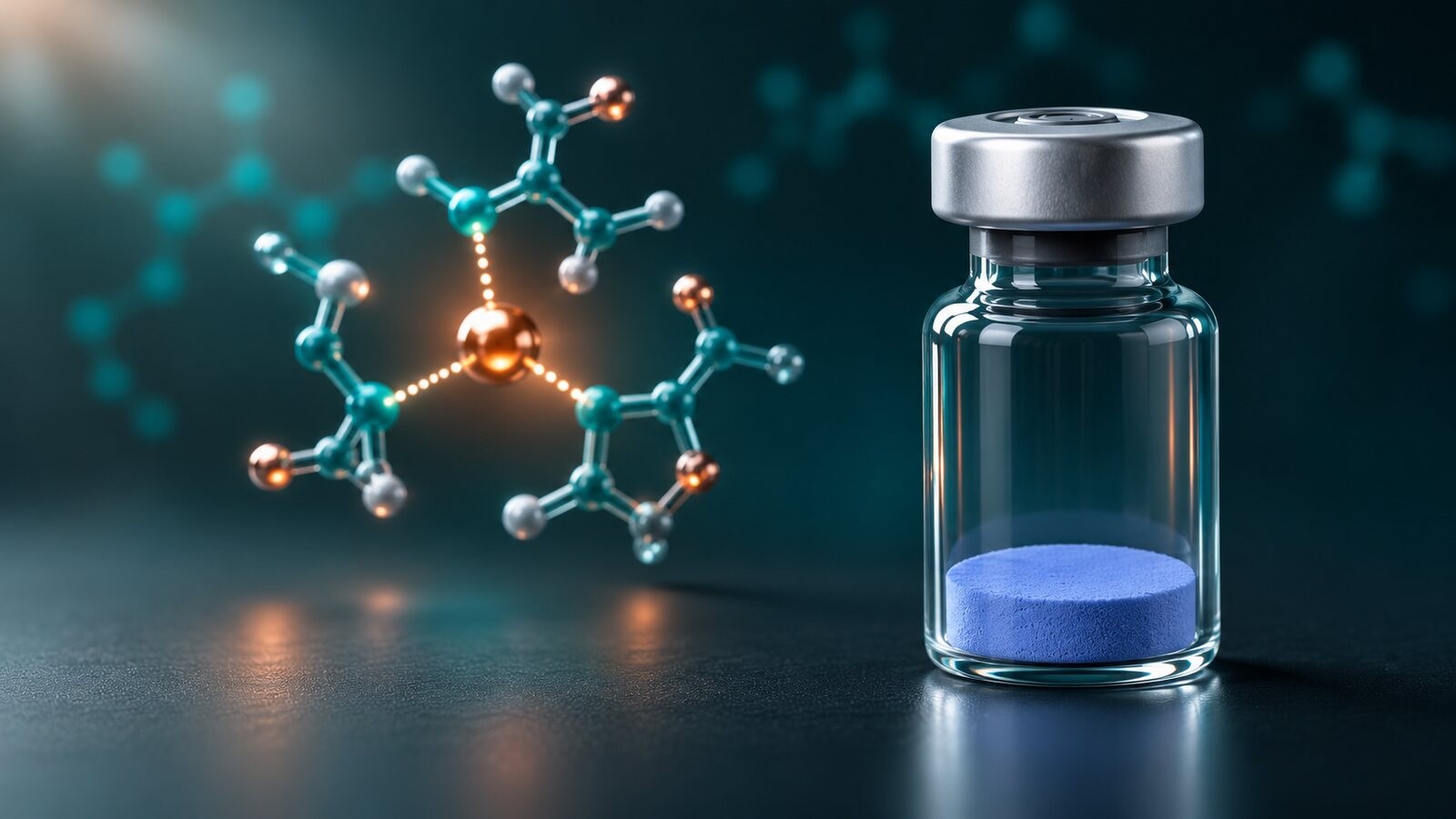
GHK-Cu is the copper(II) complex of the tripeptide glycyl-L-histidyl-L-lysine. It is a small, well-characterized molecule that appears in cell-culture and analytical research, and it is also used as a reference material for copper-peptide methods. This guide explains the chemistry and the checks that matter when you buy it for laboratory use. It does not describe any use in people or animals.
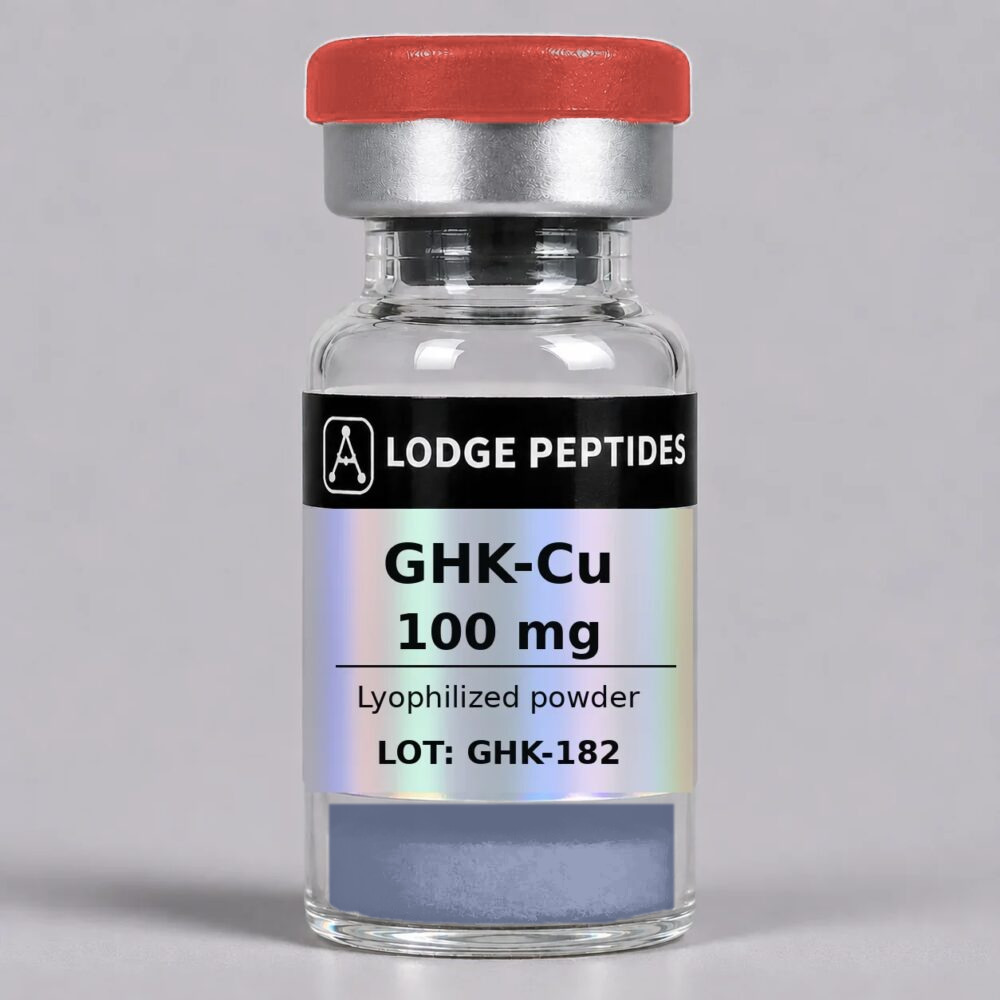
- GHK is a three-amino-acid peptide (Gly-His-Lys) that binds copper(II) tightly; the complex is written GHK-Cu.
- Formula C14H22CuN6O4, about 401.9 g/mol, CAS 89030-95-5.
- Copper is about 15.8 percent of the complex by mass, so a content test should account for it.
- Look for purity by HPLC, identity by mass spectrometry, and a stated lot number on the report.
- Sold by Lodge Peptides for in vitro laboratory research only.
Looking for GHK-Cu in Canada? The price, current lot and lab report are on our GHK-Cu 100mg page.
What GHK-Cu is
GHK is a tripeptide made of glycine, L-histidine and L-lysine. In solution it binds copper(II) ions with high affinity, forming the blue-violet complex called GHK-Cu. The peptide was first isolated from human plasma in the 1970s and has been studied in laboratory settings ever since.
Because it is short and stable, GHK-Cu is easier to characterise than long peptides. That makes analytical checks (purity, identity, copper content) more straightforward to read and to verify.
Structure and copper binding
The N-terminal amine, deprotonated backbone amide nitrogens and the imidazole nitrogen of histidine coordinate the copper ion, giving a stable 1:1 complex. The key numbers for reference:
- Formula: C14H22CuN6O4
- Molar mass: about 401.9 g/mol (the free GHK peptide is about 340.4 g/mol)
- CAS number: 89030-95-5
- Copper share: roughly 15.8 percent of the complex by mass
Copper share matters for content testing. A vial that is labelled 100 mg of GHK-Cu contains the peptide and the copper together; a method that measures only the free peptide will report a lower number unless it is calibrated against the complex.
How it appears in laboratory research
In published laboratory work, GHK-Cu has been studied in cell and tissue models, including experiments on extracellular matrix proteins and on gene expression. It is also used as a standard when developing and validating analytical methods for copper-binding peptides. Readers who want the scientific background can start with the review articles listed in the sources below.
Nothing on this page is a claim about effects in people. Products sold by Lodge Peptides are for in vitro research use only.
Copper peptides in skincare vs research-grade GHK-Cu
GHK-Cu is best known to most people as the “copper peptide” in skincare serums and creams. Those products contain small amounts of GHK-Cu blended into a cosmetic base and are regulated as cosmetics.
Research-grade GHK-Cu is different: a vial of freeze-dried powder, here 100 mg, made for laboratory work such as cell-culture and analytical studies. It is not formulated, tested or labelled as a cosmetic or a medicine, and it is not for use on people. Much of the published interest comes from Pickart’s work showing that GHK levels in human plasma fall with age, from about 200 ng/mL at age 20 to about 80 ng/mL by age 60, and from cell and animal studies on wound healing, collagen and gene expression. Controlled human clinical data remain limited.
What colour should GHK-Cu be?
Blue. The copper(II) in the complex gives the dry powder and the dissolved solution a blue to violet colour, so a clear blue solution is normal and expected.
- Normal: clear blue or blue-violet, with no particles.
- Worth questioning: cloudiness that doesn’t clear, specks, a green or brown tint, or a colourless solution from a vial sold as GHK-Cu.
- Mixing: copper can react with other ingredients. Some compounds strip or reduce the copper and change the colour, so check compatibility before combining it with anything. See mixing peptides in one solution.
For haze or particles in any peptide, see why is my peptide cloudy after reconstitution.
Quality checks to look for
A useful report for GHK-Cu usually covers:
- Purity by HPLC: the main peak area as a share of all peaks. See how to read an HPLC chromatogram.
- Identity by mass spectrometry: a signal consistent with the GHK-Cu complex. Copper has two main isotopes (63 and 65), so the pattern is distinctive.
- Content: how much active material is in the vial, which is different from purity. See purity vs net peptide content.
- Lot number and report number: so the report can be matched to the vial and checked with the lab.
Storage and handling
Keep sealed vials refrigerated, away from light and moisture, and follow the batch documentation. The general rules are in our guide to storing lyophilized peptides. Short exposure to room temperature during shipping is normal; see shipping, heat and stability.
What our current lot tested at
Our GHK-Cu lot GHK-182 was tested by Peptide Test Canada (analysis by SideChain Analytics) on 30 October 2026, by LC-MS/MS. Report COA-2026-SC-04425, verification code PTC-VK4RZ2T3.
- Purity: 99.9%
- Measured content: 135.30 mg against a 100 mg label, or 135.3% of label
Two things we noticed reading this report ourselves. First, the content came back well above the label. We show the number the lab measured rather than rounding it down to look tidy. Second, the report lists CAS 49557-75-7 and a molecular weight of 340.4 g/mol. Those are the values for the free GHK tripeptide, not the copper complex, which is about 401.9 g/mol. It is a small labelling detail, but a useful reminder to read the identity section of any GHK-Cu report closely. You can check this report yourself; see how to verify a peptide lab report.
Frequently asked questions
Is research GHK-Cu the same as the copper peptide in skincare?
It is the same molecule, but not the same product. Skincare contains small amounts of GHK-Cu in a cosmetic formula. Research-grade GHK-Cu is a vial of pure powder made for laboratory work and is not for use on people.
What colour should reconstituted GHK-Cu be?
Clear blue to blue-violet, from the copper in the complex. Cloudiness that does not clear, particles, or a green or brown tint are worth questioning with the supplier.
What is GHK-Cu?
It is the copper(II) complex of the tripeptide glycyl-L-histidyl-L-lysine, used in laboratory and analytical research.
What is the molar mass of GHK-Cu?
About 401.9 g/mol for the copper complex. The free GHK peptide is about 340.4 g/mol.
Why is the solution blue?
The copper(II) ion in the complex absorbs light in the visible range, which gives the complex its blue to violet colour.
Is purity the same as content?
No. Purity is the share of the sample that is the target compound after separation. Content is how much of the vial contents is active material, and it depends on water, salts and, here, the copper.
Is GHK-Cu from Lodge Peptides for human use?
No. It is sold for in vitro laboratory research only and is not for human or veterinary use.
Sources and further reading
- Where to buy GHK-Cu in Canada
- Growth-modulating serum tripeptide is glycyl-histidyl-lysine (PubMed)
- Pickart and Margolina 2018, GHK-Cu and the new gene data (PubMed)
Products sold by Lodge Peptides are intended for laboratory research use only and are not for human or animal consumption. This article is general educational information, not medical or legal advice.
Email list
Get lot reports and guides in your inbox
New lot reports, research guides, restocks, and occasional offers from the Lodge Peptides team.