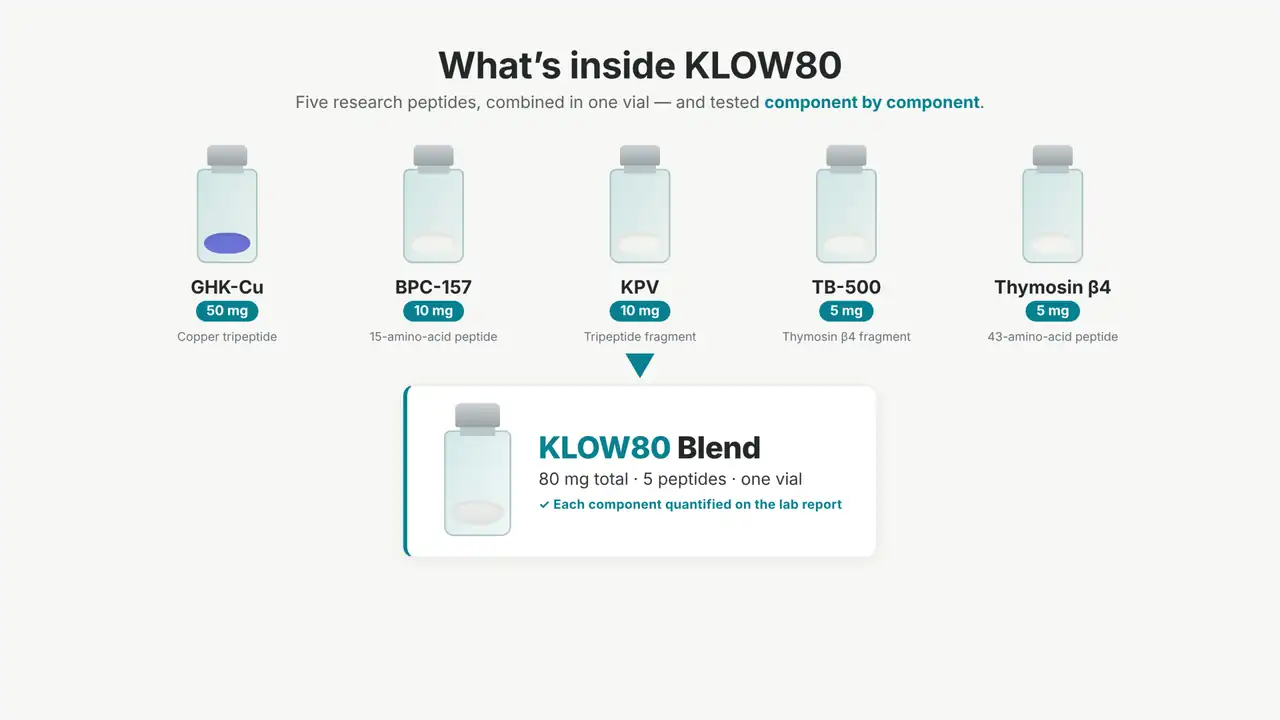
“TB-500” and “thymosin beta-4” are used as if they were the same thing, on product pages, in forums and even in a few papers. Chemically they are not. One is a 43-amino-acid protein; the other, as anti-doping chemists characterized it, is a seven-amino-acid piece of that protein with an extra chemical group on the end. This guide explains the difference, why it matters for anyone reading a label or a lab report, and how both show up, measured separately, in our KLOW80 blend.
- Thymosin beta-4 (Tβ4) is a full-length 43-amino-acid peptide, about 4,963 g/mol.
- TB-500, as identified in analytical studies, is Ac-LKKTETQ: residues 17 to 23 of Tβ4 with an acetyl group added, about 889 g/mol.
- The name TB-500 is also used loosely for the full protein, so the only reliable answer is a mass-spectrometry identity result on the lab report.
- By weight they are not equivalent: 5 mg of the fragment is about 5.6 times as many molecules as 5 mg of the full protein.
- Everything here is for laboratory research use only and is not medical advice.
Looking for TB-500 (thymosin beta-4) in Canada? The price, current lot and lab report are on our Thymosin Beta-4 (TB-500) 10mg page.
What thymosin beta-4 is
Thymosin beta-4 is a small protein found in most mammalian cells. It was first isolated from calf thymus, which gave it its name, and its 43-residue sequence was published in 1981. Inside cells its best-known job is binding actin, the protein that forms the cell’s internal scaffolding. Full-length Tβ4 has been studied in cell and animal models and has also been tested in human clinical trials, for example as eye-drop formulations.
What TB-500 is
TB-500 began as a product name rather than a chemical name. When anti-doping researchers analysed a product sold as TB-500, they did not find the full 43-residue protein. They found a seven-residue peptide, LKKTETQ, matching positions 17 to 23 of Tβ4, with an acetyl group on its starting end (Esposito et al., Drug Testing and Analysis). That stretch is the central actin-binding region of the full protein. The authors noted that the acetylation is artificial: inside the intact protein, the leucine at position 17 is not acetylated.
Since then, sellers have used “TB-500” for both the fragment and the full protein, which is the root of the confusion.
Side by side
| TB-500 (fragment) | Thymosin beta-4 | |
|---|---|---|
| Length | 7 amino acids | 43 amino acids |
| Sequence | Ac-LKKTETQ | Ac-SDKPDMAEIEKFDKSKLKKTETQEKNPLPSKETIEQEKQAGES |
| Molecular formula | C38H68N10O14 | C212H350N56O78S |
| Molar mass | About 889.0 g/mol | About 4,963 g/mol |
| CAS number | 885340-08-9 | 77591-33-4 |
| Relationship | Residues 17 to 23, acetylated | The complete peptide |
| Published research | Analytical, cell and animal studies | Cell and animal studies, plus human clinical trials |
Why the difference matters
Labels can mean two different molecules
A vial labelled “TB-500 10 mg” could contain the seven-residue fragment or the full protein, depending on the seller, and many vials sold as TB-500 turn out to be full-length thymosin beta-4 when a lab checks the mass. Neither is a fake; they are just different compounds. The honest fix is a label that names what is in the vial, backed by a report whose compound name and mass match it. If your research depends on which one you have, the label alone cannot tell you; the report can.
Milligrams are not molecules
Because the fragment is so much lighter, the same weight holds far more molecules. 5 mg of TB-500 is about 5.6 µmol; 5 mg of thymosin beta-4 is about 1.0 µmol. Any comparison between studies, or between products, has to account for that, which is why our concentration math guide works in both mg/mL and molar terms.
Prices are not comparable per mg
Synthesising a 43-residue peptide is much harder than a seven-residue one, so a fair price for full-length Tβ4 per milligram is not the same as for the fragment. Comparing “TB-500” prices only makes sense once you know which molecule each seller means.
How a lab tells them apart
Mass spectrometry separates the two with ease, because their masses differ by more than 4,000 Da. A result near 889 Da (or its charged forms, such as 445 for the doubly charged ion) points to the fragment; a result near 4,963 Da points to the full protein. HPLC purity alone cannot do this: it tells you how clean the main peak is, not which molecule the peak is. When you read a report for anything sold as TB-500, look for:
- An identity method such as LC-MS or LC-MS/MS, not HPLC alone.
- The molecule named as TB-500 fragment or thymosin beta-4, with a measured mass, and matching the label. A vial labelled as the fragment should show about 889 Da; a vial labelled thymosin beta-4 should show about 4,963 Da.
- A measured amount in mg, so you know what is in the vial rather than what was intended.
- A lot number and verify code you can check with the lab, as in our guide to verifying a peptide lab report.
Our Thymosin Beta-4 (TB-500) 10 mg vial
Our standalone 10 mg vial is a good example. It came to us as “TB-500”. When Peptide Test Canada tested lot ZB-BT10926 by HPLC-MS/MS on 18 November 2026, it identified the compound as full-length thymosin beta-4 (CAS 77591-33-4, 4,963.4 g/mol; the ion it measured, m/z 828.3, is the 6+ charge state of the 43-residue protein, not the 889 Da fragment). Purity was 99.6% and the vial held 10.16 mg against a 10 mg label.
So we label it for what it is: Thymosin Beta-4 (TB-500) 10 mg. The compound name and mass on the report match the label, and you can check the report yourself (report COA-2026-SC-05127, verify code PTC-RE4BXSYW).
Both in one vial: KLOW80
Most KLOW blends list 10 mg of “TB-500”. Our KLOW80 lists 5 mg of the TB-500 fragment and 5 mg of full-length thymosin beta-4, and the testing lab identified and measured each one separately:
| Component (lot ZB-KL800826) | Label | Measured | Purity |
|---|---|---|---|
| TB-500 | 5 mg | 4.79 mg | 99.52% |
| Thymosin beta-4 | 5 mg | 5.11 mg | 99.54% |
Tested by Peptide Test Canada by LC-MS/MS on 27 October 2026, report COA-2026-SC-04211, verify code PTC-64X7T4L9. The full five-component result is in the KLOW80 research overview, and KLOW vs GLOW vs Wolverine compares KLOW80 with the common blends. Lodge Peptides also sells full-length thymosin beta-4 on its own as Thymosin Beta-4 (TB-500) 10 mg (lot ZB-BT10926, confirmed by mass), and BPC-157 with TB-500 in the 20 mg Wolverine blend, whose lot is in for third-party testing now.
Regulatory status
Neither compound is an approved drug in Canada. Both appear on the World Anti-Doping Agency’s Prohibited List under peptide hormones, growth factors and related substances, and are banned at all times for athletes in tested sport. Products sold by Lodge Peptides are for laboratory research use only.
Frequently asked questions
Is TB-500 the same as thymosin beta-4?
No. Thymosin beta-4 is a 43-amino-acid peptide. TB-500, as characterized in analytical studies, is the acetylated seven-residue fragment Ac-LKKTETQ, residues 17 to 23 of thymosin beta-4. The name TB-500 is also used loosely for the full protein, so check the lab report.
What is the molecular weight of TB-500?
About 889.0 g/mol for the Ac-LKKTETQ fragment, compared with about 4,963 g/mol for full-length thymosin beta-4.
How can I tell which one is in my vial?
From a lab report with a mass-spectrometry identity result. A mass near 889 Da indicates the fragment and a mass near 4,963 Da indicates the full protein. HPLC purity alone cannot tell them apart.
Is 5 mg of TB-500 equal to 5 mg of thymosin beta-4?
Not in molecules. Because the fragment is about 5.6 times lighter, 5 mg of TB-500 is roughly 5.6 micromoles, while 5 mg of thymosin beta-4 is roughly 1.0 micromole.
Does KLOW80 contain TB-500 or thymosin beta-4?
Both. Lodge Peptides KLOW80 is labelled 5 mg TB-500 and 5 mg thymosin beta-4. Lot ZB-KL800826 measured 4.79 mg and 5.11 mg respectively.
Does Lodge Peptides sell TB-500 or thymosin beta-4 on its own?
Yes, as Thymosin Beta-4 (TB-500) 10 mg, sold as a single vial or a 10-pack. Peptide Test Canada confirmed lot ZB-BT10926 is full-length thymosin beta-4 (about 4,963 Da), so that is what the label says. KLOW80 contains both the TB-500 fragment and thymosin beta-4, each measured, and the Wolverine blend pairs BPC-157 with TB-500.
Sources and related guides
- Esposito et al.: synthesis and characterization of the acetylated 17-23 fragment of thymosin beta 4 identified in TB-500 (Drug Testing and Analysis)
- PubChem: TB-500 (CID 62707662)
- UniProt P62328: thymosin beta-4 (human)
- WADA Prohibited List
- KLOW80 blend explained
- How to read a peptide COA
- BPC-157 vs TB-500: how the two peptides differ
Products sold by Lodge Peptides are intended for laboratory research use only and are not for human or animal consumption. This article is for educational purposes and is not medical advice.
Email list
Get lot reports and guides in your inbox
New lot reports, research guides, restocks, and occasional offers from the Lodge Peptides team.