KPV is one of the smallest peptides sold for research: just three amino acids, lysine, proline and valine. It is best known as one of the five components of KLOW-type blends, but it is also studied on its own, mostly in cell and animal models of intestinal inflammation. This overview covers what KPV is, where it comes from, what the research has and has not shown, and what our current 10 mg lot tested at, including endotoxin.
- KPV is the tripeptide Lys-Pro-Val (C16H30N4O4, about 342.4 g/mol), the last three residues (11 to 13) of alpha-melanocyte-stimulating hormone (alpha-MSH).
- Research is preclinical: cell lines and mouse colitis models. Dalmasso and colleagues (2008) reported that KPV enters intestinal cells through the PepT1 transporter.
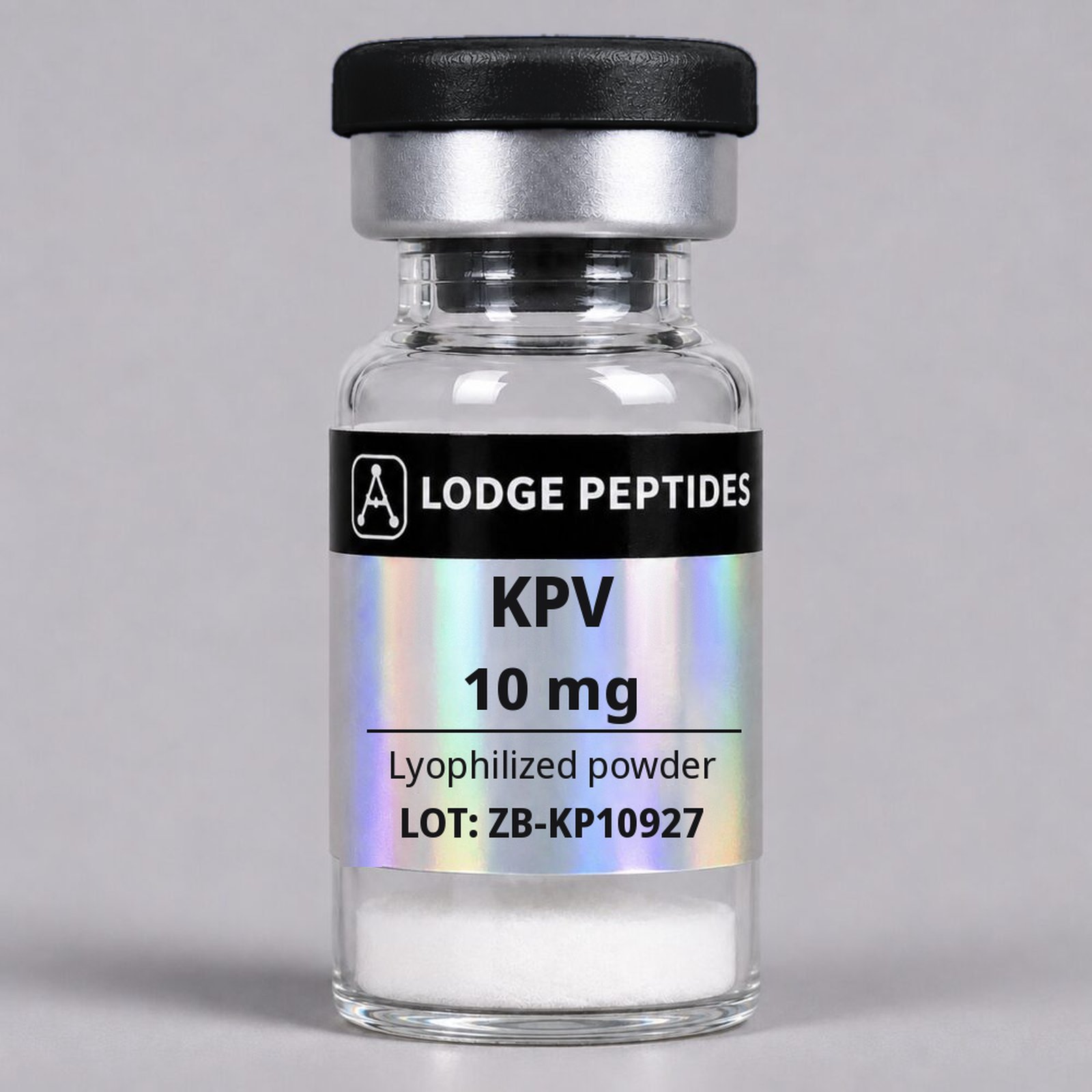
- It is one of the five peptides in KLOW80, and Lodge Peptides also sells it on its own as KPV 10 mg.
- Our lot ZB-KP10927 measured 12.67 mg at 99.9% purity, with endotoxin below 12.5 EU per vial, the lab’s limit of quantitation.
- Everything here is for laboratory research use only and is not medical advice.
Looking for KPV in Canada? The price, current lot and lab report are on our KPV 10mg page.
What KPV is
Alpha-MSH is a 13-amino-acid hormone cut from the larger precursor protein pro-opiomelanocortin. Its final three residues, lysine-proline-valine, form KPV. Researchers became interested in this fragment because it appeared to keep some of alpha-MSH’s anti-inflammatory activity in cell assays, while lacking the central His-Phe-Arg-Trp sequence that alpha-MSH uses to activate melanocortin receptors. In other words, KPV is not simply a shorter version of the hormone; it is studied as a distinct tool.
At about 342 g/mol, KPV is tiny next to most research peptides. A tripeptide like this is quick to make, but the same lab checks apply: identity, purity and the amount in the vial. Our peptide glossary explains the terms.
What the research has looked at
Most of the published work is in intestinal models. In Gastroenterology (2008), Dalmasso and colleagues showed that KPV is carried into human intestinal epithelial cells and T cells by PepT1, a transporter for di- and tripeptides, and that nanomolar concentrations reduced NF-kB and MAP kinase signalling and inflammatory cytokine release in those cells. The same paper reported reduced inflammation in two mouse colitis models. Kannengiesser and colleagues reported similar findings in murine colitis in Inflammatory Bowel Diseases (2008).
That is the extent of it: cell lines and animal models. There are no approved medicines containing KPV, and well-controlled human studies have not been published. Treat any claim beyond the preclinical evidence with caution.
KPV and KLOW blends
KPV is the “K” that separates KLOW from GLOW: a typical KLOW vial adds KPV to GHK-Cu, BPC-157 and TB-500. Our KLOW80 carries 10 mg of KPV in each vial, and its lab report measures every component on its own. Our guide KLOW vs GLOW vs Wolverine lays the blends side by side, and mixing peptides in one solution covers what changes when peptides share a vial. A single-compound vial such as KPV 10 mg keeps research on KPV alone clean.
What our current lot tested at
| Lot | ZB-KP10927 |
| Testing lab | Peptide Test Canada (SideChain Analytics) |
| Method | HPLC-MS/MS |
| Purity | 99.9% |
| Measured content | 12.67 mg (10 mg label, 126.7%) |
| Endotoxin | Below 12.5 EU per vial (below the limit of quantitation), kinetic chromogenic LAL, USP <85> |
| Date tested | 16 November 2026 |
| Reports | COA-2026-SC-05124 (verify code PTC-ZR97QXPW) and COA-2026-SC-05124-EN (verify code PTC-NESY96HT) |
The vial holds noticeably more than its label. That is good value at $40 a vial, about $3.16 per measured milligram, but it also changes your concentration arithmetic. You can check both reports on the lab’s site with the verify codes above; our guide to verifying a lab report shows how. Every lot is listed in the COA library and the lab results roundup.
Handling a 10 mg vial
KPV is supplied as a lyophilized powder. The water you add sets the concentration: with 2 mL, a 10 mg label is 5 mg/mL, or about 6.34 mg/mL using the measured 12.67 mg. Enter the measured amount in the peptide calculator to work in syringe units. See how to reconstitute lyophilized peptides for the method and how to store lyophilized peptides for storage.
Frequently asked questions
What is KPV?
A tripeptide, lysine-proline-valine, matching the last three amino acids of alpha-melanocyte-stimulating hormone. It is studied in cell and animal models, mainly of intestinal inflammation.
Is KPV the same as alpha-MSH?
No. KPV is only residues 11 to 13 of the 13-residue hormone. It lacks the His-Phe-Arg-Trp core alpha-MSH uses to activate melanocortin receptors, so it is studied as a separate tool.
Has KPV been studied in humans?
Published work is preclinical: cell lines and mouse colitis models. There are no approved medicines containing KPV.
What did the Lodge Peptides KPV lot test at?
Lot ZB-KP10927 measured 12.67 mg against a 10 mg label at 99.9% purity, with endotoxin below 12.5 EU per vial. It was tested by Peptide Test Canada on 16 November 2026.
How is KPV related to KLOW?
KPV is the component that turns GLOW into KLOW. Our KLOW80 blend carries 10 mg of KPV per vial, measured separately on its lab report. KPV 10 mg is also sold on its own.
Does Lodge Peptides ship KPV within Canada?
Yes. Every order ships from within Canada by Canada Post, $20 flat or free over $150. Orders placed by 12 pm Pacific time, Monday to Friday, ship the same day.
Related guides
- KLOW80 blend explained
- KLOW vs GLOW vs Wolverine
- Mixing peptides in one solution
- How to read a peptide COA
- Lab results roundup
Sources
- Dalmasso G, et al. PepT1-mediated tripeptide KPV uptake reduces intestinal inflammation. Gastroenterology. 2008;134(1):166-178. PubMed 18061177
- Kannengiesser K, et al. Melanocortin-derived tripeptide KPV has anti-inflammatory potential in murine models of inflammatory bowel disease. Inflamm Bowel Dis. 2008;14(3):324-331.
- Brzoska T, et al. Alpha-melanocyte-stimulating hormone and related tripeptides: biochemistry, antiinflammatory and protective effects in vitro and in vivo, and future perspectives for the treatment of immune-mediated inflammatory diseases. Endocr Rev. 2008;29(5):581-602.
Products sold by Lodge Peptides are intended for laboratory research use only and are not for human or animal consumption. This article is for educational purposes and is not medical advice.
Email list
Get lot reports and guides in your inbox
New lot reports, research guides, restocks, and occasional offers from the Lodge Peptides team.