KLOW80 is a research blend that combines five peptides in one lyophilized vial: GHK-Cu, BPC-157, KPV, TB-500 and thymosin beta-4. A blend is harder to verify than a single compound, so this guide covers what each component is, what the label means, and how third-party testing should be read. It is for laboratory research context only.
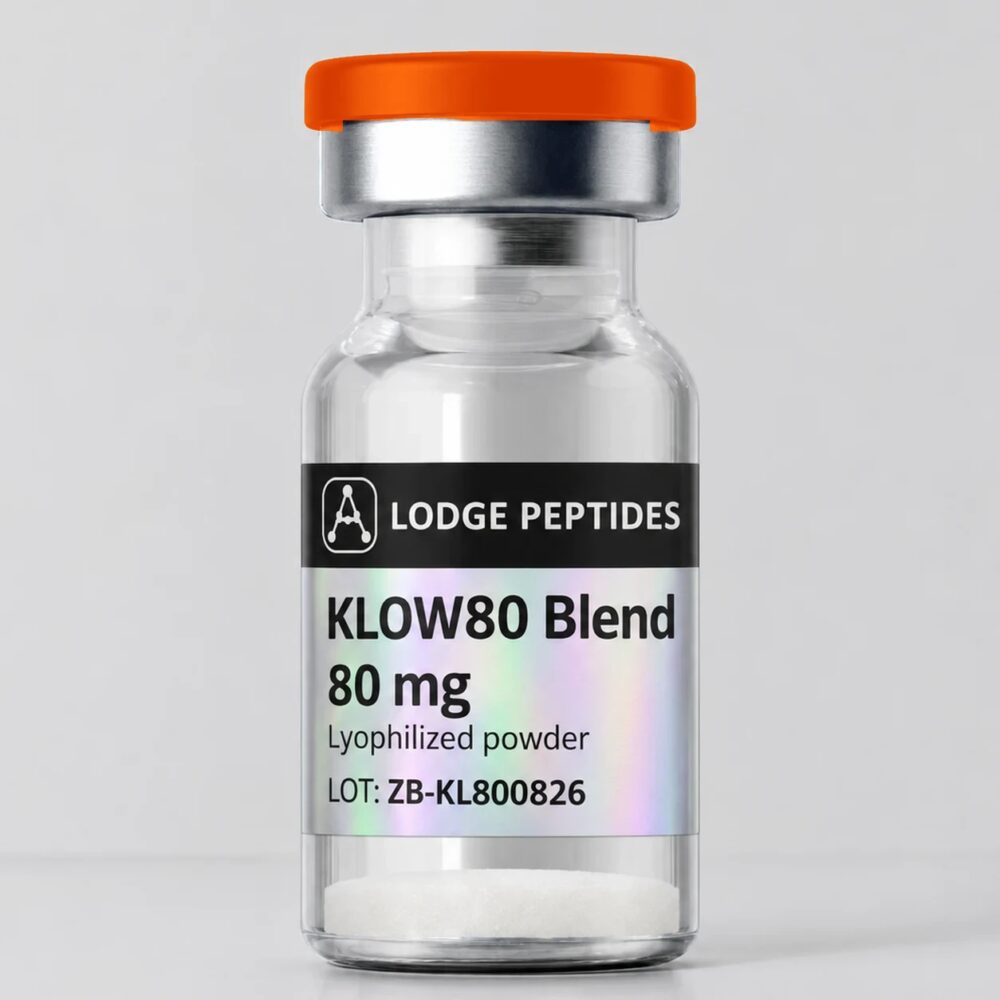
- Each vial is labelled 80 mg total: 50 mg GHK-Cu, 10 mg BPC-157, 10 mg KPV, 5 mg TB-500 and 5 mg thymosin beta-4.
- A blend report should show every component, not only a single total purity figure.
- Lot ZB-KL800826 was tested by Peptide Test Canada using LC-MS/MS; the report is on the product page and in the lab results library.
- Sold by Lodge Peptides for in vitro laboratory research only.
Looking for KLOW80 in Canada? The price, current lot and lab report are on our KLOW80 Blend page.
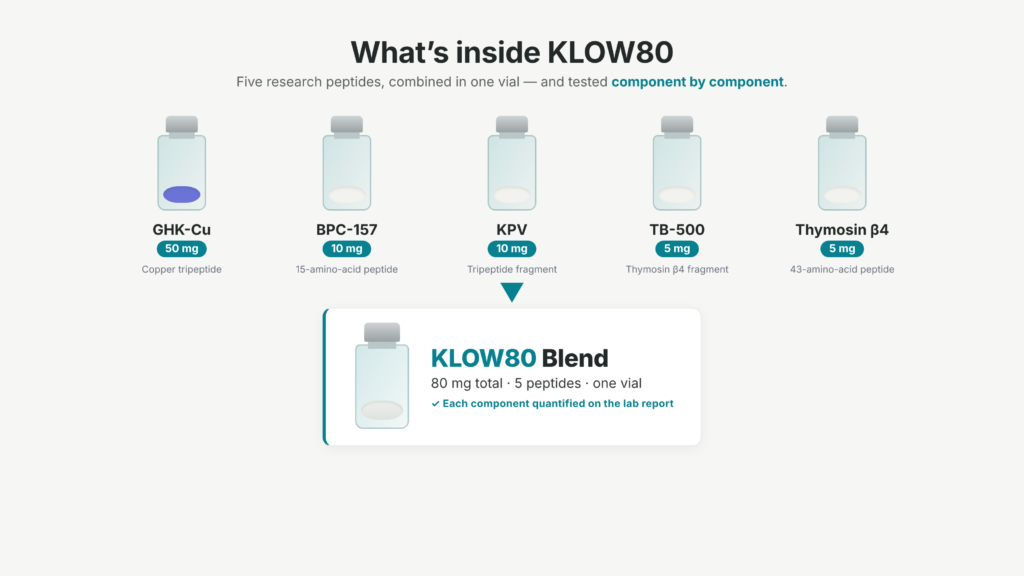
The five components
- GHK-Cu: a copper-binding tripeptide (glycyl-L-histidyl-L-lysine). See the GHK-Cu overview.
- BPC-157: a 15-amino-acid peptide whose sequence derives from a protein found in gastric juice.
- KPV: the tripeptide Lys-Pro-Val, taken from the C-terminal end of alpha-MSH.
- TB-500: a synthetic fragment related to thymosin beta-4.
- Thymosin beta-4: the full-length 43-amino-acid peptide that TB-500 is related to.
All five are studied individually in laboratory settings. Lodge Peptides supplies them together as a blend for convenience in research workflows.
Reading the label
The label states a total of 80 mg per vial and the split by component. The split is a labelled composition, so the matching question for any report is whether each component was identified and quantified against that label. Total weight alone does not tell you how much of each peptide is present. For background, see purity vs net peptide content.
How a blend is tested
Single-compound HPLC purity is not enough for a five-component blend, because the components elute at different times and must be told apart. Mass spectrometry is used to confirm identity, and LC-MS/MS is well suited to blends because each compound has its own characteristic signals. Our KLOW80 product page shows the Peptide Test Canada result for lot ZB-KL800826, with the report number and a code to verify it with the lab. The general reading skills are in how to read a peptide COA.
What the lab found in our KLOW80 lot
To make this concrete, here are the third-party results for our current lot, ZB-KL800826, tested by Peptide Test Canada (SideChain Analytics) by LC-MS/MS on 27 October 2026 (report COA-2026-SC-04211, verification code PTC-BH32X57J). Each component was identified and measured separately, which is exactly what a blend report should do.
| Component | Label | Measured | % of label | Purity |
|---|---|---|---|---|
| GHK-Cu | 50 mg | 61.42 mg | 123% | 98.81% |
| BPC-157 | 10 mg | 11.97 mg | 120% | 99.59% |
| KPV | 10 mg | 11.82 mg | 118% | 99.59% |
| TB-500 | 5 mg | 4.79 mg | 96% | 99.52% |
| Thymosin beta-4 | 5 mg | 5.11 mg | 102% | 99.54% |
| Total | 80 mg | 95.12 mg | 119% | ≥98.8% (lowest) |
A few things stand out:
- The label's 10 mg of TB-500 is split into 5 mg of the TB-500 fragment and 5 mg of full-length thymosin beta-4, and the lab quantified both. That is why the report lists five peptides for an “80 mg” four-name blend.
- Four of five components came in at or above label, and the vial holds 95.12 mg in total. TB-500 measured 4.79 mg, or 96% of its 5 mg label, which is within the normal range of fill variation.
- Every component was at least 98.8% pure, with four of five above 99.5%.
- Overfill is not the same as extra value in every case. When a component is well above label, as GHK-Cu is here, it changes the ratio between components. If your work depends on exact ratios, use the measured amounts, not the label, in your calculations.
You can open the full report and verify it from the KLOW80 product page or the lab results library.
Storage and handling
Store sealed vials refrigerated and protected from light and moisture. See storing lyophilized peptides and reconstituting lyophilized peptides for laboratory handling basics.
Frequently asked questions
What is in KLOW80?
Five peptides: GHK-Cu, BPC-157, KPV, TB-500 and thymosin beta-4, labelled at 80 mg total per vial.
How much of each component is in a vial?
The label states 50 mg GHK-Cu, 10 mg each of BPC-157 and KPV, and 5 mg each of TB-500 and thymosin beta-4.
Is there a lab report for KLOW80?
Yes. Peptide Test Canada tested lot ZB-KL800826. The result is on the product page and in the lab results library.
Why is a blend harder to test than a single peptide?
Several compounds must be separated, identified and quantified in the same sample, which is why LC-MS/MS is commonly used.
Is KLOW80 for human use?
No. It is sold for in vitro laboratory research only and is not for human or veterinary use.
- KLOW80 blend research vial
- GHK-Cu research overview
- How to read a peptide COA
- Peptide purity vs net peptide content
- How to store lyophilized peptides
- How to reconstitute lyophilized peptides
- Peptide glossary
- Lab results library
- KLOW vs GLOW vs Wolverine: what is in each blend
- TB-500 vs thymosin beta-4: are they the same?
- BPC-157 vs TB-500: how the two peptides differ
How long does reconstituted KLOW80 last?
There is no published stability data for this five-peptide blend once it is dissolved. The common convention for multi-dose solutions is to discard them 28 days after first use, kept at 2 to 8 °C. Two months is well past that, and a mixed vial that has been punctured many times also carries more contamination risk. GHK-Cu gives the solution its blue colour, so a change in colour, cloudiness or particles is a clear reason to discard it. See how to store peptides.
Sources and further reading
- KPV peptide: a research overview
- Lodge Peptides lab results library
- Pickart and Margolina 2018, GHK-Cu (PubMed)
Products sold by Lodge Peptides are intended for laboratory research use only and are not for human or animal consumption. This article is general educational information, not medical or legal advice.
Email list
Get lot reports and guides in your inbox
New lot reports, research guides, restocks, and occasional offers from the Lodge Peptides team.