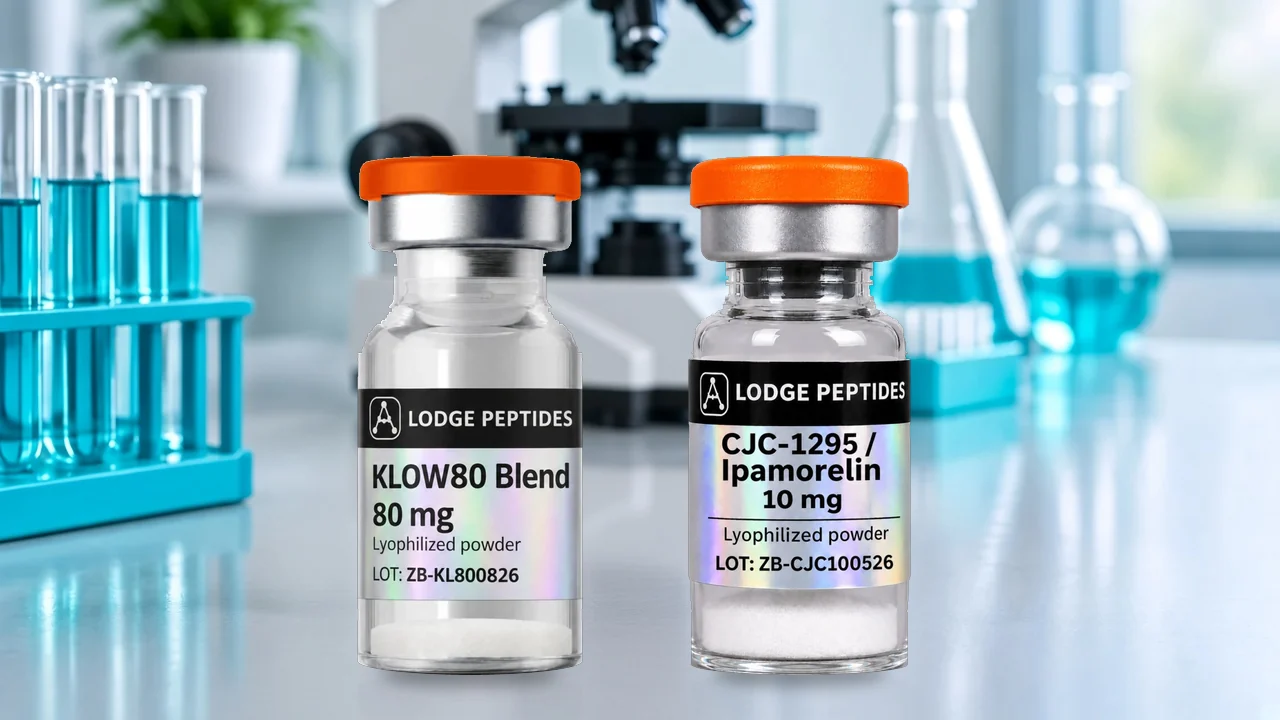
Putting two or more peptides in the same vial, syringe or pen cartridge saves time and needles, and some blends are sold that way. But a mixture is a new solution with its own chemistry. Some peptides sit happily together; others react, cloud up or break down faster. This guide explains what decides whether peptides can share a solution, which blends are common, and why so little hard stability data exists.
- Peptides can share a solution only if they dissolve in the same diluent at the same pH. A peptide that needs a different solvent or pH does not belong in the mix.
- GHK-Cu carries copper, and copper is a known catalyst for oxidizing other peptides. Treat any copper-containing blend as the most fragile kind of mixture.
- Mixing starts the clock. A mixed solution has at most the shelf life of its least stable ingredient, and usually less.
- For almost every home-made combination, there is no published stability data. A pre-made blend with a lab report for each component is the only kind you can verify.
- Mixing changes the math: every peptide is diluted by the total volume. Our peptide calculator has a blend breakdown that shows each peptide per draw.
Pre-paired vials and multi-peptide blends are on our peptide stacks and blends page.
Common peptide blends
These are the blends most often sold pre-mixed as a single lyophilized vial. Freeze-drying them together means they only meet in solution once the vial is reconstituted.
| Blend | Components | Notes |
|---|---|---|
| CJC-1295 / Ipamorelin | CJC-1295 (no DAC) and ipamorelin | Two short peptides with no metal; one of the most widely sold pairings. Ours is CP10. |
| BPC-157 / TB-500 | BPC-157 and TB-500 | A common two-peptide pairing, sold pre-blended by many suppliers. Ours is the Wolverine blend. |
| GLOW | GHK-Cu, BPC-157 and TB-500 | Contains copper (see below). |
| KLOW | GHK-Cu, KPV, BPC-157 and TB-500 (some versions add thymosin β4) | Contains copper. Our KLOW80 is tested per component. |
A blend being popular is not the same as a blend having stability data. Most suppliers test purity of the powder, not how the mixture behaves after reconstitution.
What decides whether peptides can be mixed
1. They need the same diluent
Most research peptides dissolve in bacteriostatic water. Some, especially very hydrophobic ones, need a little dilute acetic acid or another solvent first. If two peptides need different solvents, the one that does not suit the shared diluent may never dissolve fully, or may come out of solution later. Check the solubility guide for each peptide before mixing.
2. They need to tolerate the same pH
Every peptide has an isoelectric point, the pH at which it carries no net charge and is least soluble. Mix a peptide into a solution whose pH sits near its isoelectric point and it can cloud or precipitate. Many peptides also degrade faster at the wrong pH, through reactions such as deamidation.
A clear real-world example is insulin glargine. It is formulated at about pH 4, and its prescribing information states it must not be diluted or mixed with any other insulin or solution, because the mixture may turn cloudy and behave unpredictably. Approved drugs that cannot be mixed are a good reminder that “it is all just peptide in water” is not true.
3. They must not react with each other
Peptides in the same solution can interact. The main known risk is oxidation driven by trace metals, covered next. Others include aggregation (molecules clumping together) and adsorption, where one peptide coats the vial or cartridge and changes how much is actually in solution.
The GHK-Cu question
GHK-Cu is the tripeptide GHK bound to a copper ion, which is why it is blue. Copper is the reason it is studied, and also the reason it is the most cautious ingredient to mix.
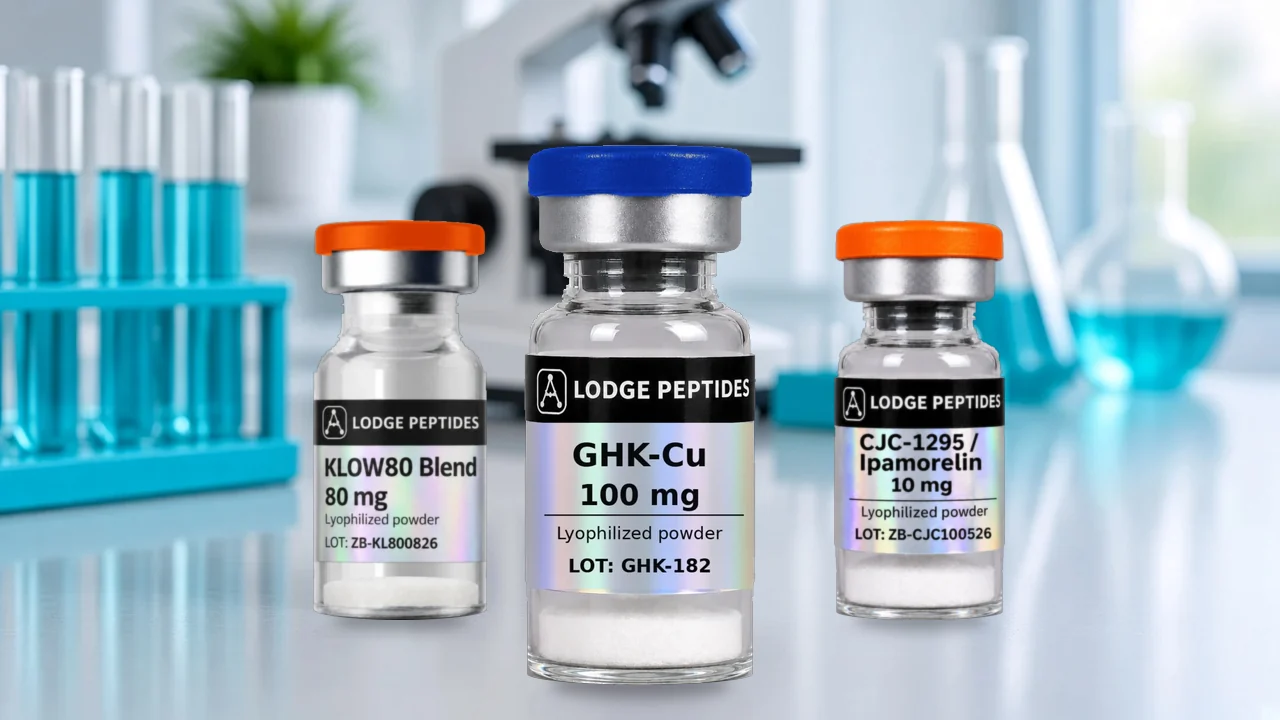
Copper and iron are well known in drug formulation for catalyzing the oxidation of proteins and peptides. They cycle between charge states and generate reactive oxygen species, which attack vulnerable amino acids such as methionine, histidine, cysteine, tryptophan and tyrosine. Formulators take this seriously at very low levels: in one accelerated study, adding just 1 part per million of copper to a protein formulation stored at 40 °C raised the level of aggregated protein from about 10% to about 24% over eight weeks, while a metal chelator kept it under 5%.
A GHK-Cu blend contains far more copper than that, though most of it is held by the GHK molecule rather than floating free. Bound copper is much less reactive, but how much stability is lost in a specific blend, at a specific concentration, over a specific number of weeks, has not been published for blends like GLOW or KLOW. Sensible conclusions:
- Do not add GHK-Cu to a vial of another peptide yourself. If you want a copper blend, use one that was made as a blend and tested per component.
- Once a copper blend is reconstituted, keep it cold, dark, and use it well within the usual window.
- A blue tint is normal for GHK-Cu. A change in color, cloudiness or particles is not.
Bacteriostatic water and the preservative
Bacteriostatic water contains 0.9% benzyl alcohol, which slows bacterial growth in a multi-dose vial. Preservatives like benzyl alcohol, phenol and m-cresol can push some proteins to aggregate. In one study on the protein interferon alpha-2a, 0.9% benzyl alcohol caused all of the protein to aggregate within eight hours at 50 °C, while 0.3% had only a small effect.
That was a large protein under heat stress, and short peptides generally tolerate the preservative well. A useful reference point: the approved multi-dose tirzepatide pens and vials themselves contain 9 mg/mL of benzyl alcohol, the same concentration as bacteriostatic water. Still, the general point holds. Every extra ingredient in a solution is another variable, and a mixture multiplies them. See bacteriostatic vs sterile water for more.
Shelf life once mixed
Lyophilized powder is the most stable form of a peptide. Once it is dissolved, hydrolysis, oxidation and other reactions start, and once two peptides share a vial, the mixture can be no more stable than its weakest member. In practice:
- Date the vial the day you mix it and store it at 2 to 8 °C, protected from light. Never freeze a reconstituted solution.
- For punctured multi-dose containers, a widely used convention is to discard them 28 days after first use unless there is data for longer. Mixed solutions deserve the same caution or more.
- Mix only what you will use within that window. A small batch mixed fresh beats a large batch that sits.
Our storage guide and degradation guide explain the chemistry behind this.
Mixing into a syringe or pen cartridge
Drawing two peptides into the same syringe just before use is a very short exposure, so slow reactions such as oxidation have little time to matter. The risks there are practical: a cloudy result means the two do not belong together, and you have to keep track of how much of each you drew.
A pen cartridge is different. It holds the mixture for days or weeks, so everything in the shelf-life section applies in full. Fill a cartridge only with a mixture you would be comfortable keeping in a vial for that long, label it with contents, concentrations and date, and keep it refrigerated. Pens and cartridges are single-person devices. See peptide pens vs vials for how reusable pens work.
Blend math
In a mixture, each peptide is spread over the total volume of liquid. If a vial holds 10 mg of one peptide and 5 mg of another in 2 mL, the first is at 5 mg/mL and the second at 2.5 mg/mL, and every draw contains both in that 2:1 ratio. You cannot change the ratio after mixing.
The peptide calculator does this for you. Pick KLOW80, CP10 or a custom blend under “Blend breakdown” to see each peptide’s amount in a draw. Enter a Lodge Peptides lot code and it uses the lab-measured amount of each component instead of the label split, which matters because blends often test above or below label for individual peptides. Our lab results roundup shows this per component.
A quick compatibility checklist
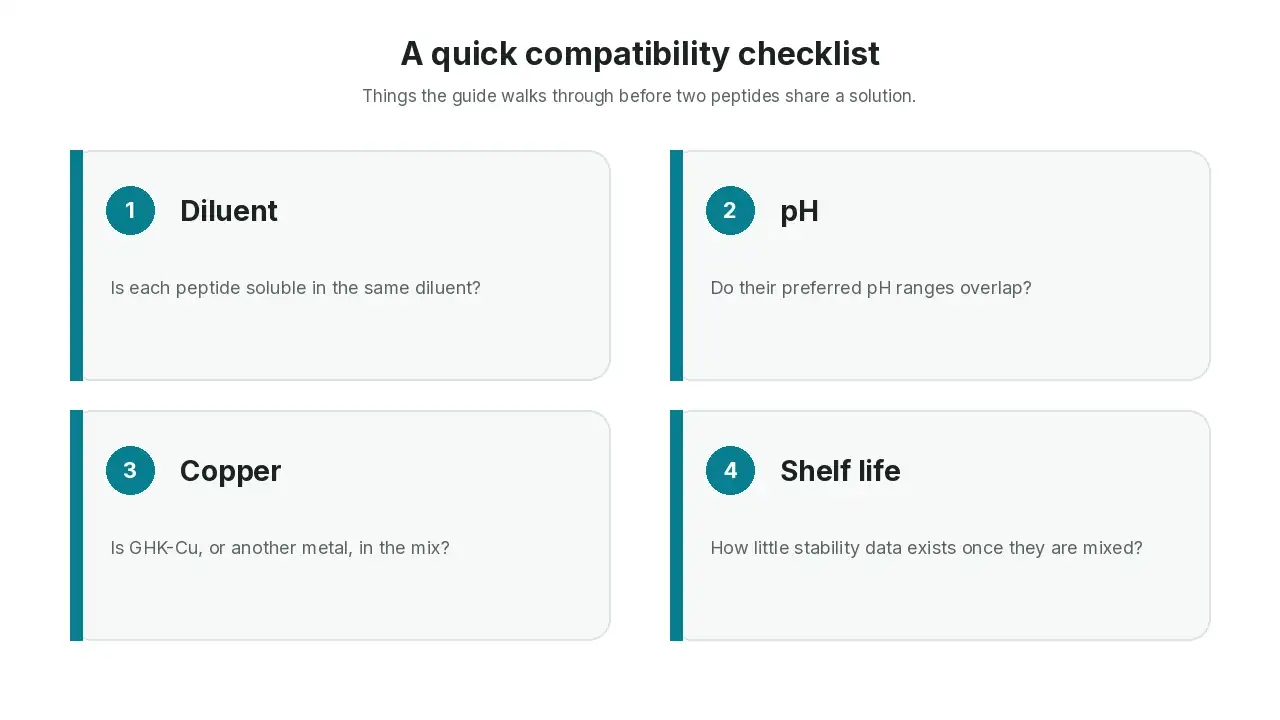
| Question | If yes | If no |
|---|---|---|
| Do they dissolve in the same diluent? | Continue | Do not mix |
| Is either one formulated at an unusual pH or in acid? | Do not mix | Continue |
| Does either contain copper or another metal (such as GHK-Cu)? | Use a pre-made, tested blend only | Continue |
| Is there stability data or a lab report for this exact blend? | Best case | Mix small batches, use quickly |
| Does the mixture stay clear and colorless (or the expected blue for GHK-Cu)? | Continue | Discard |
Frequently asked questions
Can you mix peptides in the same vial?
Some can. They need to dissolve in the same diluent, tolerate the same pH and not react with each other. Even then, the mixture is only as stable as its least stable peptide, and for most combinations no stability data has been published.
Can you mix BPC-157 and TB-500 together?
They are commonly sold as a pre-mixed blend and both dissolve in bacteriostatic water. As with any mixture, stability data for the combined solution is limited, so mix only what you will use within the usual window and keep it refrigerated.
Can GHK-Cu be mixed with other peptides?
It is the most cautious case. GHK-Cu contains copper, and copper can catalyze oxidation of other peptides. It is sold in blends such as GLOW and KLOW, but adding it to another peptide yourself is not recommended. Use a blend that was made and tested as a blend.
Does mixing peptides make them degrade faster?
It can. A mixture adds new interactions, such as metal-catalyzed oxidation or aggregation, and it can never be more stable than its weakest component. Mix small amounts, date them, refrigerate them and use them promptly.
Can I put two peptides in one pen cartridge?
Only if you would be comfortable keeping that mixture in a vial for the same length of time, because the cartridge holds it for days or weeks. Label it with contents, concentrations and the mix date, and keep it at 2 to 8 °C.
How do I calculate amounts in a peptide blend?
Each peptide is diluted by the total volume, so its concentration is its mg divided by the mL of water. Our peptide calculator has a blend breakdown that shows each peptide’s amount per draw, and can use lab-measured amounts for Lodge Peptides lots.
Why is my peptide blend blue?
If it contains GHK-Cu, the blue color comes from the copper and is normal. A change in color, cloudiness or particles is a sign the solution should be discarded.
Sources and further reading
- Lantus (insulin glargine) prescribing information: pH about 4, must not be mixed or diluted
- BioPharm International: implications of trace levels of redox-active metals in drug formulation (2014)
- Antimicrobial preservatives, including benzyl alcohol, and protein aggregation (interferon alpha-2a)
- Zepbound (tirzepatide) multi-dose formulation: benzyl alcohol 9 mg/mL
- Peptide solubility: what affects it and why
- How to reconstitute lyophilized peptides
- KLOW vs GLOW vs Wolverine: what is in each blend
- TB-500 vs thymosin beta-4: are they the same?
Products sold by Lodge Peptides are intended for laboratory research use only and are not for human or animal consumption. This article is general educational information about laboratory technique, not medical advice.
Email list
Get lot reports and guides in your inbox
New lot reports, research guides, restocks, and occasional offers from the Lodge Peptides team.