CJC-1295 and ipamorelin are two research peptides that are often studied together. This overview explains what each one is, which receptor each acts on, why researchers pair them and what to look for when you read a certificate of analysis for a blend. It is general laboratory information, not medical advice.
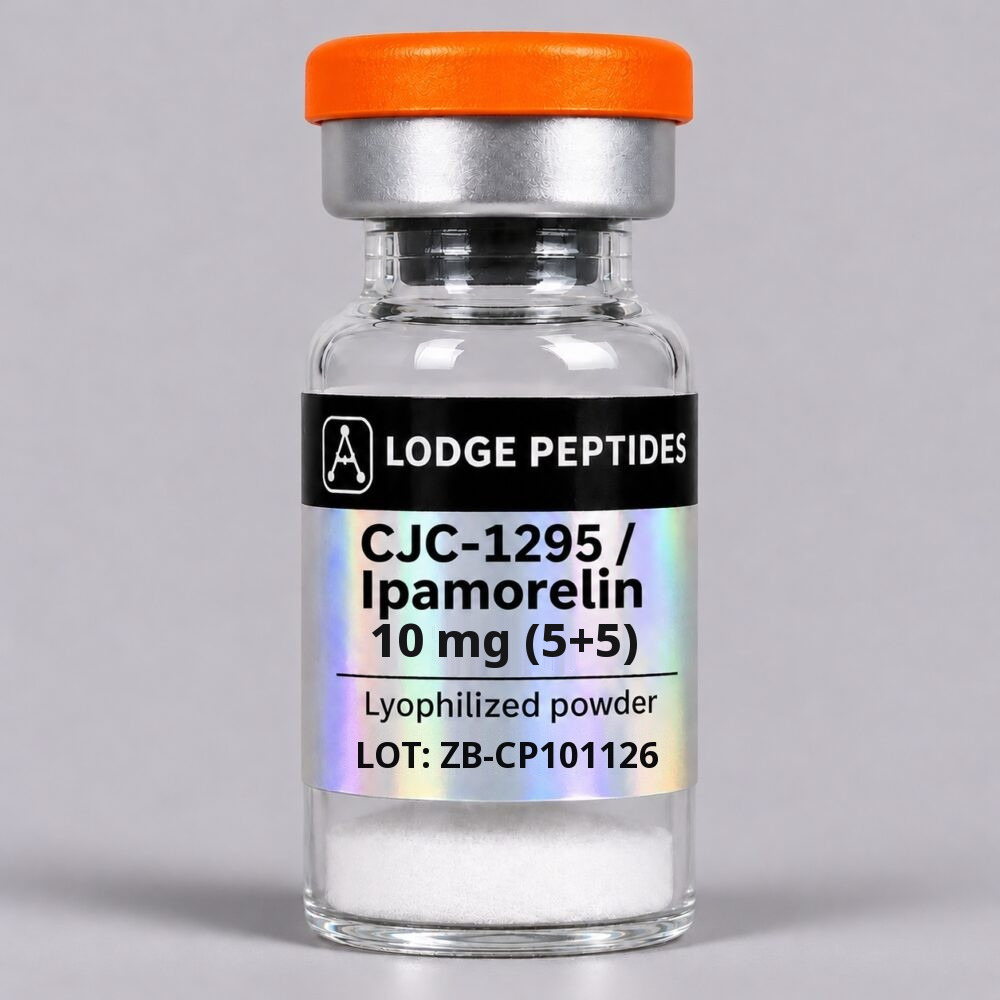
- CP10 is shorthand for a 10 mg vial blending 5 mg CJC-1295 (no DAC) and 5 mg ipamorelin.
- CJC-1295 (no DAC) is a growth hormone-releasing hormone (GHRH) analogue of 29 amino acids.
- Ipamorelin is a short peptide that acts on the ghrelin receptor (GHS-R).
- They act on different receptors, which is why researchers study them together.
- Neither is an approved medication in Canada. Lodge Peptides sells them for laboratory research only.
Looking for CJC-1295 / ipamorelin in Canada? The price, current lot and lab report are on our CJC-1295 / Ipamorelin Blend (CP10) page.
What is CP10?
CP10 is shorthand for a 10 mg vial that blends two peptides: 5 mg CJC-1295 (no DAC) and 5 mg ipamorelin. CJC-1295 without DAC is also called Mod GRF 1-29. The “10” is the total milligrams on the label, not a different compound.
- Not the same as CJC-1295 with DAC. The DAC version carries an extra chemical group that makes it last much longer. CP10 uses the no-DAC version, so check which one a seller means.
- Is it approved? No. Neither peptide is an approved medication in Canada, so any vial labelled CP10 is research material.
- Why the lab report matters more for a blend: a good report measures each peptide separately, not just the total, so you know both are present in the stated amounts.
Our CP10 blend lot ZB-CP101126 was tested by LC-MS/MS: CJC-1295 (no DAC) 6.36 mg at 99.82% purity and ipamorelin 6.54 mg at 99.84%, 12.90 mg in total. Because the vial holds more than its 10 mg label, our calculator can use the measured amount instead.
What each peptide is
CJC-1295 without DAC, also called modified GRF (1-29), is a synthetic analogue of the first 29 amino acids of growth hormone-releasing hormone. Ipamorelin is a synthetic pentapeptide, five amino acids long, that was designed to act as an agonist of the ghrelin receptor, also called the growth hormone secretagogue receptor. Tesamorelin is a different GHRH analogue (the full 44-residue sequence with a hexenoyl group). Our Tesamorelin vs CJC-1295/Ipamorelin guide compares the two.
Two receptor pathways
GHRH and ghrelin signal through different receptors on pituitary cells. That difference is the reason the two peptides are discussed together in the research literature: each engages its own pathway, and researchers compare and combine them to study how the pathways relate.
Where they sit regulatorily
Both are investigational compounds and neither is an approved medication in Canada. For current information, read the original papers and check the regulator and trial registries instead of relying on summaries.
What a blend report should show
A blend contains more than one peptide, so a good lab report lists each component separately, with its own purity and measured content, not a single combined figure. Our CJC-1295 / Ipamorelin Blend (CP10) has a third-party report in the COA library that lists both peptides. Our guide to reading a peptide COA explains the terms, and purity vs net peptide content explains the two main numbers.
Handling and storage
Freeze-dried blends are handled like other lyophilized peptides. See how to reconstitute lyophilized peptides and how to store lyophilized peptides, and use the reconstitution calculator for concentration maths.
What our current blend tested at
Our CJC-1295 (no DAC) and ipamorelin blend, lot ZB-CP101126, was tested by Peptide Test Canada on 28 October 2026 by LC-MS/MS. Report COA-2026-SC-04213, verification code PTC-DQJB3GA5.
- Purity: 99.8% or higher for both peptides
- Measured content: 12.90 mg total against a 10 mg label, or 129% of label
A blend is harder to test than a single peptide, because the lab has to identify and measure each component separately. That is why we look for a result for both peptides, not one combined purity figure. Each result can be checked with the lab; see how to verify a peptide lab report.
Frequently asked questions
What is CP10 peptide?
CP10 is shorthand for a 10 mg research vial that blends 5 mg CJC-1295 without DAC (also called Mod GRF 1-29) and 5 mg ipamorelin.
Is CP10 the same as CJC-1295 with DAC?
No. CP10 uses CJC-1295 without DAC. The DAC version has an added chemical group that makes it last much longer, so the two are different research compounds.
Are CJC-1295 and ipamorelin the same thing?
No. CJC-1295 is a GHRH analogue acting on the GHRH receptor. Ipamorelin acts on the ghrelin receptor. They are different peptides with different structures and targets.
What does no DAC mean?
DAC stands for drug affinity complex, a modification that extends how long a peptide lasts. CJC-1295 without DAC, also known as modified GRF (1-29), does not include it.
Are they approved medications in Canada?
No. Both are investigational compounds and are not approved medications in Canada. Lodge Peptides sells them for laboratory research use only.
What should I look for in a blend certificate of analysis?
Each component should have its own purity and measured content, the lot number should match your vial, and the report should name the lab and method.
Sources and further reading
- Tesamorelin vs CJC-1295/Ipamorelin: How They Differ
- Where to buy tesamorelin in Canada, another GHRH analogue
- Where to buy CJC-1295 / ipamorelin (CP10) in Canada
- Ipamorelin (overview)
- CJC-1295 (overview)
- Growth hormone secretagogue receptor (overview)
Products sold by Lodge Peptides are intended for laboratory research use only and are not for human or animal consumption. This article is general educational information, not medical or legal advice.
Email list
Get lot reports and guides in your inbox
New lot reports, research guides, restocks, and occasional offers from the Lodge Peptides team.