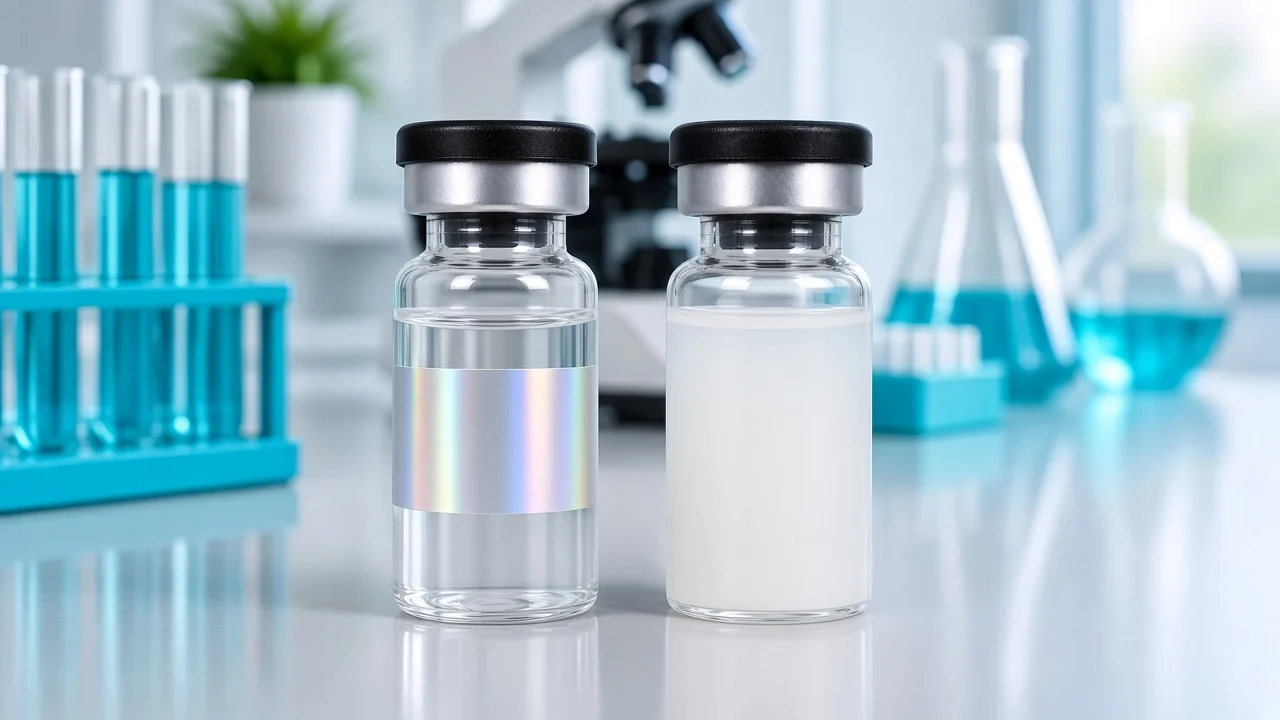
You add bacteriostatic water to a vial, and instead of a clear liquid you get haze, foam or floating specks. Is it ruined, or does it just need time? This guide explains what a properly reconstituted peptide should look like, the common reasons a vial turns cloudy, what to do in the first half hour, and when to stop and contact your supplier.
- Most reconstituted peptides should be clear and colourless, like water. GHK-Cu is the main exception: it is naturally blue.
- Bubbles, foam and a light haze straight after mixing are common and often clear within 15 to 30 minutes of resting.
- Cloudiness that does not clear, or visible specks, flakes or strings, means the vial should not be used for research. Contact the seller.
- The most common cause is mixing too hard. Larger peptides such as growth hormone clump (aggregate) when shaken.
- A syringe filter makes a cloudy vial look clearer, but it does not remove endotoxin or small clumps, so it is not a fix.
What a reconstituted peptide should look like
A well-made, fully dissolved peptide solution is normally clear and colourless. Drug labels for injectable peptide medicines say the same thing in plain terms. The US label for the growth hormone product Humatrope, for example, says the solution should be clear, and that if it is cloudy or contains particles it must not be used. That is a good standard for research material too.
| What you see | Likely meaning | What to do |
|---|---|---|
| Clear and colourless | Fully dissolved | Normal. Store as directed. |
| Bubbles or foam on top | Air mixed in while adding water | Let it rest. Foam settles in minutes. |
| Light haze right after mixing | Not fully dissolved yet | Rest 15 to 30 minutes, then roll gently. |
| Haze that stays after resting | Clumping (aggregation), wrong diluent or poor material | Do not use. Contact the seller. |
| Specks, flakes or strings | Particles, aggregates or contamination | Do not use. Contact the seller. |
| Yellow or brown tint | Degradation or contamination | Do not use. Contact the seller. |
| Blue (GHK-Cu only) | The copper in GHK-Cu | Normal for GHK-Cu. |
Why peptides go cloudy
- Mixing too hard. Shaking the vial, or squirting the water straight onto the powder, can make peptide molecules unfold and stick together. Larger peptides and proteins such as growth hormone are especially prone to this, which is why their labels say not to shake. Once clumped, they usually do not dissolve again.
- It has not dissolved yet. Some peptides take several minutes, sometimes longer, to dissolve fully. Peptides with fatty acid side chains, such as tirzepatide and semaglutide, are more water-repellent and can be slower.
- Cold vial or cold water. Powder and water straight from the fridge dissolve more slowly. Bachem, a large peptide manufacturer, recommends letting a sealed vial reach room temperature before opening, so moisture does not condense on the powder.
- The wrong diluent or pH. Solubility depends on a peptide’s chemistry. Most research peptides dissolve well in bacteriostatic water, but some are much less soluble near their natural pH balance point and need a slightly acidic or basic solution instead.
- Poor-quality material. Impurities, leftover chemicals from synthesis, fillers or bacterial contamination can all cause haze or particles. This is where a lab report for the exact lot matters.
- Old or contaminated water. A bacteriostatic water vial that has been opened many times, kept too long or stored warm can itself be the problem.
What to do if your vial is cloudy
- Don’t shake it. Shaking makes clumping worse.
- Let it rest for 15 to 30 minutes at room temperature, then move it to the fridge.
- Roll it gently between your palms or swirl slowly. Do not heat it.
- Check it against a light and a dark background. If it is now completely clear with no specks, it was simply slow to dissolve.
- If it is still cloudy or has particles, stop. Take a clear photo, note the lot number, and contact the seller. A good supplier will want to know and should replace it.
- Check the lab report for that lot. Our guide to reading a peptide COA shows what to look for.
Can you filter a cloudy vial?
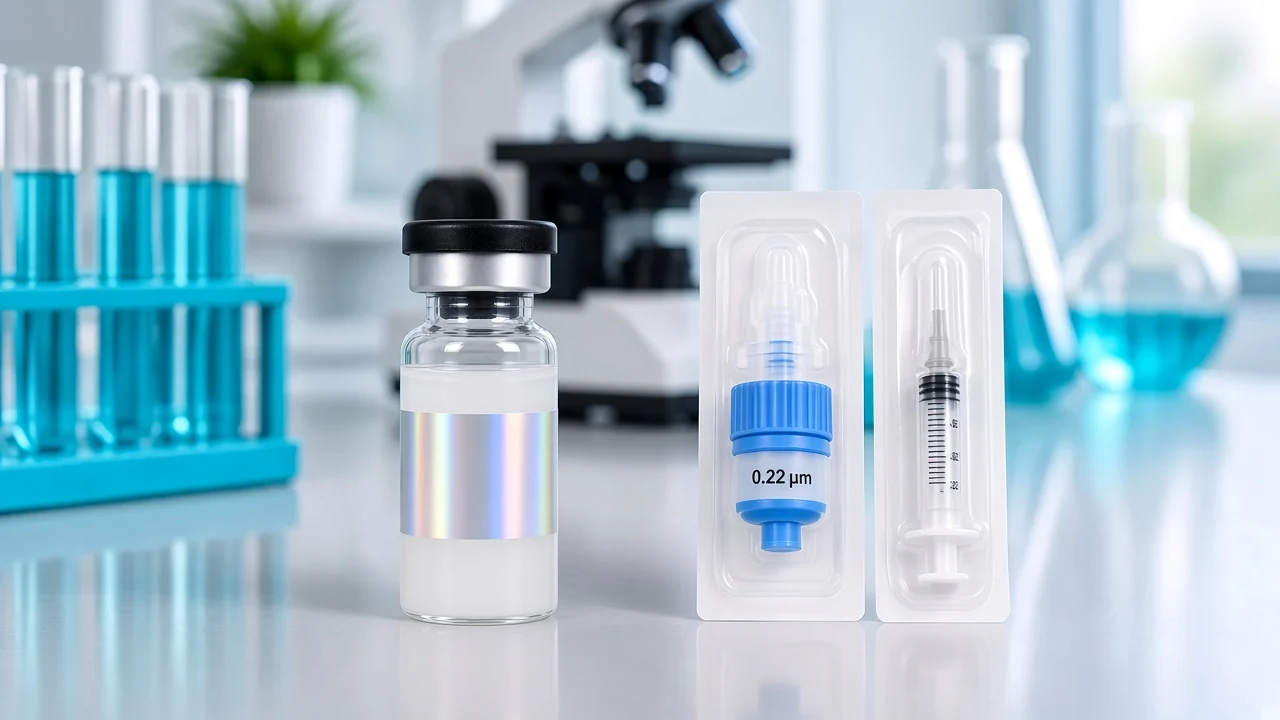
A 0.22 µm syringe filter removes bacteria and visible particles, so a cloudy solution can come out looking clear. A properly dissolved peptide passes straight through, because individual peptide molecules are far smaller than the filter’s pores. But a filter does not remove endotoxin, and small clumps that have not grown into visible specks still pass through. Filtering a cloudy vial hides the problem rather than fixing it. Our guide to sterile filtering peptides explains what a filter can and cannot do.
How to avoid it next time
- Let the vial and the water reach room temperature before opening.
- Add the water slowly down the inside wall of the vial, not onto the powder.
- Swirl or roll gently. Never shake.
- Give it time to dissolve before deciding something is wrong.
- Use sealed, in-date bacteriostatic water from a known manufacturer, such as Pfizer bacteriostatic water.
- Store dissolved peptides in the fridge and away from light. See how to store peptides.
Our step-by-step guide to reconstituting lyophilized peptides covers the full technique, and the reconstitution calculator works out concentrations.
Frequently asked questions
Is a cloudy peptide still good?
If the haze clears completely after 15 to 30 minutes of resting and gentle rolling, it was most likely just slow to dissolve. If it stays cloudy or has visible particles, it should not be used for research. Contact the seller with a photo and the lot number.
Why is my HGH cloudy after mixing?
Growth hormone is a large protein that clumps easily when the vial is shaken or the water is squirted straight onto the powder. Drug labels for growth hormone say not to shake it and not to use it if the solution is cloudy or contains particles.
Why is my GHK-Cu blue?
GHK-Cu is a peptide bound to copper, and copper gives the solution a natural blue colour. A clear blue solution is normal. Cloudiness or particles are not. More in our GHK-Cu research overview.
Can I filter a cloudy peptide to fix it?
A 0.22 µm filter removes bacteria and visible particles, but not endotoxin or small clumps of peptide. The solution may look clear afterwards without actually being fixed.
Can bacteriostatic water make a peptide cloudy?
It can. Old, warm or contaminated water can cause haze, and a few peptides dissolve poorly in bacteriostatic water and need a different diluent. Most research peptides dissolve clearly in fresh bacteriostatic water.
How long should a peptide take to dissolve?
Many dissolve within a minute or two of gentle swirling. Some, especially larger or more water-repellent peptides, can take 15 to 30 minutes. Letting the vial reach room temperature first helps.
Sources and further reading
- Why is my peptide vial’s stopper bulging?
- Humatrope (somatropin) US prescribing information: reconstitution instructions
- Bachem: handling and storage guidelines for peptides
- Sigma-Aldrich: peptide solubility guidelines
- Sterile filtering peptides: what a 0.22 µm filter does and doesn’t remove
- How to reconstitute lyophilized peptides
Products sold by Lodge Peptides are intended for laboratory research use only and are not for human or animal consumption. This article explains laboratory handling for educational purposes and is not medical advice.
Email list
Get lot reports and guides in your inbox
New lot reports, research guides, restocks, and occasional offers from the Lodge Peptides team.