Endotoxin is the test result people most often skip on a peptide report, and the one that matters most for anything that touches live cells or animals. This guide explains what endotoxin is, how labs measure it, what “EU per vial” and “below LOQ” mean, and how to read a real endotoxin certificate, using the Peptide Test Canada report for our KPV lot as the worked example.
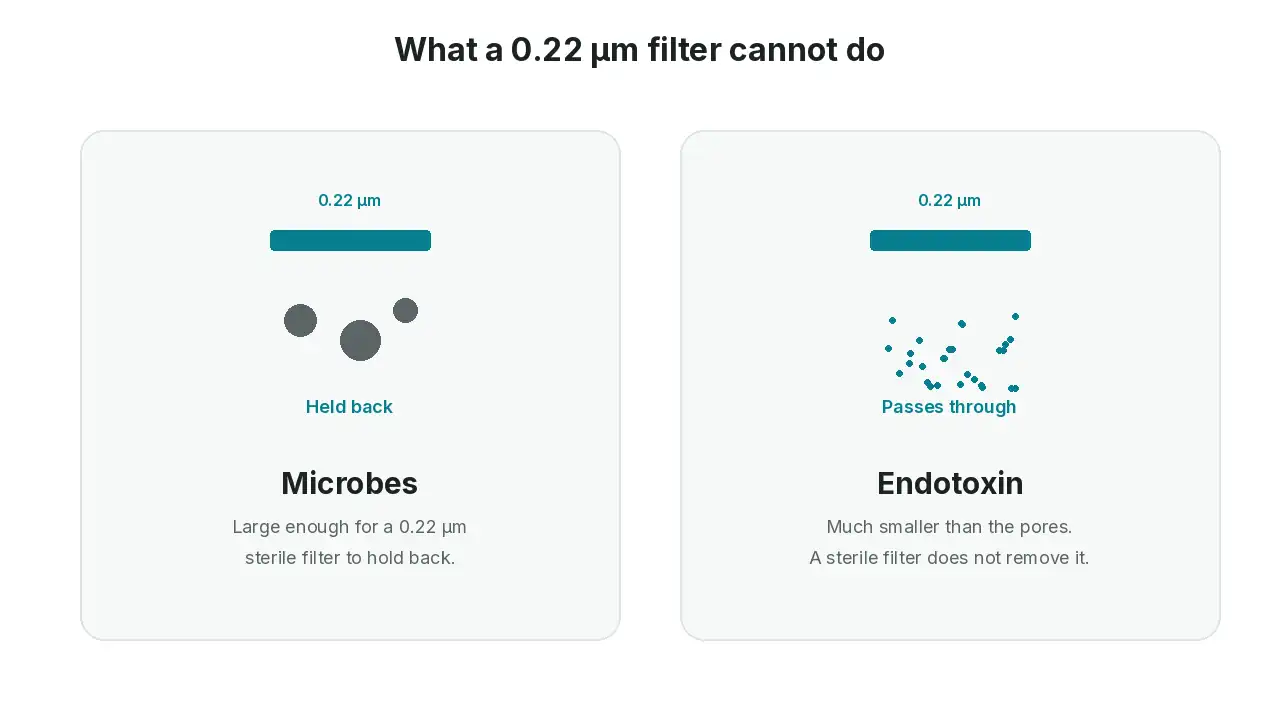
- Endotoxin is lipopolysaccharide (LPS) from the outer membrane of gram-negative bacteria. It is heat-stable and survives the processes that kill bacteria, so sterile does not mean endotoxin-free.
- It is measured with the LAL test (Limulus amebocyte lysate) described in USP <85>, by gel-clot, turbidimetric or chromogenic methods. Results are in endotoxin units (EU).
- Limits are set per body weight, not per vial: USP and FDA use a threshold of 5 EU per kg for most parenteral routes (0.2 EU/kg intrathecal). Preclinical limits for animal studies are derived the same way.
- Our KPV lot ZB-KP10927 tested below the limit of quantitation, <12.5 EU per vial (kinetic chromogenic LAL, USP <85>). The “12.5” is 5.00 EU/mL (the LOQ) times the 2.5 mL the lab used to dissolve the vial.
- An endotoxin result does not replace a sterility test, and it says nothing about identity, purity or content.
What endotoxin is
Endotoxins are lipopolysaccharides, large molecules that make up much of the outer membrane of gram-negative bacteria such as E. coli. They are released when bacteria grow and when they die. Unlike the bacteria themselves, endotoxin is not destroyed by ordinary sterilization: it tolerates heat and filtration well enough that removing it takes dedicated depyrogenation steps. That is the key point for anyone reading a report. A vial can contain no living bacteria and still carry enough endotoxin to matter.
Peptides pick up endotoxin from water, buffers, glassware, resins and handling during synthesis, purification and filling. Lyophilization does not remove it.
Why it matters in research
Endotoxin is a potent trigger of the innate immune system. In cell culture it can activate immune cells and change cytokine output at very low concentrations; in animals it causes fever and inflammatory responses. For research on peptides whose effects are themselves about inflammation or immunity, such as KPV or BPC-157, endotoxin contamination can create the very effect being measured, or mask it. That is why journals and core facilities often ask for endotoxin data on reagents.
How labs measure it
The standard method uses a reagent made from the blood cells of the horseshoe crab, Limulus polyphemus. Limulus amebocyte lysate (LAL) clots in the presence of endotoxin, and that reaction can be read three ways, all described in USP general chapter <85>:
| Method | How it reads | Output |
|---|---|---|
| Gel-clot | A gel forms or it does not at a known sensitivity | Pass/fail at a set limit, or a semi-quantitative range |
| Turbidimetric (kinetic) | Measures cloudiness as the lysate reacts over time | A number, against a standard curve |
| Chromogenic (kinetic) | A synthetic substrate releases a coloured product | A number, against a standard curve |
Recombinant factor C (rFC) assays, which do not use horseshoe crab blood, are an accepted alternative in some pharmacopeias. Whatever the method, a good report states it, along with the sample preparation and the limit of quantitation.
EU, EU/mL, EU per vial and LOQ
An endotoxin unit (EU) is a measure of biological activity defined against a reference standard endotoxin, not a weight. Labs test a solution, so the raw result is in EU per mL. To report per vial, they multiply by the volume used to dissolve the vial. To report per mg of peptide, they divide by the peptide amount.
Every assay has a lowest level it can measure reliably, the limit of quantitation (LOQ). If the sample reads below it, the honest result is “below LOQ” with the LOQ given, written as a “less than” value. That is not a failure or a missing result. It means the endotoxin present, if any, was below what the method can count.
How limits are set
There is no single “safe” endotoxin number for a vial, because the limit depends on how much material is given and to what body weight. USP <85> and the FDA’s 2012 guidance on pyrogen and endotoxin testing express the limit as K/M: K is the threshold pyrogenic dose, 5 EU per kg of body weight for most parenteral routes (0.2 EU/kg for intrathecal), and M is the maximum dose per kg. For animal research, Malyala and Singh (2008) used the same approach to publish reference endotoxin limits for common preclinical species. A report that gives EU per vial or EU/mg lets a researcher do that calculation for their own model.
Reading a real report
Here is the Peptide Test Canada endotoxin certificate for our KPV 10 mg lot, verification code PTC-NESY96HT:
| Field | What the report says | What it means |
|---|---|---|
| Lot | ZB-KP10927 | Matches the lot on the vial and on the purity report |
| Method | Kinetic chromogenic LAL, USP <85> | A quantitative method from the pharmacopeia |
| Sample preparation | Reconstituted in 2.5 mL endotoxin-free water | The volume used to convert EU/mL into EU per vial |
| Result | Below the limit of quantitation: <12.5 EU per vial | 5.00 EU/mL LOQ × 2.5 mL = 12.5 EU; the vial read below that |
| Pass/fail | None assigned | Correct: the limit depends on dose and body weight, which the lab does not know |
The same lot’s purity report shows 99.9% purity and 12.67 mg measured against a 10 mg label. Both reports are on the ZB-KP10927 lot page.
What an endotoxin result does not tell you
- Sterility. Endotoxin measures bacterial toxin, not living organisms. Some bacteria, including Sphingomonas, the genus Health Canada reported finding in a seized injectable peptide in November 2026, have unusual outer membranes and are a sterility question rather than an endotoxin one.
- Identity, purity or content. Those need HPLC and mass spectrometry.
- Other lots. Endotoxin is a property of a batch and its handling. A result for one lot does not carry over to the next.
Our guide to heavy metals, sterility and residual solvents covers the other safety tests, and peptide testing and lab reports puts all of them in one place.
Lodge Peptides endotoxin results
KPV is the first Lodge Peptides product with an endotoxin report, because its research use is so closely tied to inflammation. We plan to add endotoxin testing to more lots and will post each result on its lot page and in the COA library when it is back. KPV 10 mg is sold for laboratory research only.
Frequently asked questions
What is endotoxin in peptides?
Lipopolysaccharide from the outer membrane of gram-negative bacteria, picked up during synthesis, purification or filling. It is heat-stable and not removed by lyophilization.
What does EU per vial mean?
Endotoxin units in the whole vial. The lab measures EU per mL of the dissolved sample and multiplies by the volume it used.
What does below LOQ mean on an endotoxin report?
The endotoxin present, if any, was below the lowest level the method can measure reliably. The result is written as less than the LOQ value.
What is a safe endotoxin level?
There is no single number per vial. USP and FDA set limits as K/M, using 5 EU per kg body weight for most parenteral routes, divided by the dose per kg.
Is a sterile peptide endotoxin-free?
No. Sterilization kills bacteria but does not destroy endotoxin, so sterility and endotoxin are separate tests.
Which Lodge Peptides products have endotoxin results?
KPV lot ZB-KP10927: below the limit of quantitation, less than 12.5 EU per vial, by kinetic chromogenic LAL (USP <85>).
Related guides
- Peptide testing and lab reports
- Heavy metals, sterility and solvents
- KPV peptide: a research overview
- KPV lot ZB-KP10927
Sources
- United States Pharmacopeia. General chapter <85> Bacterial Endotoxins Test.
- US Food and Drug Administration. Guidance for Industry: Pyrogen and Endotoxins Testing: Questions and Answers. June 2012. fda.gov
- Malyala P, Singh M. Endotoxin limits in formulations for preclinical research. J Pharm Sci. 2008;97(6):2041-4. PubMed 17847072
- Health Canada. Health Canada warns about unauthorized peptides, including contaminated injectable peptides sold by Sage & Summit Wellness Co. in Ottawa, ON. Advisory RA-82944, 12 November 2026. recalls-rappels.canada.ca
- Peptide Test Canada. Bacterial endotoxin certificate, KPV lot ZB-KP10927, issued 16 November 2026, code PTC-NESY96HT.
Products sold by Lodge Peptides are intended for laboratory research use only and are not for human or animal consumption. This article is for educational purposes and is not medical advice.
Email list
Get lot reports and guides in your inbox
New lot reports, research guides, restocks, and occasional offers from the Lodge Peptides team.