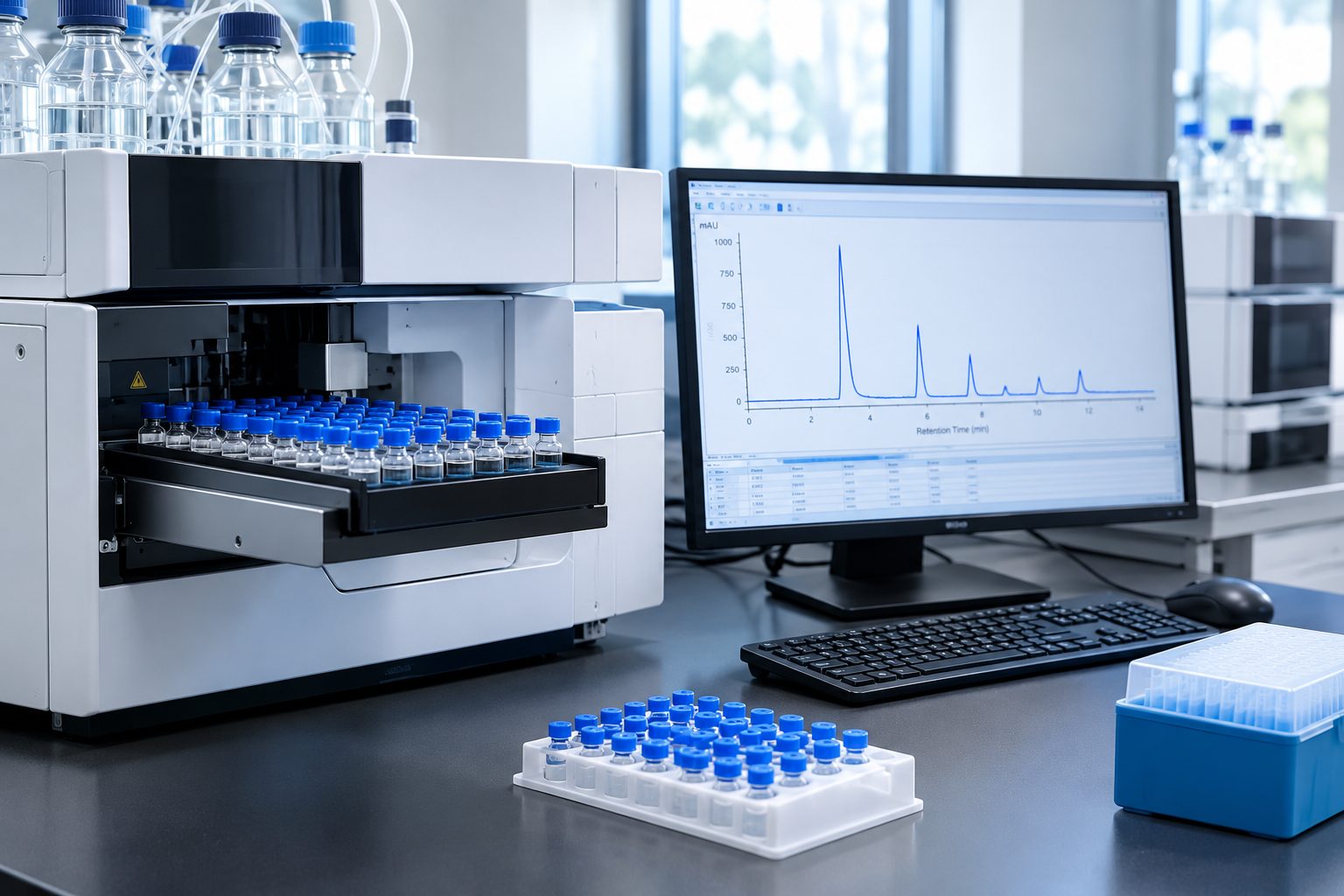
Most of the search traffic that finds Lodge Peptides is about lab testing: how to read a peptide lab report, how to check one is real, what “purity” and “content” mean, and what an endotoxin result says. This page pulls it together. It explains each test a research peptide can go through, what question that test answers, what a good result looks like on paper, and which of those tests our own Peptide Test Canada reports cover today. Each section links to a deeper guide.
- A useful peptide lab report answers four questions: is it the right molecule (identity by mass spectrometry), how clean is it (HPLC purity), how much is in the vial (measured mg against the label) and is the report real (lot number plus the lab’s own verification code).
- Safety-type tests are separate: endotoxin (bacterial toxin, in EU per vial), sterility (living microbes), heavy metals (elemental impurities) and residual solvents.
- The salt form (TFA, acetate, hydrochloride) explains why powder weight and peptide weight are not the same thing.
- Every tested Lodge Peptides lot has a Peptide Test Canada report with HPLC-MS/MS purity and measured content, posted in our COA library with a verification code. KPV also has an endotoxin report. Heavy metals, sterility and residual solvents are not part of our current reports.
The four core questions
A certificate of analysis (COA) is only worth something if it answers the questions you actually have about a vial. For research peptides those are, in order: is this the molecule on the label, how much of the powder is that molecule rather than other peptide fragments, how many milligrams are actually in the vial, and can I trust that this report belongs to this lot? A report that gives a purity number but no identity confirmation, or a purity number with no lot number, leaves the important questions open. Our guide on how to read a peptide COA walks through a real report line by line.
Every test at a glance
| Test | Question it answers | Usual method | What a good report shows |
|---|---|---|---|
| Identity | Is it the right peptide? | Mass spectrometry (LC-MS or LC-MS/MS) | Observed mass matching the expected mass for the sequence |
| Purity | How much of the peptide material is the target? | Reversed-phase HPLC, UV detection | A main peak, usually 98% or higher, with the chromatogram |
| Content / fill | How many mg of peptide are in the vial? | Quantitation against a reference standard (LC-MS/MS or HPLC) | Measured mg next to the label claim |
| Endotoxin | How much bacterial endotoxin is present? | LAL test per USP <85> (gel-clot, turbidimetric or chromogenic) | A number in EU per vial or EU/mg, or “below LOQ” with the LOQ stated |
| Sterility | Are there living microorganisms? | Growth test per USP <71> (about 14 days) | Pass / no growth |
| Heavy metals | Are toxic elements present? | ICP-MS per USP <232>/<233>, ICH Q3D | Each element below its limit |
| Residual solvents | Is synthesis solvent left over? | Gas chromatography per ICH Q3C / USP <467> | Each solvent below its limit |
| Counter-ion | Which salt is it, and how much? | Ion chromatography or 19F NMR for TFA | Salt form stated; TFA or acetate content in % |
Identity and purity
Purity and identity are different measurements that people often treat as one. HPLC purity tells you what share of the UV-absorbing peptide material sits in the main peak. It does not, on its own, prove that the main peak is the right molecule. Mass spectrometry does that, by measuring the mass of what is in the peak and comparing it with the expected mass. A vial can be 99% pure and still be the wrong peptide if nobody checked the mass. Our guides on reading an HPLC chromatogram and telling if a peptide is real go deeper, and why two labs give different results explains why purity numbers move between labs and runs.
Content, fill and salt form
A 10 mg label is a claim about peptide, not about powder. Lyophilized peptides also contain counter-ions left from purification (usually trifluoroacetate or acetate), bound water and sometimes excipients. That is why the measured peptide content in a vial can be higher or lower than the label, and why weighing the powder tells you little. Two guides cover this: purity vs net peptide content, and our new guide to TFA vs acetate salts, which explains where the counter-ion comes from and why it matters for cell work.
Endotoxin, sterility, metals and solvents
The tests above describe what the peptide is. A second group of tests describes what else might be in the vial. These matter most for anything that will touch cells or animals, and they are where research-grade material is usually least documented.
- Endotoxin is a toxin from the outer membrane of gram-negative bacteria. It survives the processes that kill the bacteria, so a vial can be sterile and still carry endotoxin. See endotoxin testing explained.
- Sterility looks for living microbes. It is a separate test from endotoxin and takes about two weeks.
- Heavy metals and residual solvents are chemistry-side impurities from equipment, reagents and synthesis. See what a full test panel covers.
Health Canada’s 2026 peptide advisories list exactly these risks for unregulated products: too much or too little active ingredient, unlisted ingredients, and contaminants such as solvents, heavy metals, particles and microbes including endotoxins. In November 2026 it reported bacteria found in one seized injectable peptide in Ottawa. That is the gap these tests exist to close.
Verifying a report
A real report from a real lab can still be attached to the wrong product. The check takes five minutes: match the lot number on the vial to the report, open the lab’s own verification page using the code on the report, and confirm the details match. Our step-by-step guide is peptide lab reports: how to verify one with the testing lab.
What Lodge Peptides tests
| Test | Lodge Peptides reports today |
|---|---|
| Identity + purity (HPLC-MS/MS or LC-MS/MS) | Yes, every tested lot, by Peptide Test Canada |
| Measured content vs label | Yes, every tested lot (and per peptide for blends) |
| Lot number + lab verification code | Yes, on every report and lot page |
| Endotoxin (LAL, USP <85>) | KPV lot ZB-KP10927: below the limit of quantitation, <12.5 EU per vial |
| Sterility, heavy metals, residual solvents, counter-ion | Not part of our current reports |
Retatrutide 40 mg is in for third-party testing and its report will be posted when it is back. Every other result is in the COA library and summarised in the lab results roundup. All products are sold for laboratory research only.
All testing guides
- How to read a peptide certificate of analysis
- Peptide lab reports: how to verify one with the testing lab
- How to read an HPLC chromatogram
- Purity vs net peptide content
- TFA vs acetate peptide salts
- Peptide endotoxin testing explained
- Heavy metals, sterility and residual solvents
- How to tell if your peptide is real
- Why two labs give different results
- Lab results roundup: every tested Lodge Peptides lot
Frequently asked questions
What should a peptide lab report include?
Identity by mass spectrometry, HPLC purity with the chromatogram, measured content in mg against the label, the lot number, the test date, the lab name and a way to verify the report with the lab.
Is HPLC purity enough?
No. HPLC purity shows how clean the main peak is, not whether it is the right molecule. Mass spectrometry confirms identity.
What is an endotoxin test?
A test for bacterial endotoxin, usually the LAL method in USP <85>. Results are given in endotoxin units (EU) per vial or per mg.
Do Lodge Peptides reports include heavy metals or sterility?
Not at present. Lodge Peptides reports cover identity, purity and measured content for every tested lot, and endotoxin for KPV.
Who tests Lodge Peptides peptides?
Peptide Test Canada, a third-party lab in Mississauga, Ontario. Each report has a verification code you can check on the lab’s site.
How do I check a report is real?
Match the lot number on the vial to the report, then open the lab’s verification page with the report code and confirm the details match.
Related guides
Sources
- Health Canada. Think twice before injecting peptides bought online: unauthorized products can seriously harm you. Advisory RA-81874, 9 April 2026. recalls-rappels.canada.ca
- Health Canada. Health Canada warns about unauthorized peptides, including contaminated injectable peptides sold by Sage & Summit Wellness Co. in Ottawa, ON. Advisory RA-82944, 12 November 2026. recalls-rappels.canada.ca
- United States Pharmacopeia. General chapters <85> Bacterial Endotoxins Test, <71> Sterility Tests, <232> Elemental Impurities—Limits, <233> Elemental Impurities—Procedures, <467> Residual Solvents.
- ICH. Q3D(R2) Guideline for Elemental Impurities and Q3C(R9) Impurities: Guideline for Residual Solvents. ich.org
- Cornish J, et al. Trifluoroacetate, a contaminant in purified proteins, inhibits proliferation of osteoblasts and chondrocytes. Am J Physiol. 1999;277:E779-83. PubMed 10567002
Products sold by Lodge Peptides are intended for laboratory research use only and are not for human or animal consumption. This article is for educational purposes and is not medical advice.
Email list
Get lot reports and guides in your inbox
New lot reports, research guides, restocks, and occasional offers from the Lodge Peptides team.