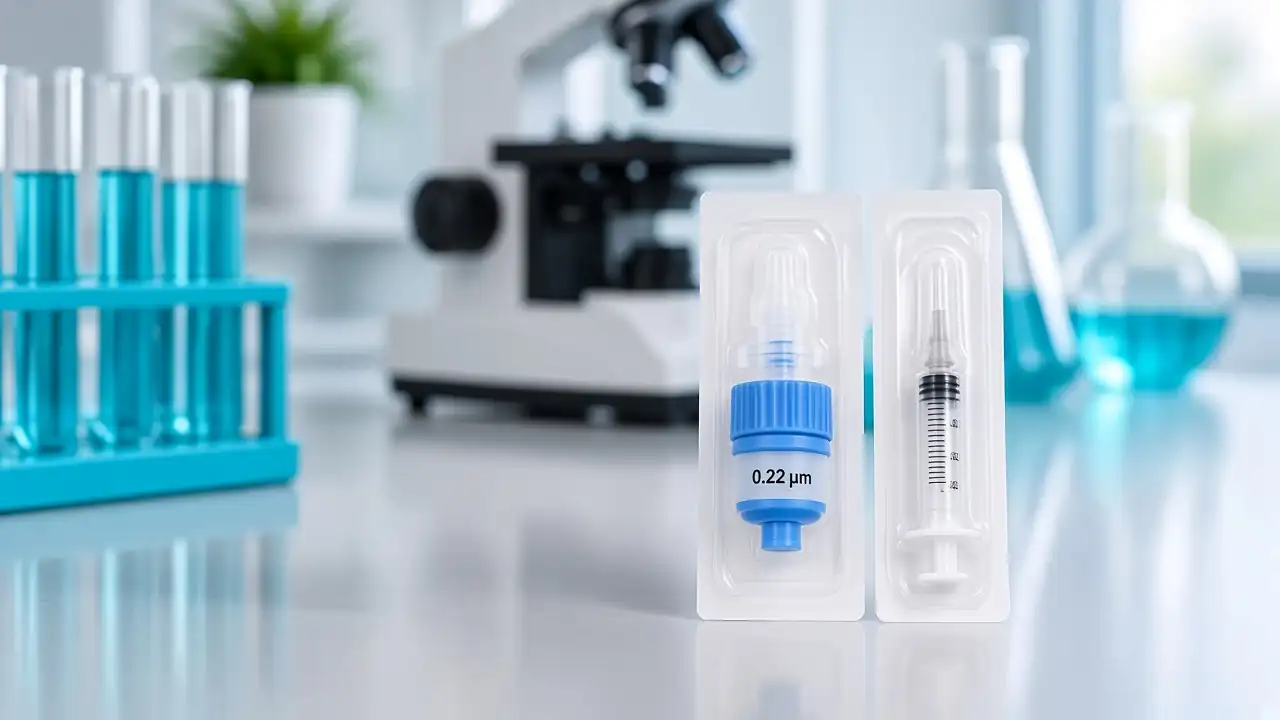
On 6 November 2026, Health Canada reported that it had seized more than 11,400 vials of injectable peptides from a Chinese wholesaler and two Canadian online retailers, and that testing had found three types of bacteria capable of causing serious infections. Not surprisingly, the question we have been asked most since then is whether filtering a reconstituted peptide solution makes it safe.
Sterile filtration is a standard laboratory technique, and it does remove bacteria. But it has real limits, and the most important one is exactly the problem a contaminated product creates. This guide explains what a 0.22 µm filter removes, what it does not, and how labs use it properly.
- A sterilizing-grade 0.2 or 0.22 µm filter is validated to retain bacteria. It is a routine step for making heat-sensitive solutions sterile in the lab.
- It does not remove endotoxin, the toxic fragments bacteria leave behind. If a product was contaminated, killing or removing the bacteria does not remove the endotoxin.
- It does not reliably remove mycoplasma (that needs a 0.1 µm filter) and does nothing for viruses, chemical impurities, degraded peptide or an under-filled vial.
- Choose a low protein-binding membrane (PES or PVDF), expect to lose a little volume in the filter, and use aseptic technique into a sterile vial.
- Filtration is a second line of defence. The first is a clean source with lot-specific purity, sterility and endotoxin data.
What Health Canada found
According to Health Canada and news coverage on 6 November 2026:
- More than 11,400 vials were seized from Shanghai ERP Peptide Biotechnology Co. Ltd. and two Canadian online retailers that resold its products. Both retail websites have been shut down.
- Testing found three different bacteria that could cause serious infections.
- Products sold by the wholesaler included retatrutide, tirzepatide, tesamorelin, MOTS-c, NAD+ and HCG.
- Health Canada advised anyone who used the products and develops a fever, or pain and swelling at an injection site, to seek medical attention right away. It is also working with the Canada Border Services Agency to stop shipments.
The lesson for anyone sourcing peptides is not that one supplier was bad. It is that a lab report showing high purity says nothing about sterility. A vial can be 99% pure peptide and still carry bacteria.
Lodge Peptides note: none of our products are sourced from ERP Peptide or the two retailers named in the advisory. Every tested lot we sell has its own third-party lab report you can verify, listed in our lab results roundup.
What a 0.22 µm filter does
A sterilizing-grade membrane filter, rated 0.2 or 0.22 µm, physically holds back bacteria as the liquid passes through. The rating is not a simple hole size. A filter earns the “sterilizing grade” label by passing a standard challenge test (ASTM F838): it must retain at least 10 million cells per square centimetre of Brevundimonas diminuta, one of the smallest bacteria, and produce a sterile filtrate.
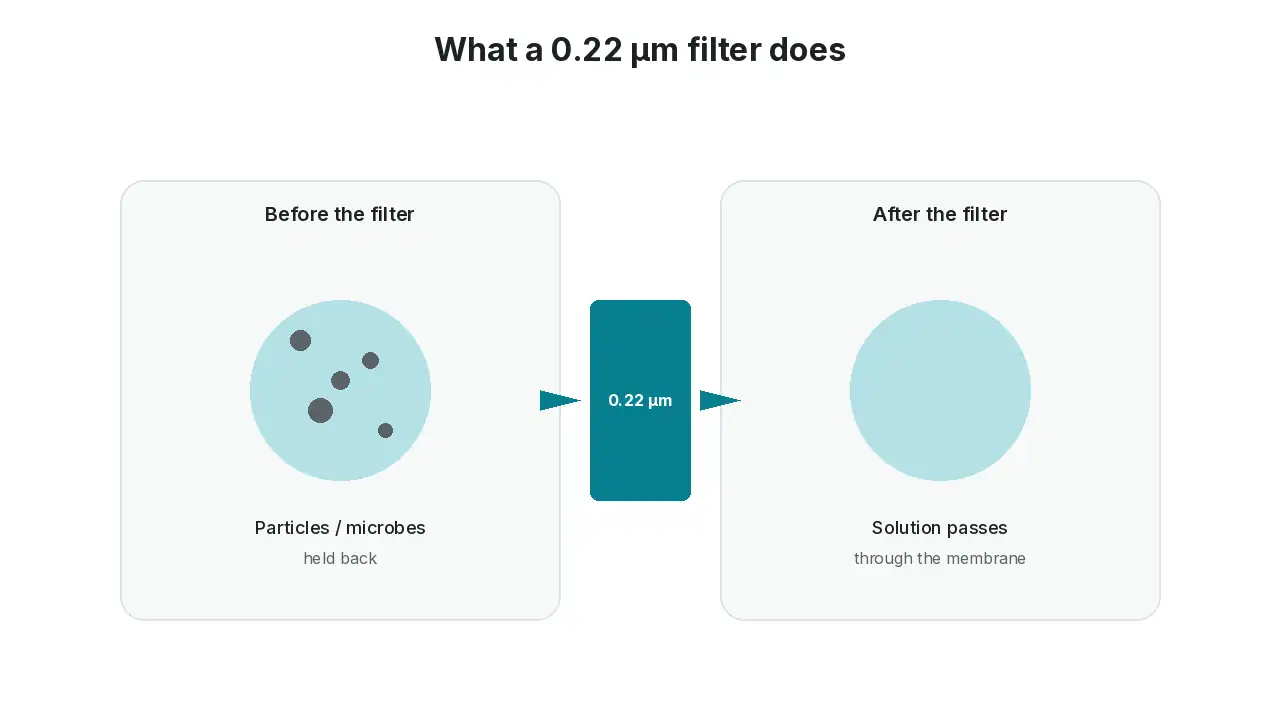
That is why sterile filtration is the standard method for solutions that cannot be heat-sterilized, such as peptides, proteins and cell culture media. Heat would destroy them; a filter does not.
What filtering does not fix
| Problem | Removed by a 0.22 µm filter? |
|---|---|
| Bacteria | Yes, when the filter is sterilizing grade and used correctly |
| Fungi and yeast | Yes |
| Endotoxin (bacterial toxin) | No |
| Mycoplasma | Not reliably; needs a 0.1 µm filter |
| Viruses | No |
| Chemical impurities and synthesis by-products | No |
| Degraded or wrong peptide | No |
| Less peptide than the label says | No |
Filtration only removes particles. Everything dissolved in the solution, good or bad, passes straight through.
Why endotoxin is the real problem
Endotoxin is part of the outer wall of gram-negative bacteria. When those bacteria die or break apart, endotoxin is released into the solution. It is far smaller than a filter pore, so it passes through, and it is heat-stable, so it is not destroyed by normal handling. In the body it is a potent trigger of fever and inflammation.
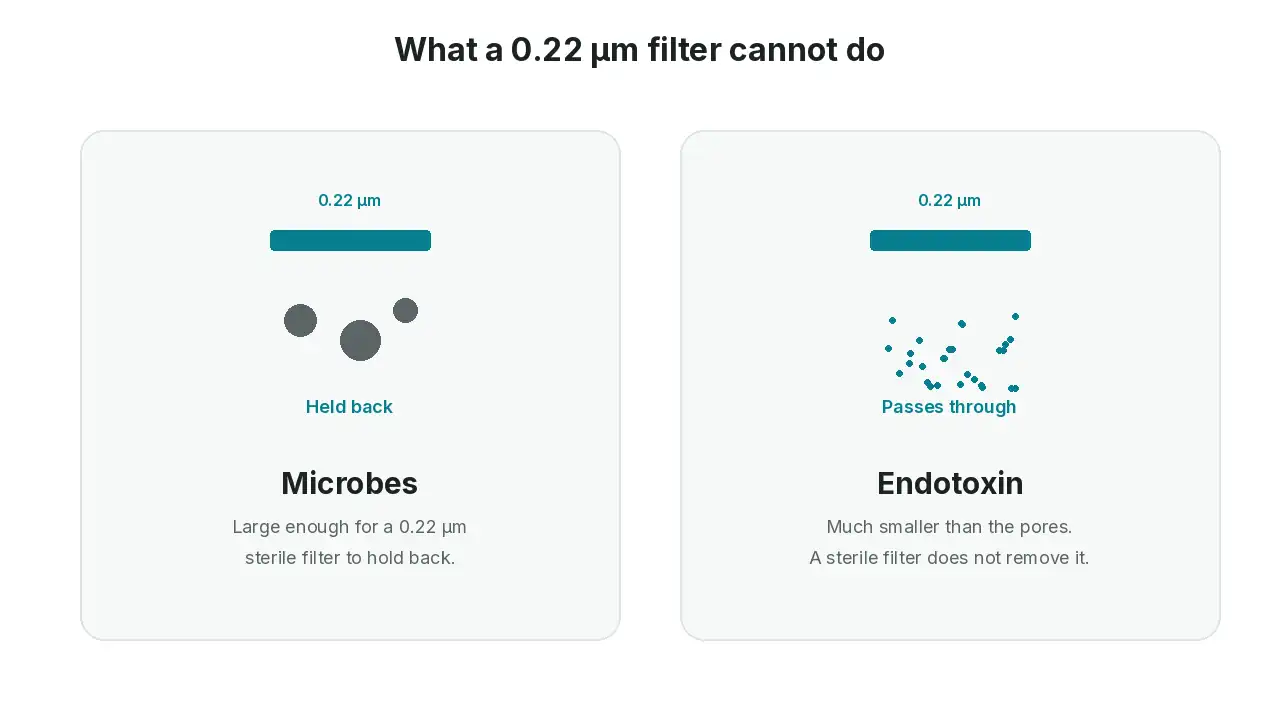
This is the key point about contaminated products. If bacteria have been growing in a vial, filtering removes the living cells but leaves their endotoxin behind. Filtration can make a clean solution stay clean; it cannot make a contaminated one clean again.
That is why endotoxin is tested separately, using the LAL test, and reported in endotoxin units (EU). Our retatrutide 40 mg batch, for example, tested at under 1 EU per vial. See the lab results roundup for every lot.
How labs sterile-filter a peptide solution
- Work clean. Wipe the bench, wash hands, wear gloves, and swab every vial septum with an alcohol pad and let it dry.
- Reconstitute first. Dissolve the lyophilized peptide in its diluent as usual. Our reconstitution guide covers this step.
- Draw the solution up into a sterile syringe without a filter attached.
- Attach a sterile syringe filter to the syringe tip without touching the outlet, then fit a fresh sterile needle to the filter outlet.
- Push slowly and steadily into a sterile, sealed empty vial. Do not force it; high pressure can damage the membrane.
- Use each filter once. Label the new vial with the contents, concentration and date, and store it at 2 to 8 °C.
Expect a small loss. A 13 mm filter typically keeps back a fraction of a millilitre in its housing, which matters with small volumes. Some labs push a little air through at the end to recover most of it.
Choosing a syringe filter
- Pore size: 0.22 or 0.2 µm, labelled sterile and sterilizing grade. A 0.45 µm filter is not sterilizing.
- Membrane: PES (polyethersulfone) or PVDF, both low protein-binding, so less peptide sticks to the filter. Nylon and cellulose nitrate bind more protein and peptide.
- Size: 13 mm filters suit volumes of a few millilitres and have lower hold-up than 25 mm filters.
- Packaging: individually wrapped and sterile, with a lot number and expiry.
Start with a clean source
Filtration is a useful second line of defence, but it cannot undo contamination that happened before the vial reached you. The questions to ask a supplier are the same ones Health Canada’s findings raise:
- Is there a lab report for this lot, and can I verify it with the lab myself? (Here is how.)
- Does the report include endotoxin, not just purity?
- Does the measured content match the label? (Purity vs content explained.)
- Is the product shipped as a sealed, lyophilized powder, which is far more stable and less prone to contamination than a pre-mixed solution? (See peptide pens vs vials.)
Vial looks cloudy after mixing? What is normal, what causes haze and when not to use a vial is covered in why is my peptide cloudy after reconstitution.
Frequently asked questions
Does filtering peptides remove bacteria?
Yes. A sterilizing-grade 0.2 or 0.22 µm filter, used correctly, retains bacteria and produces a sterile filtrate. It does not remove endotoxin, viruses or dissolved impurities.
Does a 0.22 micron filter remove endotoxin?
No. Endotoxin molecules are much smaller than the filter pores and pass straight through. Endotoxin has to be prevented at the source and measured with an LAL test.
Would filtering have made the seized Health Canada products safe?
Not reliably. Filtering would remove live bacteria, but any endotoxin released by those bacteria would remain in the solution. Filtration cannot make a contaminated product clean again.
What filter is best for peptides?
A sterile, individually packed 0.22 µm syringe filter with a low protein-binding PES or PVDF membrane. A 13 mm size suits small volumes.
Does filtering reduce the amount of peptide?
Slightly. Some solution stays in the filter housing, and a little peptide can bind to the membrane. Low-binding membranes and pushing air through at the end keep the loss small.
Is purity testing enough to know a peptide is clean?
No. Purity measures how much of the material is the correct peptide. It says nothing about bacteria or endotoxin, which need separate sterility and endotoxin tests.
Sources and further reading
- Global News: Health Canada warns of bacteria found in unauthorized peptides sold online (6 November 2026)
- Pharmaceutical Technology: assuring sterility with ASTM F838
- MilliporeSigma: mycoplasma clearance by 0.22 µm vs 0.1 µm filters
- How to store lyophilized peptides
Products sold by Lodge Peptides are intended for laboratory research use only and are not for human or animal consumption. This article is general educational information about laboratory technique, not medical advice.
Email list
Get lot reports and guides in your inbox
New lot reports, research guides, restocks, and occasional offers from the Lodge Peptides team.