“CJC-1295” names two different molecules, and much of the confusion online comes from not knowing which one a vial holds. The original CJC-1295 carries a drug affinity complex (DAC) that binds it to albumin and stretches its half-life to days. The version most research suppliers sell, labelled “CJC-1295 no DAC” or modified GRF (1-29), leaves that part off. This guide explains the difference, what the published studies actually tested, and how to tell the two apart on a lab report.
- Both are built on GRF (1-29), the active first 29 amino acids of growth hormone-releasing hormone, with four substitutions that resist enzymatic breakdown.
- With DAC: a C-terminal lysine carrying a maleimidopropionamide group bonds to albumin in the blood. Half-life in healthy adults was 5.8 to 8.1 days (Teichman et al., 2006). PubChem lists it near 3,647 g/mol.
- Without DAC: the same tetrasubstituted GRF (1-29) with no albumin anchor. Same receptor, but no days-long half-life. Most published human “CJC-1295” data are for the DAC version.
- The two have different masses, so a mass-spectrometry identity result shows which one is in the vial.
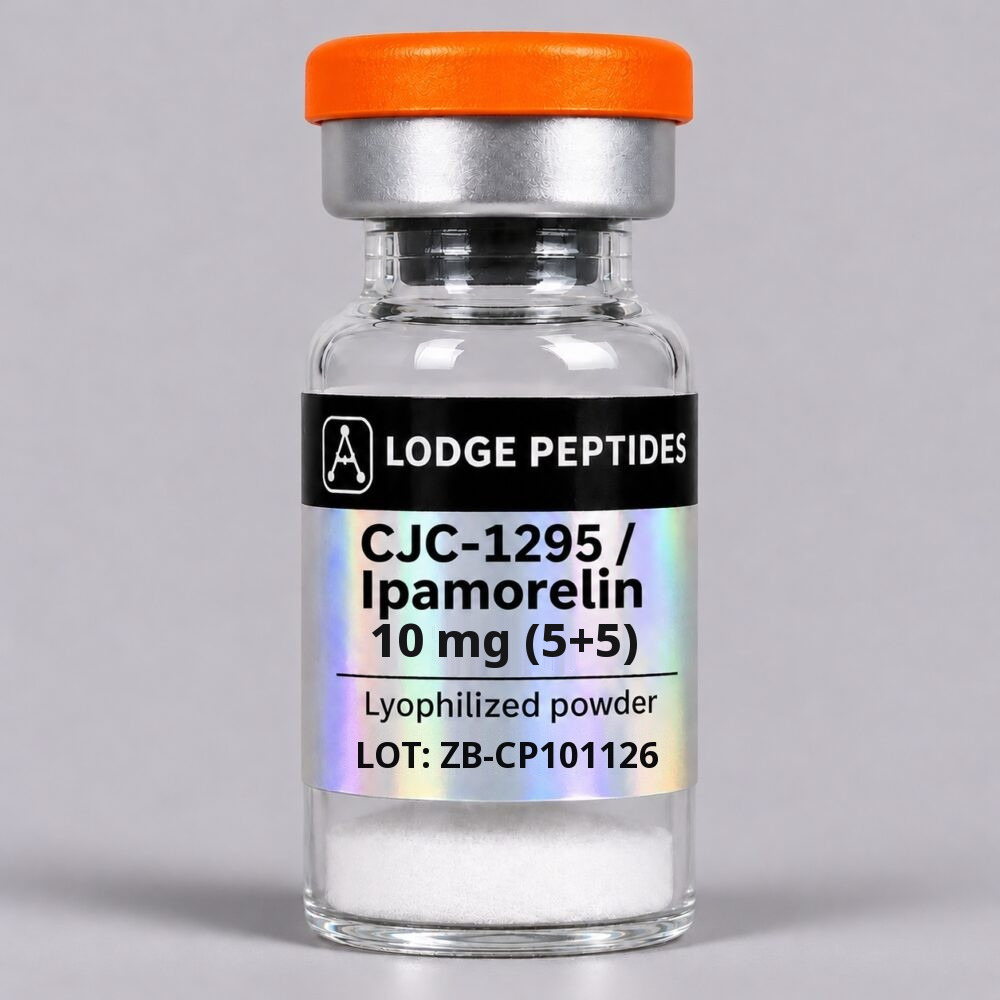
- Lodge Peptides CP10 (CJC-1295 no DAC / ipamorelin, 5 mg each) is the no-DAC version: lot ZB-CP101126 measured 6.36 mg CJC-1295 (no DAC) at 99.82% and 6.54 mg ipamorelin at 99.84% (Peptide Test Canada, LC-MS/MS, 28 October 2026).
The shared backbone: GRF (1-29)
Growth hormone-releasing hormone (GHRH) is a 44-amino-acid hypothalamic hormone that tells the pituitary to release growth hormone. Its first 29 amino acids, GRF (1-29), carry the activity, and that fragment is the basis of sermorelin. Native GRF (1-29) is broken down within minutes, largely by dipeptidyl peptidase-4 (DPP-4). CJC-1295 starts from GRF (1-29) and swaps four amino acids to resist that breakdown; Jetté and colleagues (2005) described it as a “tetrasubstituted form of hGRF(1-29)”. That tetrasubstituted peptide, on its own, is what is sold as CJC-1295 no DAC or modified GRF (1-29).
What the DAC does
The original design made the peptide bond to albumin, the most abundant protein in blood, after injection. A lysine carrying a reactive maleimide group (the drug affinity complex) was added at the chain’s end; it bonds to a free thiol on albumin (cysteine-34). Anchored to albumin, the peptide escapes fast clearance. In rats, CJC-1295 was found bound to albumin within 15 minutes and still circulating beyond 72 hours (Jetté et al., 2005). In healthy adults, one injection raised mean growth hormone 2- to 10-fold for six days or more and IGF-1 1.5- to 3-fold for 9 to 11 days, with an estimated half-life of 5.8 to 8.1 days (Teichman et al., 2006).
Side by side
| CJC-1295 with DAC | CJC-1295 no DAC (mod GRF 1-29) | |
|---|---|---|
| Backbone | Tetrasubstituted GRF (1-29) | Tetrasubstituted GRF (1-29) |
| Extra group | C-terminal lysine with maleimidopropionamide (binds albumin) | None |
| Molecular weight | About 3,647 g/mol (PubChem) | Lower, without the lysine-MPA group |
| Half-life | 5.8 to 8.1 days in healthy adults | Short; no albumin binding |
| GH release pattern | Raised trough GH, pulses preserved (Ionescu & Frohman, 2006) | A short pulse after each exposure |
| Published human data | Phase 1 / pharmacology studies (2006) | Little as a stand-alone compound |
| Usual research pairing | Long-acting GHRH studies | Often paired with a GH secretagogue such as ipamorelin |
What the studies tested
The human studies usually cited for “CJC-1295” used the DAC version. Teichman (2006) gave single and repeated injections to healthy adults and measured sustained, dose-dependent rises in GH and IGF-1. Ionescu and Frohman (2006) then asked whether continuous GHRH stimulation would flatten the body’s natural GH pulses; it did not. Trough GH rose about 7.5-fold while the pulse pattern was preserved. There is far less published human data on the no-DAC peptide as a stand-alone compound, which is worth knowing when a product page cites “clinical studies” for a no-DAC vial.
How to tell which one you have
The reliable way is mass. The DAC version carries an extra lysine-MPA group, so its measured mass is higher than the no-DAC peptide. A lab report that confirms identity by mass spectrometry will match one or the other; a label alone will not. For a blend such as CP10, the report should also show the two peptides resolved separately. Our guides on reading a COA and verifying a lab report cover how to check this.
Lodge Peptides CP10
Lodge Peptides sells the no-DAC version, paired with ipamorelin, as CP10 (CJC-1295 no DAC / ipamorelin, 5 mg each). On that lot, ZB-CP101126 measured 6.36 mg CJC-1295 (no DAC) at 99.82% and 6.54 mg ipamorelin at 99.84% (Peptide Test Canada, LC-MS/MS, 28 October 2026), the CJC-1295 is reported as “CJC-1295 (no DAC)”. For the ipamorelin half of the blend, see our ipamorelin research overview; for CJC-1295 on its own, the CJC-1295 research overview; and for the GHRH comparison, Tesamorelin vs CJC-1295/ipamorelin. All products are sold for laboratory research only.
Frequently asked questions
What is the difference between CJC-1295 with and without DAC?
The DAC (drug affinity complex) is a group that bonds the peptide to albumin, extending its half-life to days. The no-DAC version is the same tetrasubstituted GRF (1-29) without that group, so it is short-acting.
Which CJC-1295 do the studies use?
Most published human data, including Teichman (2006) and Ionescu and Frohman (2006), used the DAC version. There is little published human data on the no-DAC peptide as a stand-alone compound.
Is CJC-1295 no DAC the same as modified GRF (1-29)?
Yes. Both names refer to the tetrasubstituted GRF (1-29) peptide without the albumin-binding DAC group.
How long does CJC-1295 with DAC last?
Teichman et al. (2006) estimated a half-life of 5.8 to 8.1 days in healthy adults, with GH and IGF-1 raised for days after one injection.
Which version is in Lodge Peptides CP10?
The no-DAC version, paired with ipamorelin. Lot ZB-CP101126 reported it as CJC-1295 (no DAC) at 99.82% purity.
Related guides
- CJC-1295 research overview
- Ipamorelin research overview
- Tesamorelin vs CJC-1295/ipamorelin
- CP10 (CJC-1295/ipamorelin)
Sources
- Jetté L, et al. hGRF(1-29)-albumin bioconjugates activate the GRF receptor on the anterior pituitary in rats: identification of CJC-1295 as a long-lasting GRF analog. Endocrinology. 2005;146(7):3052-8. PubMed 15817669
- Teichman SL, et al. Prolonged stimulation of GH and IGF-I secretion by CJC-1295, a long-acting analog of GH-releasing hormone, in healthy adults. J Clin Endocrinol Metab. 2006;91(3):799-805. PubMed 16352683
- Ionescu M, Frohman LA. Pulsatile secretion of GH persists during continuous stimulation by CJC-1295, a long-acting GHRH analog. J Clin Endocrinol Metab. 2006;91(12):4792-7. PubMed 17018654
- Peptide Test Canada. CP10 lot ZB-CP101126, issued 28 October 2026, code PTC-9TNUSMN8.
- PubChem. CJC-1295, CID 91971820 (molecular weight about 3,647 g/mol). pubchem.ncbi.nlm.nih.gov
Products sold by Lodge Peptides are intended for laboratory research use only and are not for human or animal consumption. This article is for educational purposes and is not medical advice.
Email list
Get lot reports and guides in your inbox
New lot reports, research guides, restocks, and occasional offers from the Lodge Peptides team.