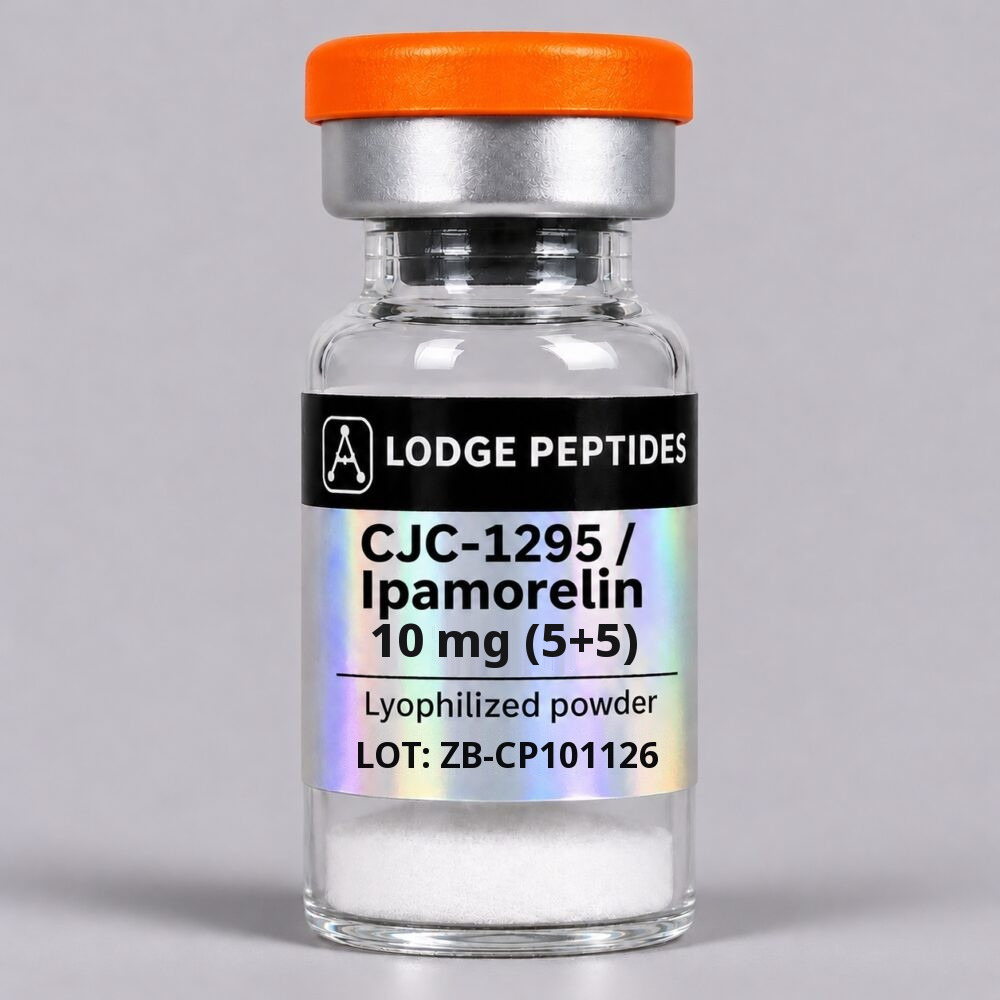
Ipamorelin is a small synthetic peptide that makes the pituitary release growth hormone. Unlike CJC-1295, it is not a GHRH analogue; it works through a different receptor, the one that normally responds to the hunger hormone ghrelin. That is why the two are so often sold together. This overview covers what ipamorelin is, how it works, what the published pharmacology found, why it is described as “selective”, and its Canadian status.
- Ipamorelin is a pentapeptide (Aib-His-D-2-Nal-D-Phe-Lys-NH2), about 711.9 g/mol (PubChem). It is a growth hormone secretagogue, not a GHRH analogue.
- It acts on the ghrelin / GHS receptor (GHS-R1a) on the pituitary, triggering a pulse of growth hormone. Raun et al. (1998) called it “the first selective growth hormone secretagogue”.
- Its selectivity is the headline finding: unlike earlier GH-releasing peptides (GHRP-6, GHRP-2), ipamorelin raised GH without raising ACTH or cortisol (Raun et al., 1998). Its half-life in humans was about 2 hours (Gobburu et al., 1999).
- It is often paired with CJC-1295 so one peptide gives a GHRH signal and the other a secretagogue signal.
- In Canada it is not an approved drug (no DIN), was named among seized unauthorized peptides in 2026, and is on the WADA 2026 Prohibited List (S2.2.4).
Looking for ipamorelin in Canada? We sell CJC-1295 (no DAC) and ipamorelin together as the CP10 blend, 5 mg each. The price, current lot and lab report are on our CJC-1295 / Ipamorelin Blend (CP10) page.
What ipamorelin is
Ipamorelin is a five-amino-acid peptide developed at Novo Nordisk in the 1990s. Raun and colleagues (1998) found it within a series of compounds derived by removing the central Ala-Trp dipeptide from growth hormone-releasing peptide-1 (GHRP-1). Its sequence is Aib-His-D-2-Nal-D-Phe-Lys-NH2, and PubChem lists its molecular weight at about 711.9 g/mol. It belongs to the growth hormone secretagogue (GHS) class, the same broad family as the GHRPs and later oral drugs such as MK-677.
How it works
Ipamorelin binds the growth hormone secretagogue receptor (GHS-R1a), the receptor the stomach hormone ghrelin acts on. Activating it on the pituitary triggers a pulse of growth hormone. This is a different pathway from GHRH analogues such as CJC-1295, which is why combining the two can give a larger GH response than either alone. Pharmacological profiling with GHRP and GHRH antagonists confirmed that ipamorelin works through the GHRP-like (ghrelin) receptor, not the GHRH receptor (Raun et al., 1998).
Why selectivity matters
The older GH-releasing peptides had an unwanted effect: they also raised adrenocorticotropic hormone (ACTH) and cortisol. Ipamorelin’s defining result was that it released growth hormone with a potency and efficacy similar to GHRP-6, but, as Raun and colleagues noted, “very surprisingly, ipamorelin did not release ACTH or cortisol”, and it did not disturb FSH, LH, prolactin or TSH. That clean, GH-specific profile is why it became the reference selective secretagogue.
What the research shows
The foundational pharmacology is Raun et al. (1998), in rat and swine models. The human pharmacokinetics come from Gobburu and colleagues (1999): dose-proportional kinetics, a single episode of GH release peaking around 40 minutes, and a terminal half-life of about 2 hours. Ipamorelin was later studied in humans for a different indication, postoperative ileus (slowed gut recovery after bowel surgery): a rodent model supported gastric motility effects (Venkova et al., 2009), but a controlled proof-of-concept trial in bowel-resection patients found it well tolerated with no significant difference from placebo on the main endpoints (Beck et al., 2014). That trial is useful because it is a real human safety-and-tolerability dataset, not a growth-hormone marketing claim.
Why it is paired with CJC-1295
CJC-1295 provides a GHRH signal; ipamorelin provides a ghrelin-receptor (secretagogue) signal. Because they act on two different receptors, research protocols often combine them, which is why “CJC-1295/ipamorelin” is sold as one blend. The two halves and how they differ from a GHRH-analogue drug are covered in the CJC-1295 overview and Tesamorelin vs CJC-1295/ipamorelin.
Canadian status and sport
Ipamorelin is not an approved drug in Canada (no DIN in the Drug Product Database) and cannot be lawfully sold for human use. Health Canada’s April 2026 advisory listed ipamorelin among seized unauthorized peptides. For athletes it is on the WADA 2026 Prohibited List under S2.2.4 (growth hormone secretagogues), prohibited at all times.
Lodge Peptides CP10
Lodge Peptides sells ipamorelin blended with CJC-1295 (no DAC) as CP10 (CJC-1295 no DAC / ipamorelin, 5 mg each); lot ZB-CP101126 measured 6.36 mg CJC-1295 (no DAC) at 99.82% and 6.54 mg ipamorelin at 99.84% (Peptide Test Canada, LC-MS/MS, 28 October 2026). To buy, see where to buy CJC-1295 / ipamorelin in Canada. Sold for laboratory research only.
- Match the lot number on the vial to the lot on the report.
- Open the lab’s own verification page with the report code (not a screenshot or a PDF someone emails you).
- Check identity by mass spectrometry, purity by HPLC and measured content in mg against the label.
- For Lodge Peptides CP10, the report should resolve ipamorelin and CJC-1295 separately; lot ZB-CP101126 shows ipamorelin at 99.84%. See the lot page.
Frequently asked questions
What is ipamorelin?
A synthetic pentapeptide (Aib-His-D-2-Nal-D-Phe-Lys-NH2) that releases growth hormone by acting on the ghrelin / growth hormone secretagogue receptor. It is not a GHRH analogue.
How is ipamorelin different from CJC-1295?
They act on different receptors: ipamorelin on the ghrelin receptor and CJC-1295 on the GHRH receptor. That is why they are often combined.
Why is ipamorelin called selective?
Raun et al. (1998) found it raised growth hormone without raising ACTH, cortisol or other pituitary hormones, unlike earlier GH-releasing peptides.
What is ipamorelin’s half-life?
About 2 hours in humans, with a single GH pulse peaking around 40 minutes (Gobburu et al., 1999).
Is ipamorelin legal in Canada?
It is not an approved drug (no DIN) and was named among seized unauthorized peptides by Health Canada in 2026. It is also on the WADA 2026 Prohibited List.
Does Lodge Peptides sell ipamorelin?
Yes, blended with CJC-1295 (no DAC) as CP10. Lot ZB-CP101126 measured 6.54 mg ipamorelin at 99.84% purity.
Related guides
- CJC-1295 research overview
- CJC-1295 DAC vs no DAC
- Tesamorelin vs CJC-1295/ipamorelin
- Where to buy CJC-1295 / ipamorelin in Canada
Sources
- Raun K, et al. Ipamorelin, the first selective growth hormone secretagogue. Eur J Endocrinol. 1998;139(5):552-61. PubMed 9849822
- Gobburu JV, et al. Pharmacokinetic-pharmacodynamic modeling of ipamorelin, a growth hormone releasing peptide, in human volunteers. Pharm Res. 1999;16(9):1412-6. PubMed 10496658
- Beck DE, et al. Proof-of-concept study of the ghrelin mimetic ipamorelin for postoperative ileus in bowel resection patients. Int J Colorectal Dis. 2014;29(12):1527-34. PubMed 25331030
- Venkova K, et al. Efficacy of ipamorelin, a novel ghrelin mimetic, in a rodent model of postoperative ileus. J Pharmacol Exp Ther. 2009;329(3):1110-6. PubMed 19289567
- Health Canada. Drug Product Database, active-ingredient search for ipamorelin (no result), checked 21 November 2026. health-products.canada.ca
- Health Canada. Think twice before injecting peptides bought online: unauthorized products can seriously harm you. Advisory RA-81874, 9 April 2026. recalls-rappels.canada.ca
- World Anti-Doping Agency. The 2026 Prohibited List (in force 1 January 2026). wada-ama.org
- PubChem. Ipamorelin, CID 9831659 (molecular weight about 711.9 g/mol). pubchem.ncbi.nlm.nih.gov
Products sold by Lodge Peptides are intended for laboratory research use only and are not for human or animal consumption. This article is for educational purposes and is not medical advice.
Email list
Get lot reports and guides in your inbox
New lot reports, research guides, restocks, and occasional offers from the Lodge Peptides team.