A typical research peptide report covers identity, purity and content. A pharmaceutical release test covers much more: microbial safety, elemental impurities and leftover solvents, each against a published limit. This guide explains what those extra tests are, which standards define them, what a result looks like, and why research-grade reports, ours included, usually stop short of them.
- Heavy metals are now tested as elemental impurities under ICH Q3D and USP <232>/<233>, usually by ICP-MS. The highest-concern elements are arsenic, cadmium, mercury and lead.
- Residual solvents are left over from synthesis and purification. ICH Q3C sorts them into classes with limits; acetonitrile, common in peptide purification, is a Class 2 solvent limited to 410 ppm.
- Sterility (USP <71>) looks for living microbes over about 14 days. Endotoxin (USP <85>) is a separate test for bacterial toxin.
- Health Canada’s 2026 peptide advisories name solvents, heavy metals, particles and microbes as contaminants found in or risked by unauthorized products.
- Lodge Peptides reports cover identity, purity and content for every tested lot, plus endotoxin for KPV. They do not include heavy metals, sterility or residual solvents.
What a full panel includes
| Test | Standard | Typical method | Result format |
|---|---|---|---|
| Identity | Sequence-specific | LC-MS / MS-MS | Observed vs expected mass |
| Purity | Method-specific | RP-HPLC (UV) | % main peak |
| Content / assay | Against reference standard | HPLC or LC-MS/MS quantitation | mg or % of label |
| Endotoxin | USP <85> | LAL (gel-clot, turbidimetric, chromogenic) | EU per vial or EU/mg |
| Sterility | USP <71> | Membrane filtration or direct inoculation, ~14 days | Pass / fail |
| Bioburden | USP <61> | Microbial count | CFU per unit |
| Elemental impurities | ICH Q3D, USP <232>/<233> | ICP-MS or ICP-OES | µg/g per element vs limit |
| Residual solvents | ICH Q3C, USP <467> | Headspace gas chromatography | ppm per solvent vs limit |
| Water content | USP <921> | Karl Fischer titration | % w/w |
| Counter-ion | Method-specific | Ion chromatography, 19F NMR (TFA) | % w/w |
Heavy metals (elemental impurities)
The old pharmacopeial “heavy metals” test was a colour reaction that gave one combined number. It has been replaced by element-by-element testing under the ICH Q3D guideline and USP chapters <232> (limits) and <233> (procedures), usually by inductively coupled plasma mass spectrometry (ICP-MS). ICH Q3D groups elements by toxicity. Class 1, the highest concern, is arsenic, cadmium, mercury and lead. Other classes cover metals that can come from catalysts and equipment, such as nickel, cobalt, palladium and chromium. Limits are set as permitted daily exposures, separately for oral, parenteral and inhaled products.
For a synthetic peptide, the realistic sources are reagents, water, resins, steel equipment and the vial and stopper. A result is reported per element against its limit. A report that just says “heavy metals: pass” with no element list or limit says much less.
Residual solvents
Peptide synthesis uses organic solvents such as dimethylformamide (DMF), N-methyl-2-pyrrolidone (NMP) and dichloromethane, and HPLC purification uses acetonitrile. Lyophilization removes most of what is left, but not necessarily all. ICH Q3C (and USP <467>) divides solvents into Class 1 (to be avoided), Class 2 (limited) and Class 3 (low toxicity), with a limit for each. Acetonitrile, DMF and dichloromethane are all Class 2; acetonitrile’s limit is 410 ppm. Testing is by headspace gas chromatography. Note that trifluoroacetate is a counter-ion rather than a residual solvent, and is measured separately; see TFA vs acetate salts.
Sterility and bioburden
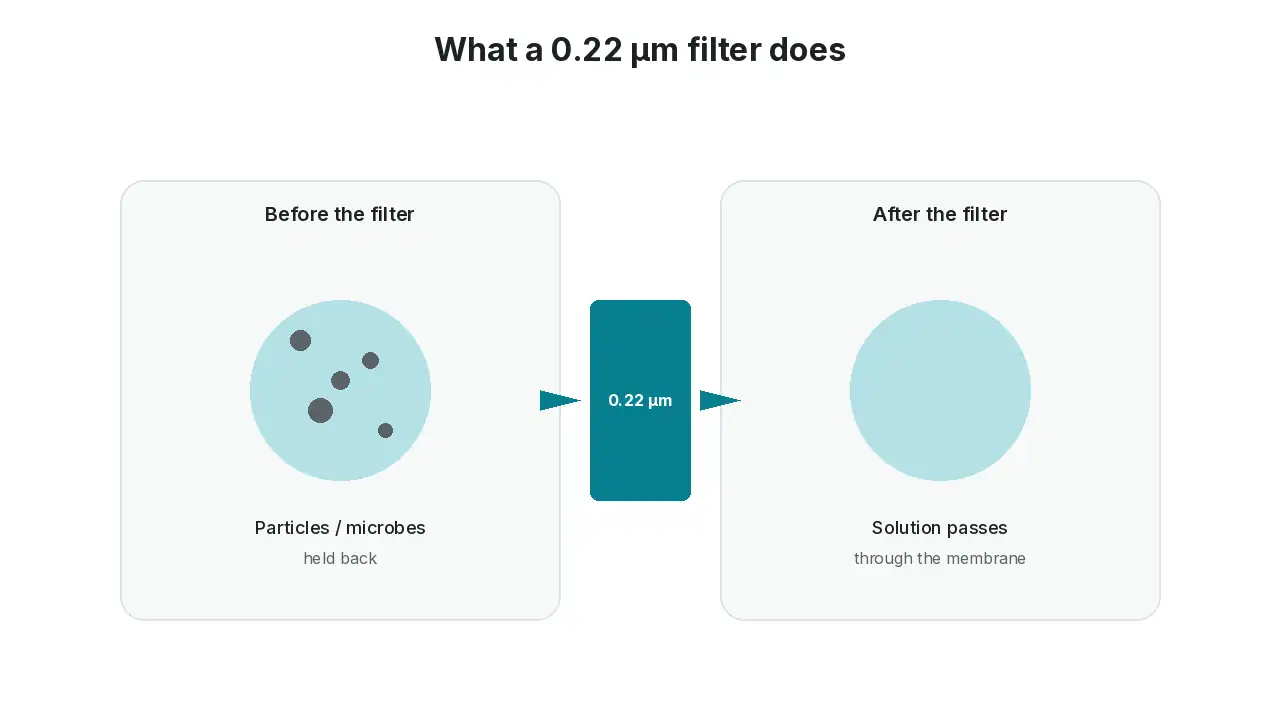
A sterility test (USP <71>) puts the product, or a filter it has passed through, into growth media and watches for microbial growth for about 14 days. It is pass or fail. Bioburden (USP <61>) counts how many microbes are present on a non-sterile product. Neither one is the same as endotoxin: sterility finds living organisms, while endotoxin finds a toxin that remains after bacteria die. Our guide to endotoxin testing explains why a sterile product can still carry endotoxin.
In November 2026 Health Canada reported that lab testing found Sphingomonas bacteria in an unauthorized injectable peptide seized from an Ottawa store. That is a sterility failure, and exactly what a sterility test is designed to catch.
Particles, water and appearance
Injectable drug products are also checked for visible and sub-visible particles, and lyophilized powders for water content (Karl Fischer) and appearance. For research peptides, appearance is usually the only one reported: “white lyophilized powder”. A cloudy solution after reconstitution usually has a solubility explanation; our guide to why a peptide is cloudy covers the common causes.
Why research reports stop short
A full release panel costs many times a purity-and-content test, needs more material, and takes weeks because of the sterility incubation. Research-grade peptides are sold for laboratory use, not as finished sterile products, so most research-grade reports, from any seller, cover identity, purity and content and stop there. A researcher who needs metals, solvents or sterility data for a protocol usually commissions those tests on their own material or buys a grade made for that purpose.
What Lodge Peptides reports cover
Every tested Lodge Peptides lot has a Peptide Test Canada report with HPLC-MS/MS or LC-MS/MS purity and measured content in mg, a lot number and a verification code. KPV lot ZB-KP10927 also has an endotoxin report (below the limit of quantitation, <12.5 EU per vial). Heavy metals, sterility, bioburden and residual solvents are not part of our current reports, and we say so rather than imply otherwise. All reports are in the COA library, and peptide testing and lab reports explains every test in one place.
Frequently asked questions
What does a full peptide test panel include?
Identity, purity and content, plus endotoxin, sterility or bioburden, elemental impurities (heavy metals), residual solvents, water content and sometimes counter-ion content.
How are heavy metals tested in peptides?
As elemental impurities under ICH Q3D and USP <232>/<233>, usually by ICP-MS, with a limit for each element. Arsenic, cadmium, mercury and lead are the highest-concern group.
What residual solvents can be in a peptide?
Synthesis and purification solvents such as DMF, NMP, dichloromethane and acetonitrile. ICH Q3C sets a limit for each; acetonitrile’s is 410 ppm.
Is a sterility test the same as an endotoxin test?
No. Sterility looks for living microbes over about 14 days; endotoxin measures bacterial toxin, which can remain after bacteria are killed.
Do Lodge Peptides reports include heavy metals or sterility?
No. They cover identity, purity and measured content for every tested lot, and endotoxin for KPV.
Related guides
- Peptide testing and lab reports
- Peptide endotoxin testing
- TFA vs acetate salts
- How to tell if your peptide is real
Sources
- ICH. Q3D(R2) Guideline for Elemental Impurities. ich.org
- ICH. Q3C(R9) Impurities: Guideline for Residual Solvents. ich.org
- United States Pharmacopeia. General chapters <61>, <71>, <85>, <232>, <233>, <467> and <921>.
- Health Canada. Think twice before injecting peptides bought online: unauthorized products can seriously harm you. Advisory RA-81874, 9 April 2026. recalls-rappels.canada.ca
- Health Canada. Health Canada warns about unauthorized peptides, including contaminated injectable peptides sold by Sage & Summit Wellness Co. in Ottawa, ON. Advisory RA-82944, 12 November 2026. recalls-rappels.canada.ca
Products sold by Lodge Peptides are intended for laboratory research use only and are not for human or animal consumption. This article is for educational purposes and is not medical advice.
Email list
Get lot reports and guides in your inbox
New lot reports, research guides, restocks, and occasional offers from the Lodge Peptides team.