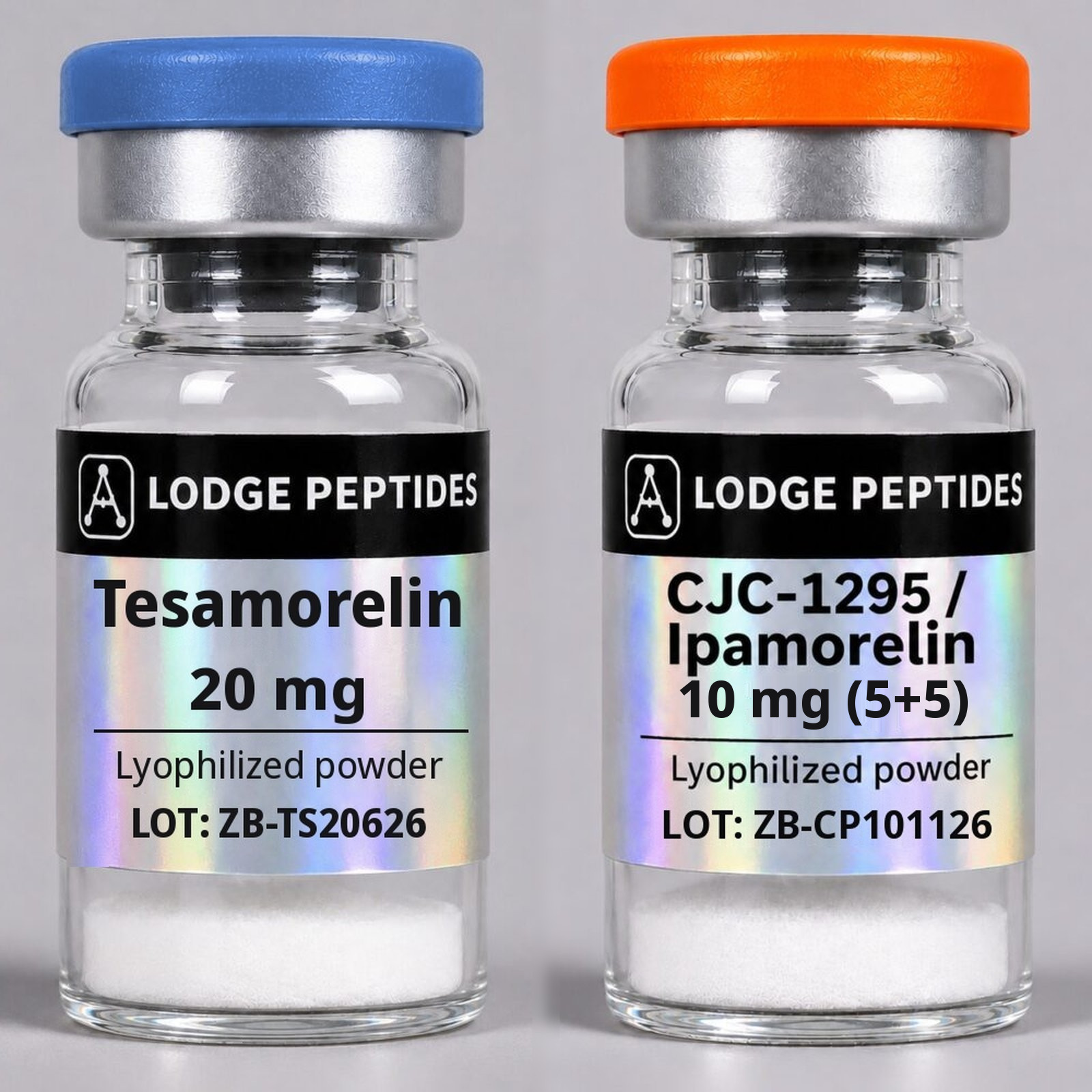
Tesamorelin and CJC-1295 / ipamorelin get compared because they sit on the same growth-hormone axis, and because some labs run them in the same protocol. They are not the same peptide, and they do not all hit the same receptor. Tesamorelin is a GHRH analogue with a long clinical paper trail. CJC-1295 (without DAC) is a shorter, modified GHRH fragment. Ipamorelin is a different class entirely: a ghrelin-receptor agonist, usually sold in the same vial as CJC-1295. This guide lays those differences out, then shows how Lodge sells them: as Tesamorelin 10 mg or 20 mg, as CP10 (CJC-1295 and ipamorelin in one vial), and as the Tesamorelin + CP10 stack.
Products sold by Lodge are for laboratory research use only and are not medical advice.
- Tesamorelin is a synthetic 44-amino-acid GHRH analogue with a trans-3-hexenoyl group on the N-terminal tyrosine. It is also an approved prescription drug in the United States (Egrifta) for a specific indication, which is why its sequence and identity are on public record.
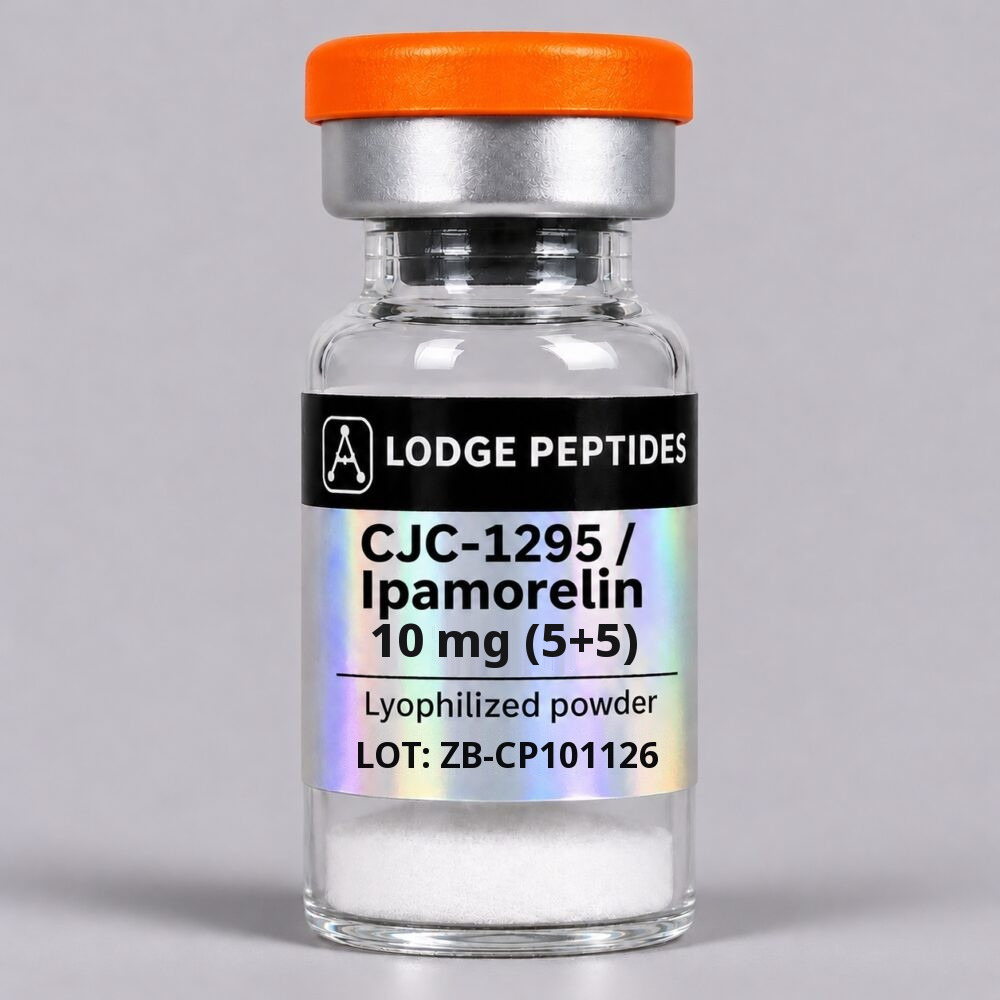
- CJC-1295 without DAC is a modified 29-residue GHRH fragment. Ipamorelin is a selective ghrelin / GHS-R agonist, not a GHRH analogue. Lodge CP10 is 5 mg of each, no DAC.
- Tesamorelin and CJC-1295 both act on the GHRH receptor. Ipamorelin acts on a different receptor. That is the usual reason the two pathways are studied together.
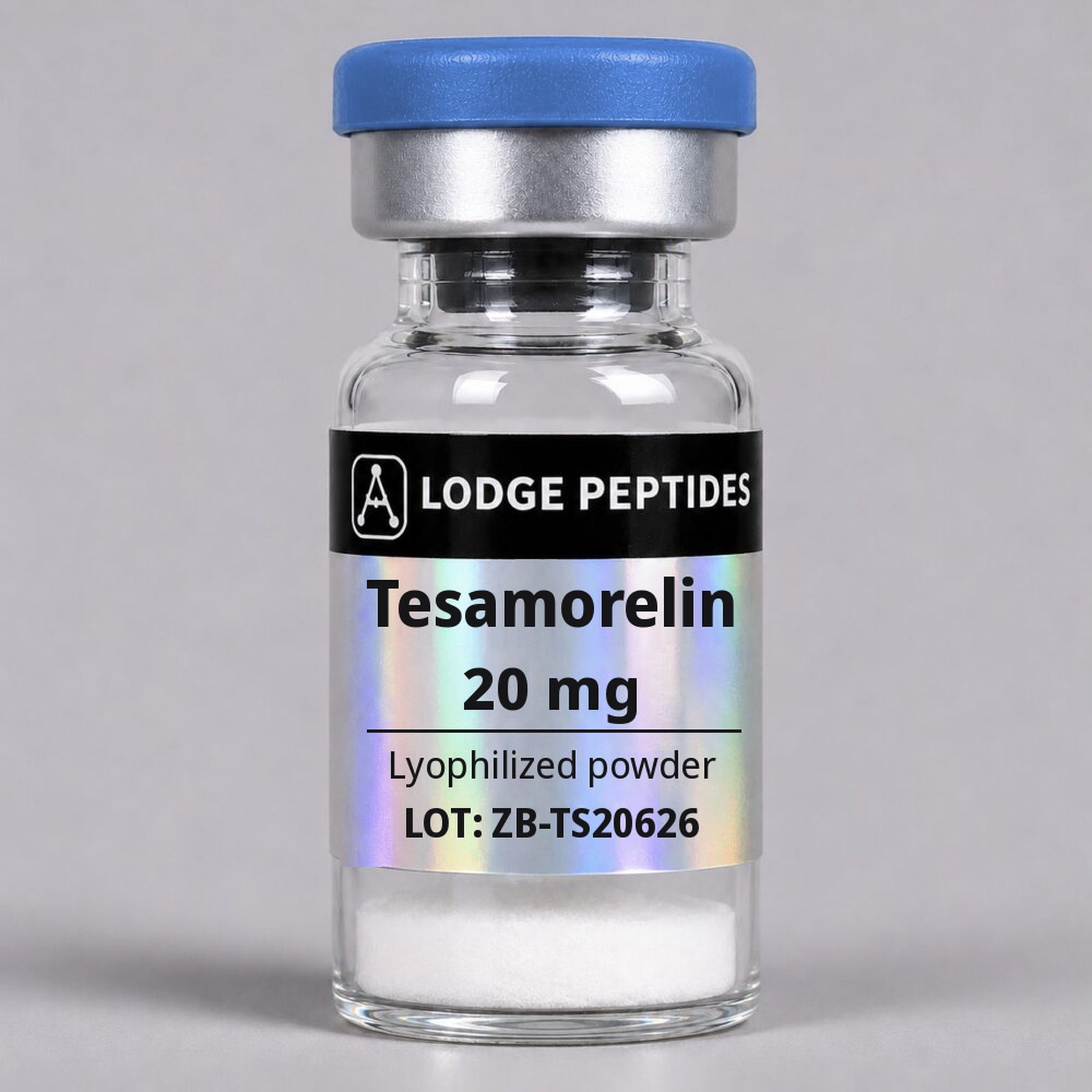
- The current Tesamorelin 20 mg lot ZB-TS20626 measured 22.34 mg at 99.6% purity. CP10 lot ZB-CP101126 measured 6.36 mg CJC-1295 (no DAC) and 6.54 mg ipamorelin, each above 99.8%. The Tesamorelin 10 mg lot ZB-TS10626 measured 11.11 mg at 99.2% purity.
- Everything here is for laboratory research use only.
Tesamorelin and CP10 lots and lab results are side by side on our growth hormone peptides page.
What tesamorelin is
Tesamorelin is a synthetic analogue of growth hormone-releasing hormone. The chain is 44 amino acids, matching the length of human GHRH, with a trans-3-hexenoyl group added on the N-terminal tyrosine. Its free-base molecular weight is about 5,136 g/mol. That extra group is part of how a lab tells tesamorelin apart from shorter GHRH fragments such as sermorelin or CJC-1295: the intact mass is different, and a mass-spectrometry report should identify the right sequence.
It is also one of the better-documented peptides in this group because it is an approved prescription drug in the United States (Egrifta), studied and authorized for reducing excess abdominal fat in adults with HIV-associated lipodystrophy. That clinical history is useful for identity and quality checks. It does not make a research vial a medicine, and Lodge does not sell tesamorelin as a drug. For buying details, strengths and the current lot report, see where to buy tesamorelin in Canada.
What CJC-1295 and ipamorelin are
CJC-1295 without DAC (often called modified GRF 1-29) is a 29-residue analogue of the N-terminal fragment of GHRH, with substitutions that make it more resistant to breakdown than the native fragment. It still acts on the GHRH receptor. The “with DAC” version adds a drug-affinity complex that binds albumin and stretches the half-life. Those are different molecules, and a report should say which one is in the vial. Lodge CP10 is the no-DAC version. Our CJC-1295 and ipamorelin research overview and where to buy CJC-1295 / ipamorelin in Canada cover that check in more depth.
Ipamorelin is not a GHRH analogue. It is a short, selective agonist of the growth-hormone secretagogue receptor (GHS-R, the ghrelin receptor). It is usually sold with CJC-1295 because the two pathways, GHRH-receptor and ghrelin-receptor, are often studied in the same protocol. A blend only helps if the lab measured each peptide on its own, not as one combined figure.
Side by side
| Tesamorelin | CJC-1295 (no DAC) | Ipamorelin | |
|---|---|---|---|
| What it is | 44-residue GHRH analogue with an N-terminal hexenoyl group | Modified 29-residue GHRH fragment | Selective ghrelin-receptor (GHS-R) agonist |
| Receptor | GHRH receptor | GHRH receptor | GHS-R (ghrelin receptor) |
| Approx. mass | About 5,136 g/mol (free base) | About 3,368 g/mol | About 712 g/mol |
| Clinical documentation | Approved in the US as Egrifta for a specific indication; visceral-fat trials in that population | Research use; the better-known clinical papers often describe the DAC form, which is a different molecule | Research use; selective GHSR agonist studied as a secretagogue |
| Lodge product | 10 mg ($72) and 20 mg ($120) | 5 mg in each CP10 vial ($60) | 5 mg in each CP10 vial |
The practical point is simple: tesamorelin is not a stronger CJC-1295, and CJC-1295 is not a cheaper tesamorelin. They share a receptor class, they differ in chain length and modifications, and ipamorelin is a different lever. A mass-spectrometry report is how you confirm which of those three is actually in the vial.
Why they are studied together
Labs that run a GHRH analogue and a ghrelin-receptor agonist in the same protocol are pairing two inputs to growth-hormone secretion, not doubling one peptide. Tesamorelin or CJC-1295 can fill the GHRH-receptor side; ipamorelin fills the other. CP10 already combines CJC-1295 (no DAC) with ipamorelin in one vial. A tesamorelin vial plus CP10 therefore includes tesamorelin and CJC-1295, which both act on the GHRH receptor, plus ipamorelin on GHS-R.
That overlap is worth being explicit about. It is not automatically a problem for research, but it is not the same as tesamorelin plus ipamorelin alone. If a protocol needs one GHRH analogue and one secretagogue, the cleaner pairing is tesamorelin with ipamorelin, or CJC-1295 with ipamorelin (which is what CP10 is). If a protocol uses tesamorelin and CP10 together, it should account for two GHRH-receptor ligands in the mix. Our guide to mixing peptides in one solution covers what changes when peptides share a vial or a protocol.
Lodge vials, lots and the stack
Lodge ships from within Canada, with flat $20 Canada Post shipping, free over $150, and same-day dispatch on orders paid by 12 pm Pacific Monday to Friday.
| Product | Lot | What was measured | Price (CAD) |
|---|---|---|---|
| Tesamorelin 10 mg | ZB-TS10626 | 11.11 mg (10 mg label, 111.1%) at 99.2% purity, HPLC-MS/MS | $72 |
| Tesamorelin 20 mg | ZB-TS20626 | 22.34 mg (20 mg label, 111.7%) at 99.6% purity, HPLC-MS/MS, Peptide Test Canada, 29 Sep 2026 (PTC-9DRPGMMW) | $120 |
| CP10 (CJC-1295 / ipamorelin) | ZB-CP101126 | CJC-1295 (no DAC) 6.36 mg (5 mg label, 99.82%); ipamorelin 6.54 mg (5 mg label, 99.84%); 12.90 mg total, 28 Oct 2026 (PTC-9TNUSMN8) | $60 |
| Tesamorelin + CP10 stack | Same lots as above | One Tesamorelin 20 mg vial and one CP10 vial, each with its own report | $165 |
On measured content, the Tesamorelin 20 mg vial is $5.37 per milligram and CP10 is $4.65 per milligram. Buying the two together as the stack is $165, which is $15 less than the $180 list of the two vials purchased separately. A 10-pack of any single product is priced 20% below ten single vials. The Tesamorelin 10 mg lot is $6.48 per measured milligram; its report is on the product page and in the COA library. You can check the posted reports on Peptide Test Canada’s site with the verify codes above; how to verify a lab report shows the steps.
Handling
All of these arrive as lyophilized powder. The water you add sets the concentration. For a 20 mg tesamorelin label, 2 mL gives 10 mg/mL on the label, or about 11.17 mg/mL if you use the measured 22.34 mg on lot ZB-TS20626. For CP10, use the per-peptide measured amounts, not just the 10 mg combined label. Enter those figures in the peptide calculator. Method and storage are in how to reconstitute lyophilized peptides and how to store lyophilized peptides.
Frequently asked questions
Is tesamorelin the same as CJC-1295?
No. Both act on the GHRH receptor, but tesamorelin is a 44-residue analogue with an N-terminal hexenoyl group, and CJC-1295 without DAC is a modified 29-residue fragment. Mass spectrometry tells them apart.
What is CP10?
CP10 is Lodge’s 10 mg blend of 5 mg CJC-1295 without DAC and 5 mg ipamorelin in one vial, currently $60. Lot ZB-CP101126 measured 6.36 mg and 6.54 mg respectively, each above 99.8% purity.
Why are tesamorelin and CJC-1295/ipamorelin used together?
Ipamorelin acts on the ghrelin receptor, a different pathway from tesamorelin and CJC-1295, which both act on the GHRH receptor. CP10 already pairs CJC-1295 with ipamorelin. A tesamorelin vial plus CP10 therefore includes two GHRH-receptor ligands plus ipamorelin. That overlap should be accounted for in the protocol.
What did the Tesamorelin 20 mg lot test at?
Lot ZB-TS20626 measured 22.34 mg against a 20 mg label, at 99.6% purity by HPLC-MS/MS, tested by Peptide Test Canada on 29 September 2026 (verify code PTC-9DRPGMMW).
Has the Tesamorelin 10 mg lot been tested?
Yes. Lot ZB-TS10626 measured 11.11 mg against a 10 mg label, at 99.2% purity by HPLC-MS/MS, tested by Peptide Test Canada on 27 October 2026 (verify code PTC-JCMG97CT).
Does Lodge sell a Tesamorelin + CP10 stack?
Yes. The Tesamorelin + CP10 stack is $165 and includes one Tesamorelin 20 mg vial (lot ZB-TS20626) and one CP10 vial (lot ZB-CP101126), each with its own third-party report. Lodge ships from within Canada.
Related guides
- Where to buy tesamorelin in Canada
- CJC-1295 and ipamorelin: a research overview
- Where to buy CJC-1295 / ipamorelin (CP10) in Canada
- Tesamorelin 20 mg lab results, lot ZB-TS20626
- CP10 lab results, lot ZB-CP101126
- Mixing peptides in one solution
- Price per mg calculator
- Peptide reconstitution calculator
- COA library
Sources
- Falutz J, et al. Effects of tesamorelin (TH9507), a growth hormone-releasing factor analog, in HIV-infected patients with excess abdominal fat: a 26-week randomized, placebo-controlled trial. N Engl J Med / subsequent extension literature; see also Falutz J, et al. Effects of tesamorelin on visceral fat in HIV-infected patients with abdominal fat accumulation: a randomized clinical trial. JAMA. 2014;312(4):380-389. PubMed 25038333
- PubChem. Tesamorelin, CID 16137828. pubchem.ncbi.nlm.nih.gov
- ChEBI. Tesamorelin (CHEBI:63626).
- Teichman SL, et al. Prolonged stimulation of growth hormone (GH) and insulin-like growth factor I secretion by CJC-1295, a long-acting analog of GH-releasing hormone. J Clin Endocrinol Metab. 2006;91(3):799-805. (Describes the DAC form, which is not the Lodge CP10 peptide.) PubMed 16352683
- Raun K, et al. Ipamorelin, the first selective growth hormone secretagogue. Eur J Endocrinol. 1998;139(5):552-561. PubMed 9849822
- Lodge Peptides. Where to buy tesamorelin in Canada; CJC-1295 and ipamorelin research overview; lot pages ZB-TS20626 and ZB-CP101126.
Products sold by Lodge are intended for laboratory research use only and are not for human or animal consumption. This article is for educational purposes and is not medical advice.
Email list
Get lot reports and guides in your inbox
New lot reports, research guides, restocks, and occasional offers from the Lodge Peptides team.