
Every so often a research buyer sends a vial to an independent lab and gets a nasty surprise: the compound inside is not what the label says, or there is far less of it than the label claims, or it is barely half pure. A vial sold as one peptide can come back identified as a completely different one. The only way to know what is actually in a vial is a lot-specific, third-party certificate of analysis (COA) — and knowing how to read it. This guide covers the three ways a research peptide can be wrong, how testing catches each one, and the red flags to watch for before you order.
- A research peptide can fail in three independent ways: wrong compound (identity), too little peptide (net content), or low purity.
- Identity is confirmed by mass spectrometry — it is the only check that catches a vial that is secretly a different molecule.
- Net peptide content (mg) and chromatographic purity (%) are two different numbers; a vial can pass one and fail the other.
- A COA only means something if it is tied to your exact lot and carries a verification code you can check on the testing lab’s own site.
- No COA, a generic COA not tied to your lot, or purity with no content figure are all reasons to walk away.
Three ways a research peptide can be wrong
These are independent problems. A vial can have any one, any two, or all three at once, which is why a single number on a product page tells you very little on its own.
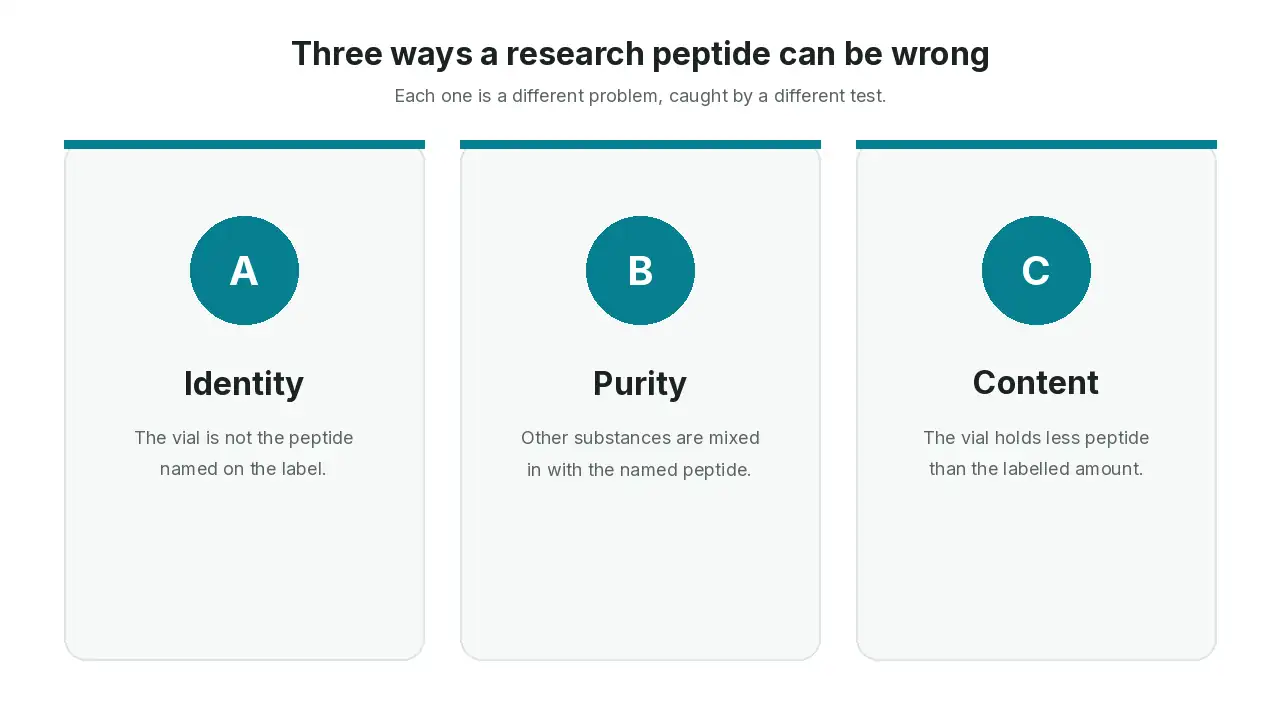
| Problem | What it means | The number to look at |
|---|---|---|
| Wrong compound | The vial contains a different peptide than the label claims — for example, labelled as one GLP-1 peptide but actually another. It may not be the molecule you think at all. | Identity (by mass spectrometry) |
| Underdosed | The right peptide, but far less of it than the label says. A “30 mg” vial that holds 13.5 mg of actual peptide is under half the claim. | Net peptide content (mg) |
| Impure | The peptide is present but mixed with related impurities, fragments or other material. A 45% purity result means less than half of the peptide material is the target. | Chromatographic purity (%) |
The reason all three matter: a vial can be the correct peptide and still be underdosed, or be full and the wrong molecule. A real report measures each separately so one good number cannot hide a bad one.
How testing catches each one
A proper third-party analysis runs more than one test, because each problem shows up in a different place.
- Identity — mass spectrometry (LC-MS/MS). The lab measures the molecular mass and confirms it matches the claimed peptide. This is the check that catches a mislabelled vial. A chromatogram labelled with a different compound name than the product, or a mass that does not match, is a red flag that the molecule itself is wrong.
- Net peptide content — quantitative HPLC. The lab measures how many milligrams of actual peptide are in the vial, against a known reference. This is reported in mg, separate from purity. Our guide on purity vs net peptide content explains why the two are not the same.
- Purity — chromatographic (HPLC). The share of the peptide material that is the target peptide, versus related impurities. See how to read an HPLC chromatogram for what a clean trace looks like.
Red flags before you buy
You can avoid most bad batches by checking the documentation before you order, not after:
- No COA at all. The most common setup for a surprise later. If testing is not offered, there is nothing to verify.
- A COA not tied to your lot. A single generic certificate reused across every batch proves nothing about the vial you receive. The report should name the exact lot number on your vial.
- Purity but no content, or content but no purity. One number alone lets an underdosed or impure vial look fine.
- No identity check. Without mass spectrometry, nothing confirms the vial is even the right molecule.
- No verification code. If you cannot confirm the report on the testing lab’s own website, the document on the page could say anything. Our guide to verifying a lab report walks through this.
Verifying a report yourself
A COA is only as trustworthy as your ability to confirm it independently. Three quick checks:
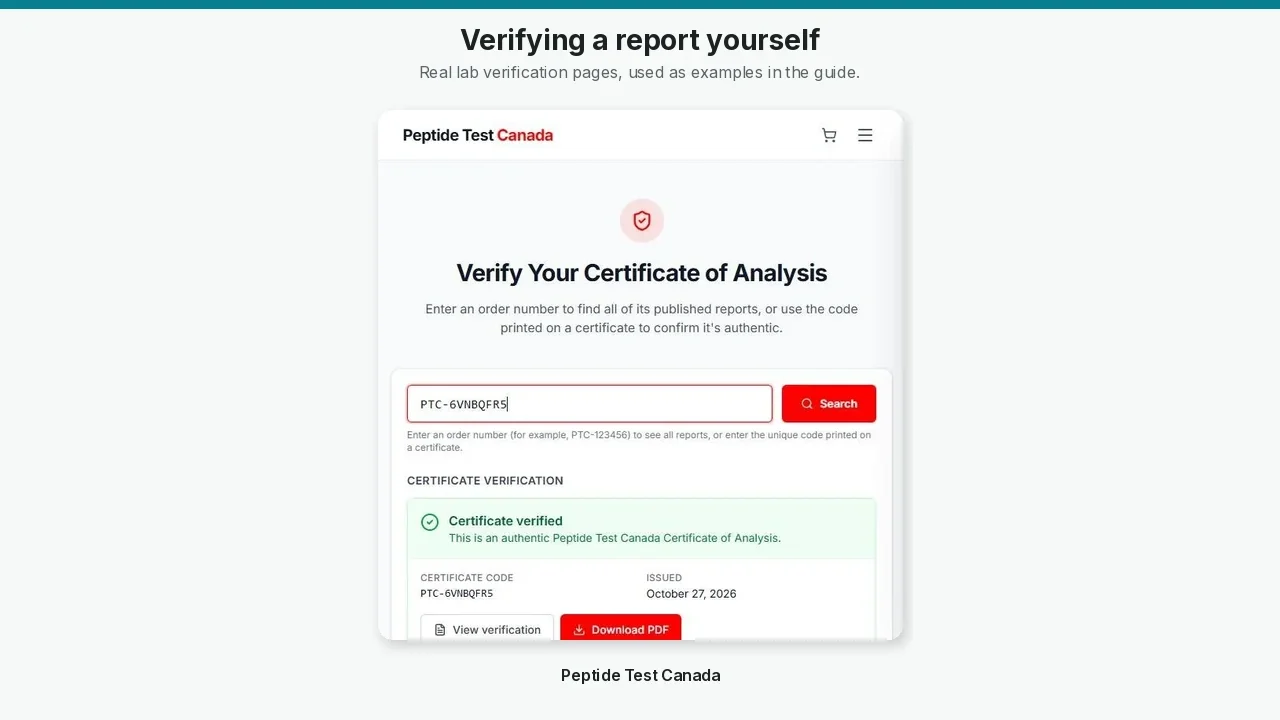
- Match the lot. The lot number on the report should match the number on your vial, exactly.
- Run the verification code. Enter the report’s code on the testing lab’s verification page and confirm it returns the same result shown to you.
- Confirm all three numbers are present. Identity, net peptide content, and purity — a report missing any of them leaves a gap a bad batch can hide in.
How Lodge Peptides handles it
Lodge Peptides lots are third-party tested by Peptide Test Canada and posted as results come in, with identity, net peptide content and purity each measured and reported. For blends, every component is quantified on its own. Each tested product’s page links the full report as a downloadable PDF, with a verification code you can check directly on the lab’s site — so you are never taking our word for it. You can see every tested lot in the lab results roundup.
See every tested lot’s lab results →
Frequently asked questions
Can a peptide be a completely different compound than the label says?
What is the difference between purity and net peptide content?
What does a low purity number mean?
A product has no COA. What does that tell me?
How do I confirm a lab report is genuine?
Related reading
- How to read a peptide certificate of analysis
- Peptide purity vs net peptide content
- How to verify a peptide lab report
- Lodge Peptides lab results roundup
Products sold by Lodge Peptides are intended for laboratory research use only and are not for human or animal consumption. This article is for educational purposes and is not medical advice.
Email list
Get lot reports and guides in your inbox
New lot reports, research guides, restocks, and occasional offers from the Lodge Peptides team.