Bacteriostatic water is the most common diluent for reconstituting lyophilized research peptides. It looks like plain water, so it is easy to assume every vial is the same. It is not: the grade, the preservative, the seal and the expiry date all matter. This guide covers what to look for when you buy it in Canada and how to store it once it arrives.
- Bacteriostatic water is sterile water with 0.9% benzyl alcohol added as a preservative, which is what allows a vial to be punctured more than once.
- Look for a sealed manufacturer vial labelled USP, with the benzyl alcohol content, a lot number and an expiry date printed on it.
- Store unopened vials at controlled room temperature as the label directs, and write the date on a vial when you first puncture it.
- A common lab convention is to discard a punctured multi-dose vial after 28 days unless the manufacturer states otherwise.
What bacteriostatic water is
Bacteriostatic water is sterile water that contains 0.9% benzyl alcohol (9 mg per mL). The benzyl alcohol does not sterilize anything. It slows the growth of most bacteria that might get in when a needle passes through the stopper, which is why the vial can be used more than once. Plain sterile water has no preservative, so it is meant for a single use.
For a deeper comparison of the two, see bacteriostatic water vs sterile water.
What to check on the vial
- USP grade. The label should say Bacteriostatic Water for Injection, USP, or an equivalent pharmacopeial grade.
- Preservative stated. It should list 0.9% benzyl alcohol. If no preservative is listed, it is not bacteriostatic water.
- Manufacturer, lot and expiry. A real manufacturer name, a lot number and an expiry date should all be printed on the vial or box.
- Intact seal. The flip-off cap and the crimped metal seal should be undamaged, with no sign the stopper has been punctured.
- Clear solution. The liquid should be clear and colourless, with no particles or cloudiness.
Be cautious with unbranded vials, hand-filled bottles or listings that cannot tell you the manufacturer. You cannot check what is in them.
Sterility and endotoxin: two different things
These two terms get used interchangeably, but they measure different problems — and a product can pass one while failing the other.
- Sterility means no living organisms in the water. It is what USP bacteriostatic water guarantees, and the benzyl alcohol keeps the vial sterile through repeated punctures.
- Endotoxin is different. Endotoxins (lipopolysaccharides, or LPS) are fragments shed by gram-negative bacteria. They survive sterilization and are not removed by a 0.22 micron filter, so a solution can be perfectly sterile and still carry endotoxin. It is measured separately, by an LAL assay, and reported in endotoxin units per millilitre (EU/mL).
For research work this matters because a sterility statement on its own says nothing about endotoxin load: a product that shows a sterility pass but no endotoxin figure has answered only half the question. Genuine pharmaceutical bacteriostatic water is made to USP limits that cover both; the risk with grey-market or relabelled product is that neither has been verified for the vial you actually receive. For the peptides themselves, we publish per-lot endotoxin results in the COA library.
10 mL or 30 mL?
Bacteriostatic water is usually sold in 10 mL and 30 mL multi-dose vials. The larger vial costs less per mL, but once it is punctured the 28-day convention starts, so a 30 mL vial only makes sense if you will use it within that window. If you reconstitute only occasionally, smaller vials waste less.
Storing it once it arrives
Keep unopened vials at controlled room temperature, as the manufacturer label directs, and away from direct light. They do not need refrigeration before opening.
When you first puncture a vial, write the date on it. Many labs follow the multi-dose vial convention used in clinical settings: discard a punctured vial after 28 days, or sooner if the manufacturer says so or if the solution changes appearance. Wipe the stopper with an alcohol pad before every puncture.
The Pfizer vial, label by label
A widely used option in Canada is Pfizer's 30 mL Bacteriostatic Water for Injection, USP, made by Hospira (a Pfizer company). Here is what its official label says, so you know exactly what you are getting.
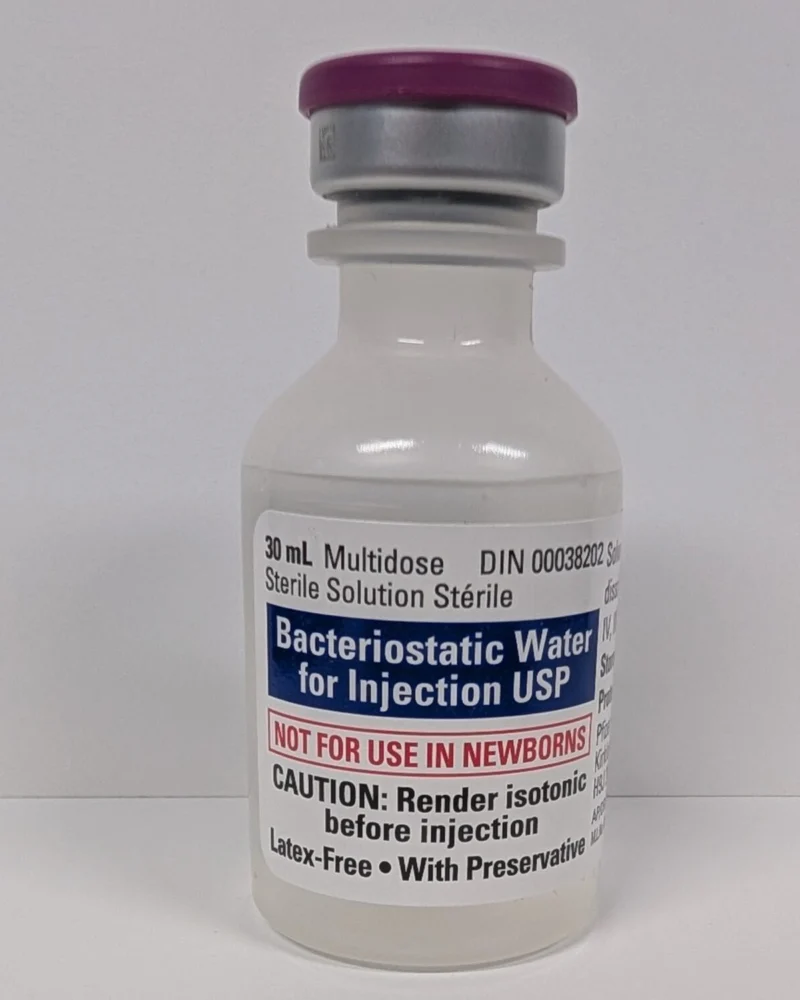
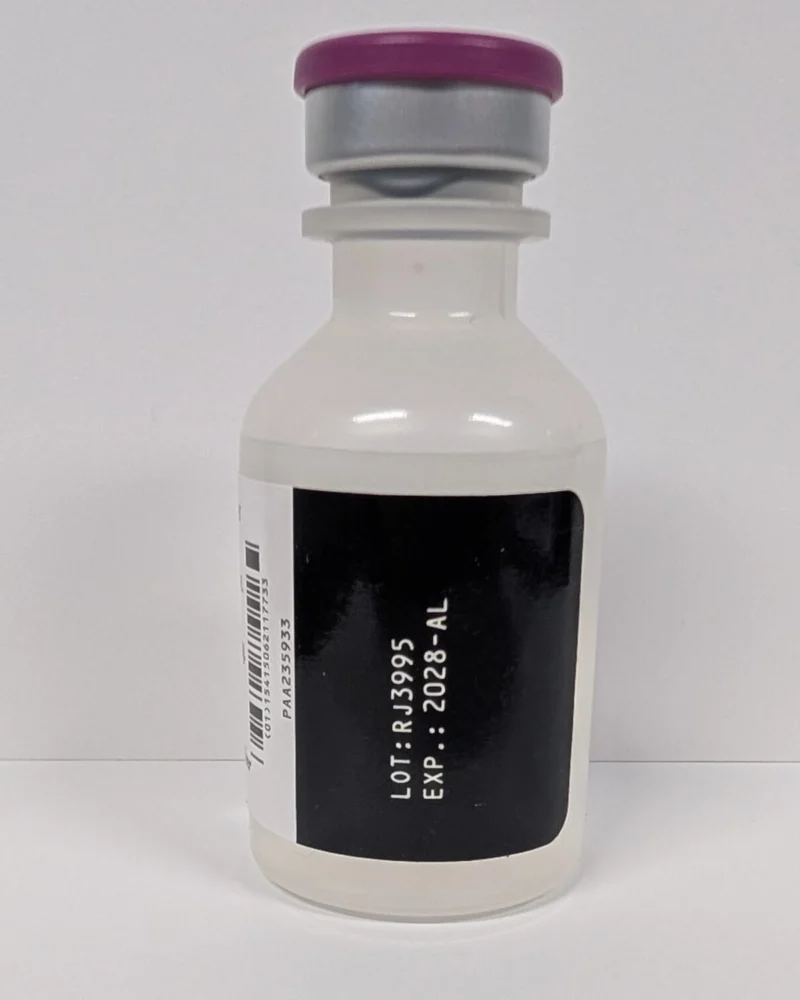
- Contents: sterile, nonpyrogenic water for injection with 0.9% benzyl alcohol (9 mg per mL) as the preservative.
- Container: a 30 mL multiple-dose fliptop vial, designed for repeated withdrawals.
- pH: 5.7 (range 4.5 to 7.0).
- Storage before opening: 20 to 25°C (controlled room temperature). No refrigeration needed.
- Printed on every vial: manufacturer, a Canadian DIN (Drug Identification Number), lot number and expiry date.
- Label warning: not for use in newborns, because of the benzyl alcohol. Labs working with sensitive systems sometimes choose preservative-free sterile water for that reason.
One detail many buyers miss: Pfizer also makes a version with 1.1% benzyl alcohol, sold as a 20 mL fill in a 30 mL glass vial. If a listing shows a glass vial or a 20 mL fill, it is a different product, so check the percentage on the label. Ours is the standard 0.9% version.
Every Lodge Peptides order ships the vial sealed in its original packaging, with the flip-off cap and crimp seal intact.
Genuine pharmaceutical product vs a relabel
With bacteriostatic water the biggest quality risk is not the formula — it is whether a vial is the genuine pharmaceutical product it claims to be, or a relabelled or counterfeit one. Open wholesale marketplaces are where relabelled “pharma” water tends to turn up.
A few ways to tell genuine product from a relabel:
- Manufacturer, lot and NDC/DIN on the vial. Genuine pharma vials carry the maker’s name, a lot number and a product identifier (an NDC in the United States, a DIN in Canada) that you can check against the manufacturer.
- Intact, consistent labelling. Smudged, re-printed or mismatched labels are a warning sign.
- A legitimate supply route. Product that moves through regulated pharmaceutical channels is far harder to counterfeit than listings bought in bulk from an open marketplace.
Genuine Pfizer bacteriostatic water comes through legitimate Canadian pharmaceutical supply — not as a relabelled marketplace import.
Buying bacteriostatic water in Canada
Buy from a supplier that ships sealed manufacturer vials and tells you the brand. Pfizer Bacteriostatic Water for Injection USP, 30 mL, is a sealed manufacturer vial that meets that bar.
Bacteriostatic water is stable at room temperature, so it does not need cold-pack shipping.
Pharmacy, Amazon or online: where to get it
People often look for bacteriostatic water at a local drugstore first. Here is what to expect from each route in Canada.
| Where | What to expect | What to check |
|---|---|---|
| Shoppers Drug Mart, Rexall, London Drugs and other pharmacies | Not an over-the-counter shelf item. It is a sterile injectable product with a DIN, so pharmacies handle it as a clinical item. Some will order it in, some ask for a prescription or a prescriber’s order, and the answer can differ from store to store. | Call ahead and ask whether they can order it, which brand, and what they need from you. |
| Amazon.ca and online marketplaces | Listings come and go, and many are third-party sellers. Some are plain sterile water, or products that are not labelled USP for injection. | A named manufacturer, “USP”, 0.9% benzyl alcohol, a DIN or NDC, a lot number and expiry, and an intact flip-off seal. |
| Medical supply wholesalers | Usually sell to clinics and businesses, often by the case. | Whether they sell to individuals or labs at all. |
| Canadian research suppliers | Ship sealed vials as a reconstitution supply alongside peptides. | The brand on the vial, so you can check the lot against the manufacturer, and domestic shipping. |
Whichever route you use, the label checks in what to check on the vial apply. A vial with no manufacturer, lot or expiry printed on it is not worth the saving.
Frequently asked questions
Is bacteriostatic water the same as sterile water?
No. Both are sterile, but bacteriostatic water contains 0.9% benzyl alcohol as a preservative so the vial can be punctured more than once. Sterile water has no preservative and is intended for single use.
Does bacteriostatic water need to be refrigerated?
Unopened vials are stored at controlled room temperature as the manufacturer label directs. Follow the label and the storage conditions of whatever you reconstitute with it.
How long does a punctured vial of bacteriostatic water last?
A common convention for multi-dose vials is to discard them 28 days after first puncture unless the manufacturer specifies a different time. Date the vial when you first open it.
Does Lodge Peptides ship bacteriostatic water across Canada?
Yes. We ship sealed Pfizer 30 mL vials anywhere in Canada by Canada Post, with flat-rate shipping and free shipping on orders over 150 dollars.
Can I use tap water or distilled water instead?
No. Tap and distilled water are not sterile and are not made for injection-grade use. Bacteriostatic water is sterile, nonpyrogenic and preserved, which is why labs use it to reconstitute lyophilized peptides.
How long does bacteriostatic water last after opening?
The Pfizer label does not give a fixed discard time. Many labs follow the 28-day convention for punctured multi-dose vials, or the manufacturer's instructions where they are stricter. Always check the printed expiry date too.
What is the difference between 0.9% and 1.1% benzyl alcohol?
Both are bacteriostatic water. The 0.9% version is the most common and comes in 30 mL plastic fliptop vials. The 1.1% version is sold as a 20 mL fill in a 30 mL glass vial. Check the label to see which one you have.
Is endotoxin the same as sterility?
No. Sterility means no living organisms; endotoxin is bacterial fragments (LPS) that survive sterilization and are not caught by a 0.22 micron filter. Endotoxin is tested separately by an LAL assay and reported in EU/mL, so a sterile product can still carry it.
Is “Pfizer” or “Hospira” bacteriostatic water from a wholesale marketplace genuine?
Not necessarily. Genuine pharmaceutical bacteriostatic water carries the manufacturer name, a lot number and an NDC or DIN on the vial that you can check against the maker. Relabelled or counterfeit product often appears on open wholesale marketplaces, so skepticism toward those listings is reasonable.
Can I buy bacteriostatic water at Shoppers Drug Mart?
It is not an over-the-counter shelf item. Some Shoppers Drug Mart and other pharmacy locations will order it in, and some ask for a prescription or prescriber’s order. Policies differ by store, so call ahead.
Is bacteriostatic water on Amazon.ca genuine?
Some listings are, many are third-party sellers, and some are plain sterile water. Check for a named manufacturer, USP grade, 0.9% benzyl alcohol, a DIN or NDC, a lot number, an expiry date and an intact seal before you rely on it.
Where can I buy bacteriostatic water in Canada?
Pharmacies can sometimes order it in, and Canadian research suppliers ship it as a reconstitution supply. Look for a sealed manufacturer vial, such as Pfizer Bacteriostatic Water for Injection USP, 30 mL.
Sources and further reading
- Bacteriostatic water (overview)
- Benzyl alcohol (overview)
- Joint Commission requirements for multi-dose vials (Becker’s ASC)
- Pfizer (Hospira): Bacteriostatic Water for Injection, USP, prescribing information
Products sold by Lodge Peptides are intended for laboratory research use only and are not for human or animal consumption. This article is general educational information, not medical or legal advice.
Email list
Get lot reports and guides in your inbox
New lot reports, research guides, restocks, and occasional offers from the Lodge Peptides team.